Canny Pricing & Review (2026): Real Costs, Pros & Cons
Canny is customer feedback software with voting boards, a public roadmap, a changelog and an AI assistant called Autopilot. Canny pricing looks simple at the start. It gets harder to predict as your board grows. The bill follows the number of people who leave feedback.
Canny has three plans in 2026. Free costs $0 for up to 25 tracked users. Pro starts at $79 a month billed yearly ($99 month to month) for 100 tracked users and climbs with each usage band, reaching $1,079 a month billed yearly at 5,000. Business is custom-priced. A tracked user is anyone who posts, votes or comments.
Prices checked on canny.io/pricing and Canny's help center on October 25, 2026.
Canny Pricing at a Glance (2026)
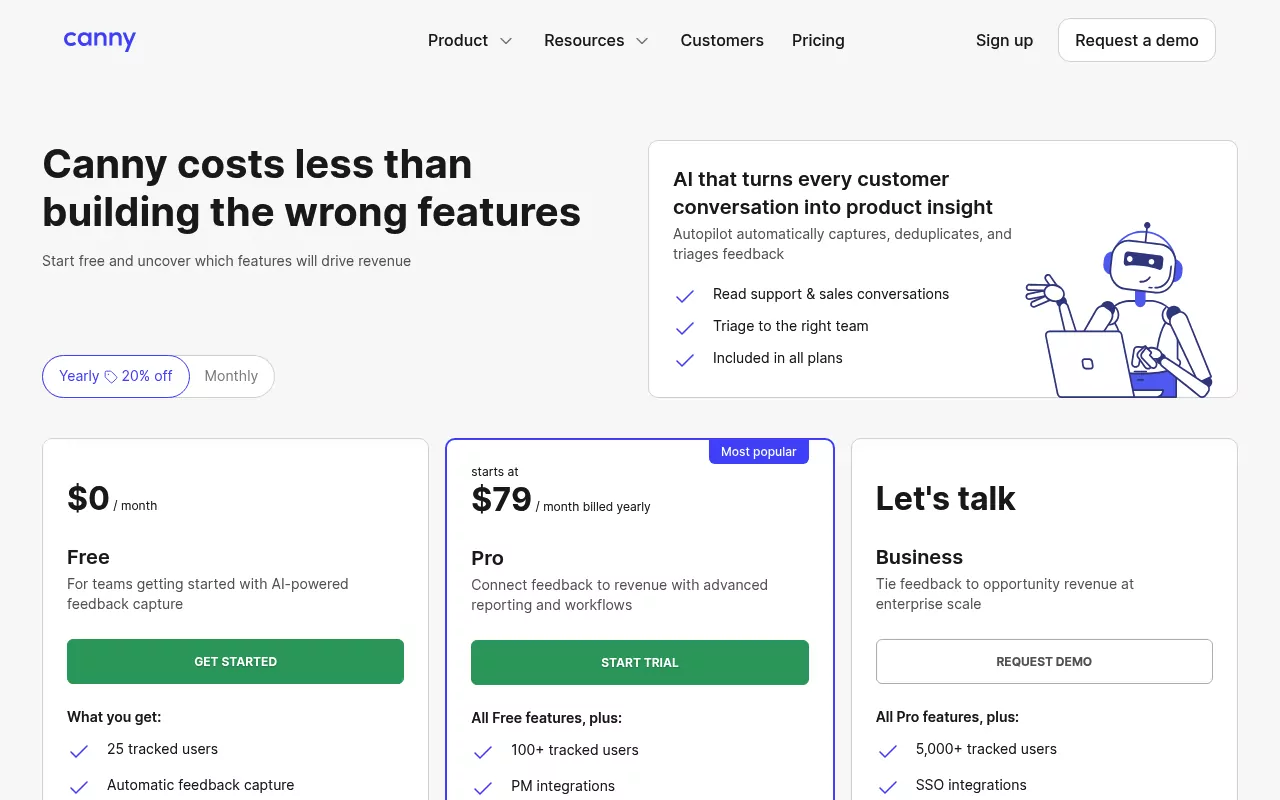
| Plan | Price (October 2026) | How it is billed | Tracked users | Managers | Key inclusions |
|---|---|---|---|---|---|
| Free | $0 | No time limit | 25 | 5, plus unlimited contributors | Unlimited posts and boards, roadmap, changelog, private boards, widget, API, Autopilot |
| Pro | From $79 a month billed yearly ($948 a year), or $99 month to month ($1,188 a year) | Subscription. The price rises in bands as tracked users grow. | 100 to 5,000 | 10, plus unlimited contributors | Custom domain, custom statuses, internal comments, changelog emails, PM integrations, Zapier, MCP connectors, SOC 2 |
| Business | Custom quote | Yearly. Invoice or bank transfer available. | 5,000+ | Custom | Admin SSO, custom admin roles, invoicing. Branding removal and CRM are paid add-ons. |
Paying yearly saves up to 20%, or $240 a year at the 100 band. Canny also offers special plans for high-volume B2C products and discounts for qualified non-profits. Neither the pricing page nor the billing article says whether prices include tax.
How Canny's Tracked-User Pricing Works
Canny does not charge per seat. It charges for the customers behind your feedback.
What Counts as a Tracked User
Canny's pricing FAQ puts it plainly: "A tracked user is someone who has given feedback." That covers anyone who posts, votes or comments. It also counts people when an admin acts for them or Autopilot finds their feedback.
Syncing customer records alone does not add to the bill. Canny's managing tracked users article (April 15, 2026) shows 348 synced users, of whom 191 are tracked.
Canny's rule of thumb is that about 1 to 5% of a B2B SaaS company's total users become tracked users.
What Happens When You Pass a Band
Pro is priced in steps. Without a spend limit, Canny moves you up a band as soon as you pass your limit. It charges a prorated amount for the rest of the billing period.
With a monthly spend limit, Canny pauses upgrades when you hit it and stops tracking feedback from new users. Per its help article on the cap, Autopilot also holds new conversations in a backlog until you raise the limit.
That is the real trade-off. A cap protects the budget, but votes from new customers stop counting until you lift it.

You can also delete inactive users to lower the count. Be careful: this permanently removes their votes, comments and insights, and Canny warns it cannot be undone.
The Full Pro Price Ladder
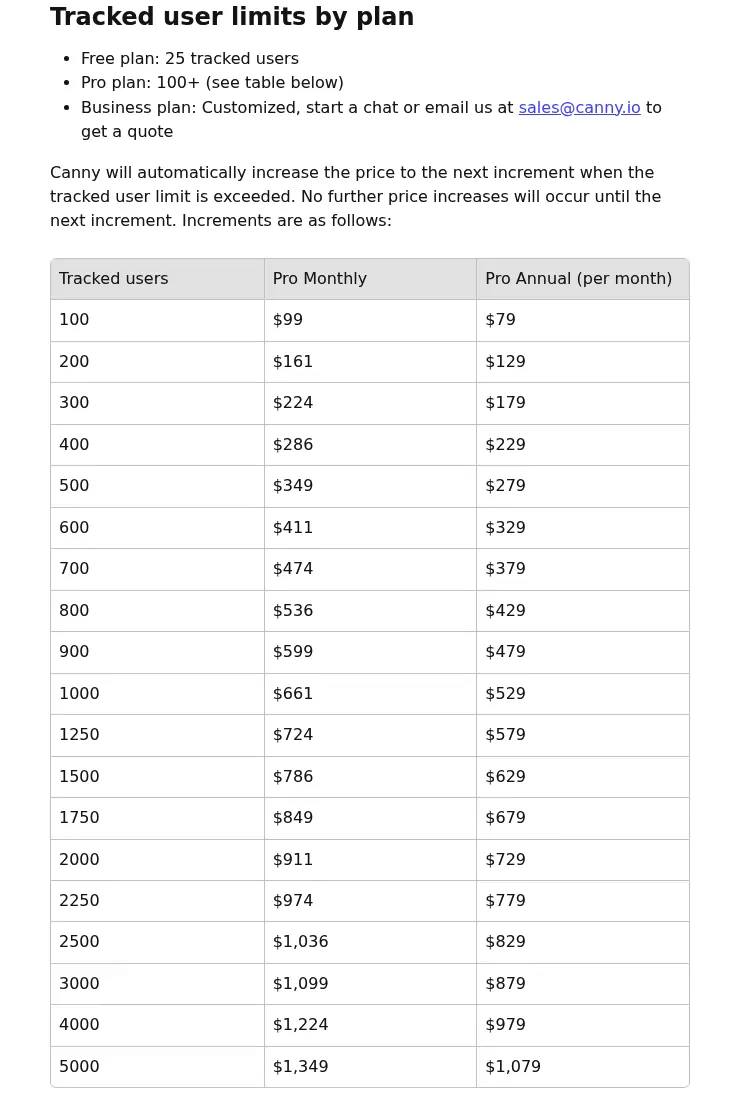
Canny's billing article lists every Pro band. Some guides mix up the monthly and yearly columns, so read the headers.
| Tracked users | Pro billed monthly | Pro billed yearly (per month) | Pro billed yearly (per year) |
|---|---|---|---|
| 100 | $99 | $79 | $948 |
| 200 | $161 | $129 | $1,548 |
| 300 | $224 | $179 | $2,148 |
| 400 | $286 | $229 | $2,748 |
| 500 | $349 | $279 | $3,348 |
| 600 | $411 | $329 | $3,948 |
| 700 | $474 | $379 | $4,548 |
| 800 | $536 | $429 | $5,148 |
| 900 | $599 | $479 | $5,748 |
| 1,000 | $661 | $529 | $6,348 |
| 1,250 | $724 | $579 | $6,948 |
| 1,500 | $786 | $629 | $7,548 |
| 1,750 | $849 | $679 | $8,148 |
| 2,000 | $911 | $729 | $8,748 |
| 2,250 | $974 | $779 | $9,348 |
| 2,500 | $1,036 | $829 | $9,948 |
| 3,000 | $1,099 | $879 | $10,548 |
| 4,000 | $1,224 | $979 | $11,748 |
| 5,000 | $1,349 | $1,079 | $12,948 |
Prices are from Canny's table as of October 2026. The last column is the yearly price times 12.
What Canny Really Costs: Worked Examples
These examples use canny.io list prices as of October 2026, yearly billing, no discounts and no add-ons. Tracked users follow Canny's 1 to 5% rule.
| Total users | Tracked users | Plan and band | Per month, billed yearly | Per year |
|---|---|---|---|---|
| 2,000 | 20 to 100 | Free, then Pro 100 | $0 to $79 | $0 to $948 |
| 10,000 | 100 to 500 | Pro 100 to 500 | $79 to $279 | $948 to $3,348 |
| 25,000 | 250 to 1,250 | Pro 300 to 1,250 | $179 to $579 | $2,148 to $6,948 |
| 100,000 | 1,000 to 5,000 | Pro 1,000 to 5,000 | $529 to $1,079 | $6,348 to $12,948 |
Note that 250 tracked users lands in the 300 band. Past 5,000 tracked users, you need a Business quote.

Watch the steps. Going from 500 to 501 tracked users moves a yearly plan from $279 to $329 a month. That is $600 more a year for one new voter.
At 500 tracked users on yearly billing, three years cost 3 x $3,348 = $10,044. That holds only if the band and price stay put.
Autopilot is another cost driver. Each customer it finds in support chats and sales calls counts as a tracked user. More capture means a bigger bill.
Canny's Free Plan: What You Get and the Catch
Is Canny free? Yes, within limits. Free has no time limit and covers 25 tracked users, 5 managers and unlimited contributors. Canny's "Is the Free plan really free?" article (updated June 5, 2026) adds that Autopilot has no credit limit on Free.
The catches, as of October 2026:
- You have to unlock it. New accounts must finish onboarding steps within 7 days, including feedback from 5 separate people. Miss the window and you upgrade or ask support to extend it or skip the steps (unlocking the Free plan).
- No custom domain. Your board lives on a canny.io subdomain or inside the widget.
- No changelog emails to subscribers.
- Fixed statuses. Free keeps Canny's default statuses, with Open, Under Review, Planned and In Progress as the active ones. Custom statuses and internal comments need Pro.
- Branding stays. Removing "Powered by Canny" is a paid Business add-on.
Canny also offers a 14-day Pro or Business trial with no credit card. Owners start a Pro trial from the Billing page, while Business trials go through Canny's team. With no payment method added, you end the trial from Billing and carry on with Free.
Pro vs Business: What Sits Behind Each Paywall
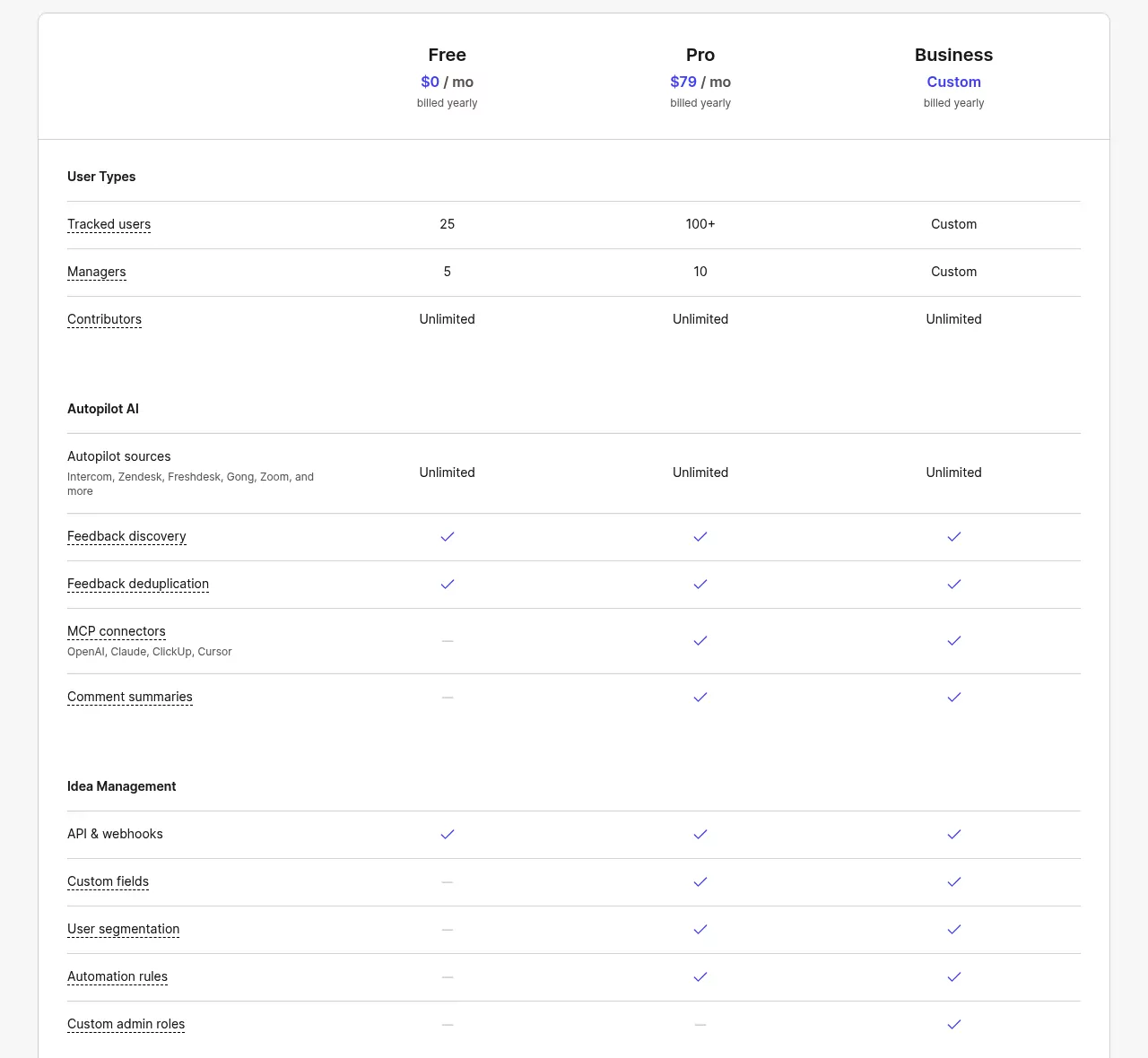
Canny's pricing matrix, checked October 25, 2026, splits the features like this. "Paid add-on" means an extra marked with a dollar icon.
| Feature | Free | Pro | Business |
|---|---|---|---|
| API and webhooks | Yes | Yes | Yes |
| Custom domains, custom statuses, internal comments | No | Yes | Yes |
| Changelog emails | No | Yes | Yes |
| Smart replies, comment summaries, MCP connectors | No | Yes | Yes |
| Custom fields, segmentation, automation rules | No | Yes | Yes |
| Jira, ClickUp, Linear, Asana, GitHub, Azure DevOps, Zapier | No | Yes | Yes |
| Segment | See note | Yes | Yes |
| SOC 2 | No | Yes | Yes |
| Admin SSO (Okta, OIDC, Entra ID, OneLogin) | No | No | Yes |
| Custom admin roles | No | See note | Yes |
| Pay by invoice | No | No | Yes |
| Remove branding, email whitelabel, security review | No | No | Paid add-on |
| CRM (HubSpot, Salesforce) | No | No | Paid add-on, see note |
Three conflicts between Canny's own pages are worth a question before you buy:
- The Business card says "CRM integrations", but the matrix marks CRM as a paid add-on.
- The billing article says Pro includes custom roles. The matrix shows them on Business only.
- The billing article lists Segment.com among Free integrations. The matrix starts Segment at Pro.
How Canny Works (and What Canny AI Does)
Canny software follows a simple loop. Customers post and vote on a branded portal or an in-app widget. Your team sets statuses, shares a public roadmap and announces releases in a changelog.
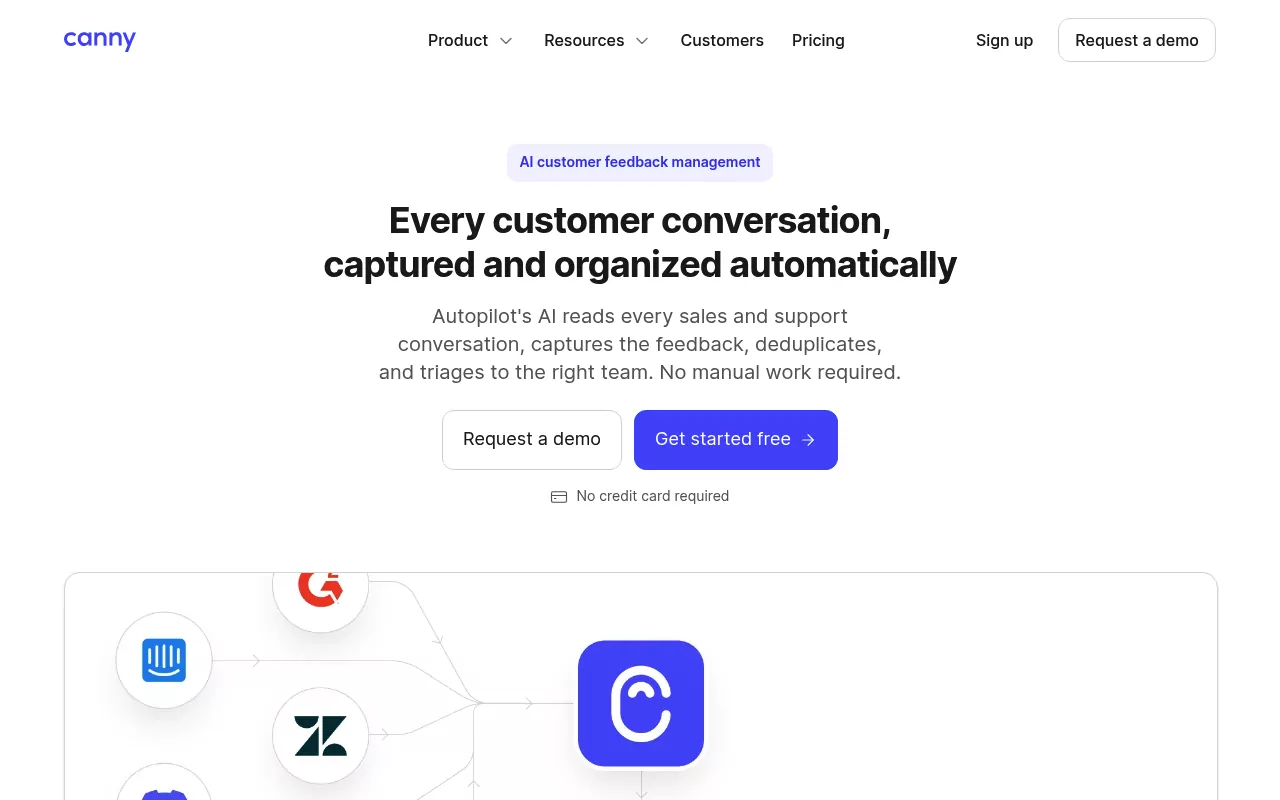
Canny AI goes by the name Autopilot. Its feature page says it captures feedback from Intercom, Zendesk, Slack, Gong, Zoom, Freshdesk, Help Scout and tl;dv. It also reads public reviews on G2, Capterra, Trustpilot, the App Store and Google Play. It merges duplicates and ties each request to the customer and revenue behind it.
For developers, the Canny API and webhooks work on every plan. On Free, the API cannot set custom fields on new posts. Canny MCP connectors for OpenAI, Claude, ClickUp and Cursor need Pro.
Canny Review: What It Does Well
- Autopilot on every plan, with no credit cap on Free or Pro since May 9, 2025. For a busy support inbox, that saves real time.
- A capable Free plan. You get unlimited posts, boards and contributors, a changelog, a roadmap, private boards and the API.
- A long integration list on Pro, from Jira and Linear to Zapier and Segment, plus MCP connectors.
- Revenue context. Requests link to accounts and revenue, and Pro adds user segmentation.
- Steady development. The public changelog shows Ideas action fields (October 13, 2026), Follow ideas (October 9) and Google Meet for Autopilot (September 24).
- Budget controls: a trial with no card, and a monthly spend limit on paid plans.
Canny Cons: Where the Price Hurts
- Every voter is billable. Success on the board raises the bill, and Autopilot adds tracked users on its own.
- Automatic upgrades. Without a cap you move up a band the moment you pass it. With one, new customers' feedback stops being tracked.
- A gated Free plan that must be unlocked within 7 days and tops out at 25 tracked users.
- Branding removal costs extra and is only offered on Business.
- Card-only Pro. Invoices and bank transfer are Business only.
- Pricing keeps changing. Canny's June 17, 2025 changelog entry announced tracked-user pricing with paid plans from $19 a month for 100 tracked users. As of October 2026, Pro starts at $79 a month billed yearly.
Legacy Starter and Growth customers who signed up before May 9, 2025 are grandfathered. That is why some directories still list old Canny prices, so trust the dated tables above.
How These Tools Were Compared
Every figure here comes from public pages. Prices were checked on Canny's pricing page and billing article on October 25, 2026. Plan rules come from the pricing matrix and Canny's help center, with each article's update date. G2 and Capterra ratings are not quoted, because they could not be checked that day. Alternatives were checked on each vendor's own site on the same date.
Who Should Pay for Canny (and Who Should Not)
Canny is worth the price if:
- Your team lives in Intercom, Zendesk, Gong or Slack and wants AI to capture feedback.
- You push requests into Jira or Linear.
- You need revenue weighting, user segments, admin SSO or SOC 2.
Think twice if:
- Your product is early and voting comes in spikes, so your band could jump fast.
- You run a consumer app. Ask Canny about B2C plans first.
- You only need a board, a roadmap and a changelog, without a bill that grows with every voter.
Canny Alternatives Worth Pricing
If tracked-user pricing is the sticking point, other tools charge in other ways. Featurebase sells per-seat plans, with a free one-seat plan and a fee per AI resolution. Frill caps plans by ideas and surveys and lists unlimited tracked users. Fider offers a free hosted board and a self-hosting option.
Tiny Team Feedback: Best for Small Teams That Want a Board Without a Per-Voter Bill
Tiny Team's Feedback module puts boards, a roadmap, a changelog and surveys in one module, on a branded portal.
- As many private or public boards as you need. Customers post, vote and comment on public boards after verifying their email, with no password.
- Up to 20 statuses per board, internal notes, and manual merging that moves votes and subscribers.
- A drag-and-drop roadmap with a read-only public view.
- A changelog with scheduling and emails to subscribers.
- NPS, CSAT, customer effort and product-market fit surveys, by portal link or website popup.
- A portal on your own subdomain, and an embeddable widget.
Pricing model: a one-time purchase per organization, with no subscription and no per-seat or per-voter fees. Its free trial needs no credit card, and nothing is charged automatically.
Where it falls short of Canny: no AI of any kind, so duplicates are merged by hand. No integrations (Jira, Linear, Slack, Intercom or Zapier), webhooks or public API, and no SSO: customers verify by email. No revenue weighting, prioritization scores or custom fields. No CSV import, so moving from Canny means re-entering requests by hand.
Best for: small teams that want a board, roadmap, changelog and surveys without a per-voter bill. Pick Canny if you need Autopilot, Jira or Linear sync, revenue weighting, an API or SSO.
| Feature | Canny Pro | Tiny Team Feedback |
|---|---|---|
| How you pay | Subscription by tracked users, from $79 a month billed yearly (October 2026) | One-time payment per module; see current prices |
| Trial or free option | Free plan for 25 tracked users, plus a 14-day trial | Free trial, no credit card |
| Boards, voting, private boards | Yes | Yes |
| Custom statuses and internal notes | Yes | Yes |
| Public roadmap | Yes | Yes |
| Changelog emails | Yes | Yes |
| Custom domain | Yes | One custom subdomain per portal |
| NPS and CSAT surveys | Not listed | Yes |
| AI feedback capture | Yes, Autopilot | No |
| Integrations, API and webhooks | Yes | No |
| User identification | Single sign-on in base features; admin SSO on Business | Email verification only |

If that covers what your team needs, see current prices. Or create a free workspace and start the Feedback trial from Modules & Billing when you are ready.
Final Verdict
Canny is one of the most complete feedback tools for teams that will use Autopilot and its integrations. The tracked-user ladder is fair at 100 to 300 tracked users and steep past 1,000. A spend limit keeps the bill in check, but only if new votes can wait at the cap.
Small teams that only need a board, a roadmap, a changelog and surveys should price a one-time option first, like the one above.
Frequently Asked Questions
Is Canny free?
Yes. Canny's Free plan has no time limit and covers 25 tracked users and 5 managers. You must finish a few unlock steps in your first 7 days, or ask support to extend the window or skip them. Custom domains and changelog emails need Pro, as of October 2026.
How much does Canny cost for 1,000 users?
As of October 2026, 1,000 tracked users on Pro cost $529 a month billed yearly ($6,348 a year). Month to month, it is $661. If you mean 1,000 total customers, Canny's 1 to 5% rule suggests 10 to 50 tracked users. Free covers 25, and above that you are in Pro's 100 band at $79 a month billed yearly.
What is Canny AI, and does Autopilot cost extra?
Canny AI is Autopilot. It reads support chats, sales calls and public reviews, captures feature requests and merges duplicates. It is included on every plan with no credit cap. But each customer whose feedback it finds counts as a tracked user, which can push you into a higher band.
What is the Canny company?
Canny was founded in 2017 by Sarah Hum and Andrew Rasmussen, per its about page. It is bootstrapped, profitable, fully remote and incorporated in the United States. It began as feature voting boards and now calls itself an AI-native customer intelligence platform.
What are some good alternatives to Canny?
Popular Canny alternatives price feedback in other ways. Featurebase charges per seat and has a free one-seat plan. Frill caps plans by ideas and surveys, not tracked users. Fider offers a free hosted board and can be self-hosted. Check each pricing page before you switch.