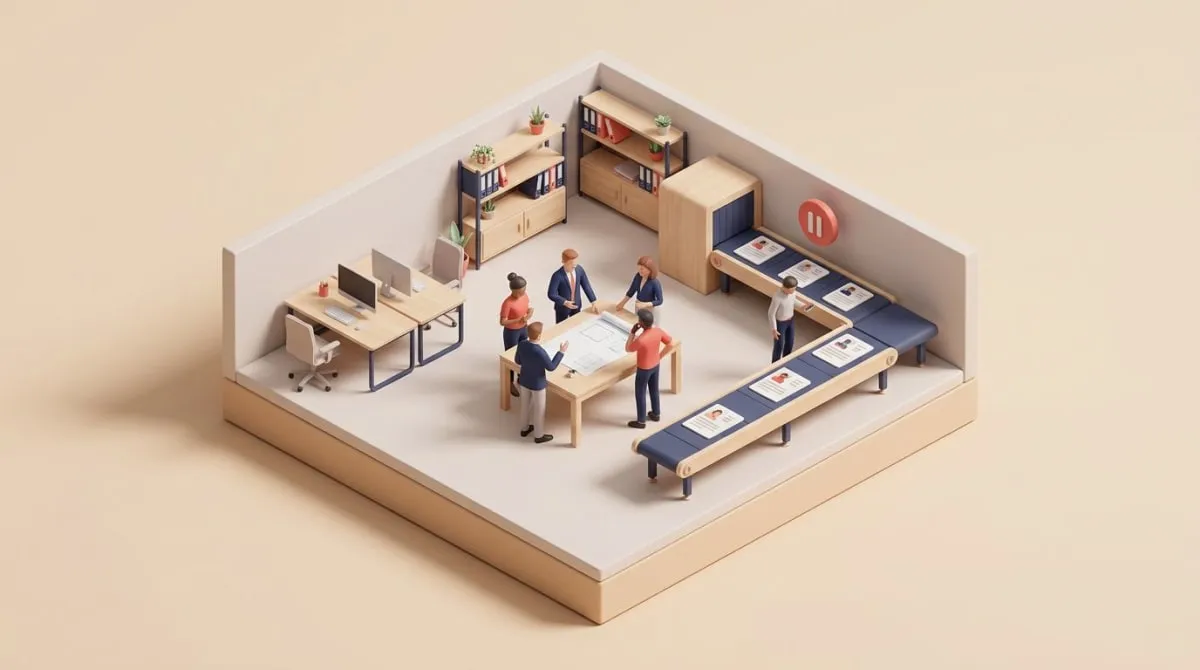
A panel interview puts one candidate in front of two or more interviewers at the same time. Each one sizes up the candidate from their own angle. Instead of running four separate one-on-one rounds, you get everyone's read in a single, structured chat. Done well, it makes for a faster, fairer, more reliable hire.
Most guides about panel interviews are written for the candidate: how to survive the room, how to make eye contact with three people at once. This guide is the opposite. It is written for you, the hiring manager on a small team. You have to set the thing up, assign roles, ask good questions, and turn four sets of notes into one confident yes or no.

What is a panel interview?
A panel interview is a hiring chat where one candidate meets several interviewers together in one session. Each panelist stands in for a different part of the team: the hiring manager, a future teammate, someone from another department. Each one asks about what they care about most.
The format matters because it changes how a decision gets made. In a one-on-one, one person's take carries the whole call. In a panel, several trained people watch the same answers and score them on their own. SHRM notes that gathering several viewpoints at once makes candidate reviews more reliable and fair. You are trading one gut feeling for a small, mixed jury.
Panels can run from two to eight interviewers. For a small company, three to four is the sweet spot. Fewer than three and you lose the mix of views that makes the format worth it. More than four and the candidate feels grilled, the logistics get painful, and the quieter panelists stop chiming in.
Panel vs. group vs. one-on-one interview
These three terms get mixed up all the time, and they mean very different things. It comes down to how many candidates and how many interviewers are in the room.
| Format | Candidates | Interviewers | Best for |
|---|---|---|---|
| One-on-one | 1 | 1 | Early screens, quick culture chats, sensitive roles |
| Panel interview | 1 | 2–8 | Final rounds, cross-functional roles, high-stakes hires |
| Group interview | Several | 1 or more | High-volume hiring, roles that test group dynamics |
A one-on-one interview is a single interviewer and a single candidate. It is flexible and low-pressure, great for a first screen, but it rests the whole judgment on one person's read.
A panel interview keeps one candidate but adds interviewers. Everyone hears the same answers at the same time. That removes the "telephone game" of comparing notes from separate rounds days apart.
A group interview, sometimes loosely called a group panel interview, flips it. Several candidates are interviewed together, usually by one or two people. This is a volume play for retail, hospitality, or seasonal roles. It is a poor fit for most small-team hires, where each hire is a big bet.
If you are hiring one carefully chosen person into a team of ten, the panel interview is almost always the right tool.
When to use panel interviews
Panels take more work to set up than a quick one-on-one. So use them where the payoff earns that effort. They shine in a few clear cases.
- Final-round decisions. After a phone screen and a skills test, a panel is a strong way to close. It surfaces doubts before you make an offer, not after.
- Cross-functional roles. If the new hire will work daily with engineering, sales, and support, put one person from each in the room. Each panelist tests the ties they will actually own.
- Leadership and manager hires. A manager sets the tone for a whole team. Several views catch red flags one interviewer might talk themselves out of.
- When you want legal cover. A written, steady process across candidates is your best proof of fair hiring. The EEOC warns that uneven treatment invites bias claims. A structured panel with saved scores is far easier to defend.
Skip the panel for a first screen or a very junior, high-volume role. There, a light one-on-one moves faster and respects everyone's time.
The advantages and disadvantages at a glance
Every format has tradeoffs. Here is the honest list of panel interview advantages and disadvantages before you commit.
Advantages
- Less personal bias, since one person's blind spot is covered by others
- A better read on job performance when the panel is structured and scored
- Speed, since one session replaces several rounds
- A built-in record that backs up fair hiring
- A real look at how the candidate handles a room
Disadvantages
- Candidates can feel put on the spot, which can hide their true skill
- Groupthink, where one loud panelist sways everyone else
- Getting several busy people into one slot is truly hard
- A badly run panel gives you worse data than a good one-on-one
The downsides are all failures of process, not of the format itself. The rest of this guide is about running the process so those risks never show up.
How to set up a panel interview (step-by-step)
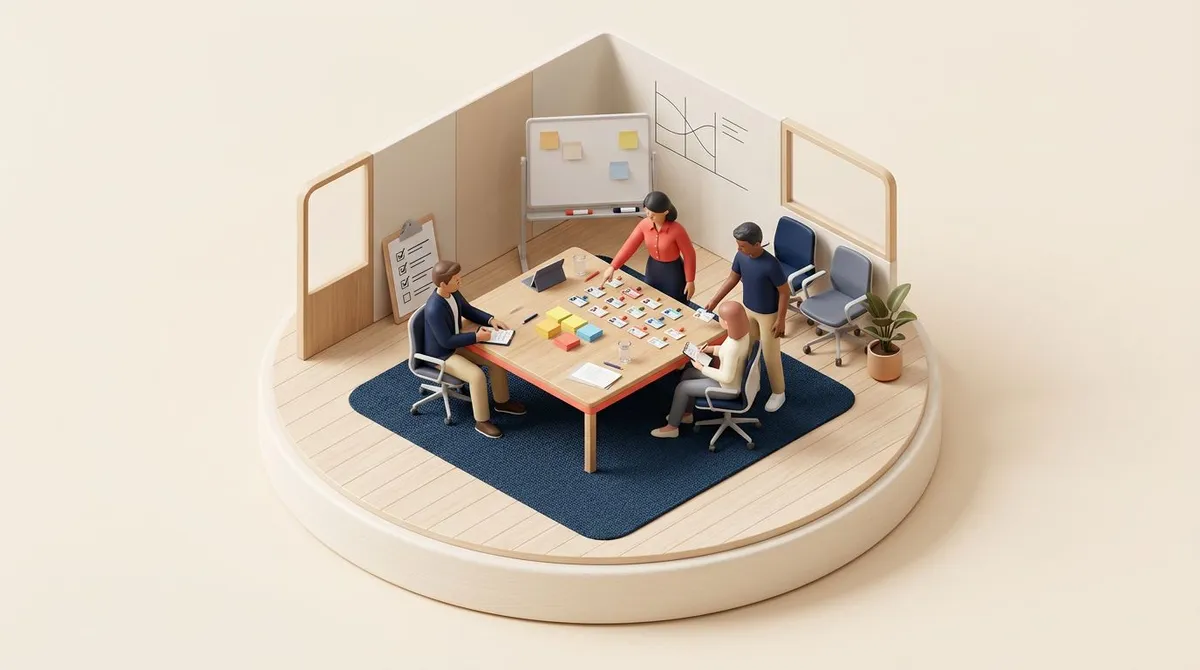
A good panel interview is 80% prep. Here is the workflow, tuned for a team with no recruiting department.
Step 1: List the core skills first. Before you pick people or questions, name the three to five things this hire must be able to do. For a support lead that might be empathy, clear writing, staying calm under pressure, and coaching. Everything else maps back to these skills.
Step 2: Choose three to four panelists. Pick for coverage, not job title. A strong small-team panel is the hiring manager, one future peer, and one person from a nearby team. Vary who is in the room on purpose. A mix of roles and backgrounds cuts the odds that everyone shares the same blind spot.
Step 3: Assign a role to each panelist. This is the step most teams skip. It is also the one that splits a sharp panel from a messy one. See the role table below.
Step 4: Split the skills across the panel. Give each panelist one or two skills to own so questions do not overlap. The peer probes teamwork, the manager probes judgment, the cross-team guest probes clear speaking. Nobody asks "tell me about yourself" three times.
Step 5: Write the questions ahead of time and keep them the same. Every candidate for the role gets the same core questions in the same order. That is what makes candidates easy to compare and the process easy to defend.
Step 6: Brief the candidate. Tell them who they will meet, each person's role, and how long it will run. Cutting the surprise gives you a truer read of their skill instead of a read of their nerves.
Step 7: Prep a scorecard. Every panelist should have a scorecard ready before the candidate walks in. That way ratings happen in the moment, not from fuzzy memory later.
Panel roles and who does what
Clear roles keep the session from turning into a free-for-all. On a three or four person panel, these are the roles worth naming.
| Role | Responsibility |
|---|---|
| Lead interviewer | Greets the candidate, explains the format, keeps time, opens and closes |
| Facilitator | Keeps the flow, makes sure no panelist takes over, invites quieter voices in |
| Subject-matter expert | Digs into role-specific skills the others cannot judge |
| Records keeper | Captures notes and checks that everyone filled out their scorecard |
On a small team, one person often wears two hats. The lead interviewer usually runs the flow too. That is fine. The point is that the roles are set ahead of time, not made up in the room.
Panel interview questions by category
Good panel questions are shared out by type so each panelist covers different ground. Below are ready-to-use questions, laid out the way a small-team panel should split them. Lean on behavioral and situational questions. They predict on-the-job performance far better than "what's your greatest weakness."
Behavioral questions (past behavior predicts future behavior)
These ask for real examples, not what-ifs. Assign them to the peer and the hiring manager.
- "Tell me about a time you disagreed with a teammate on how to solve a problem. What did you do?"
- "Describe a project that went off the rails. What was your role, and what did you change?"
- "Walk me through a time you had to learn something new fast to hit a deadline."
- "Give an example of feedback that was hard to hear. How did you respond to it?"
Situational questions (how they'd handle what's coming)
These test judgment on scenarios the role will actually throw at them. Great for the hiring manager.
- "Two priorities land on your desk with the same deadline and you can only finish one. How do you decide?"
- "A customer is upset about something that isn't your fault. Walk me through your first five minutes."
- "You notice a teammate is quietly missing commitments. What do you do?"
Technical or role-specific questions
Owned by the subject-matter expert. Tie these to the actual work, ideally with a short real task rather than trivia.
- "Here's a sample of the work you'd do day one. Talk me through how you'd approach it."
- "What would you check first if [common failure in this role] happened?"
- "Which tools have you used for this, and where did they fall short?"
Culture and values fit questions
These probe how someone works, not whether they will be your friend. Assign to the cross-team panelist. Screen for shared work values, never for "someone like us." That is how bias creeps in.
- "What kind of environment brings out your best work?"
- "How do you prefer to give and receive feedback?"
- "Tell me about a workplace value you hold that you won't compromise on."
For more on the behavioral side, our guide to interview feedback examples shows how to turn these answers into clear, written notes the whole panel can line up behind.
How to evaluate candidates after a panel interview
The interview is only half the job. How you score and debrief decides whether the panel sharpens your call or just adds noise.
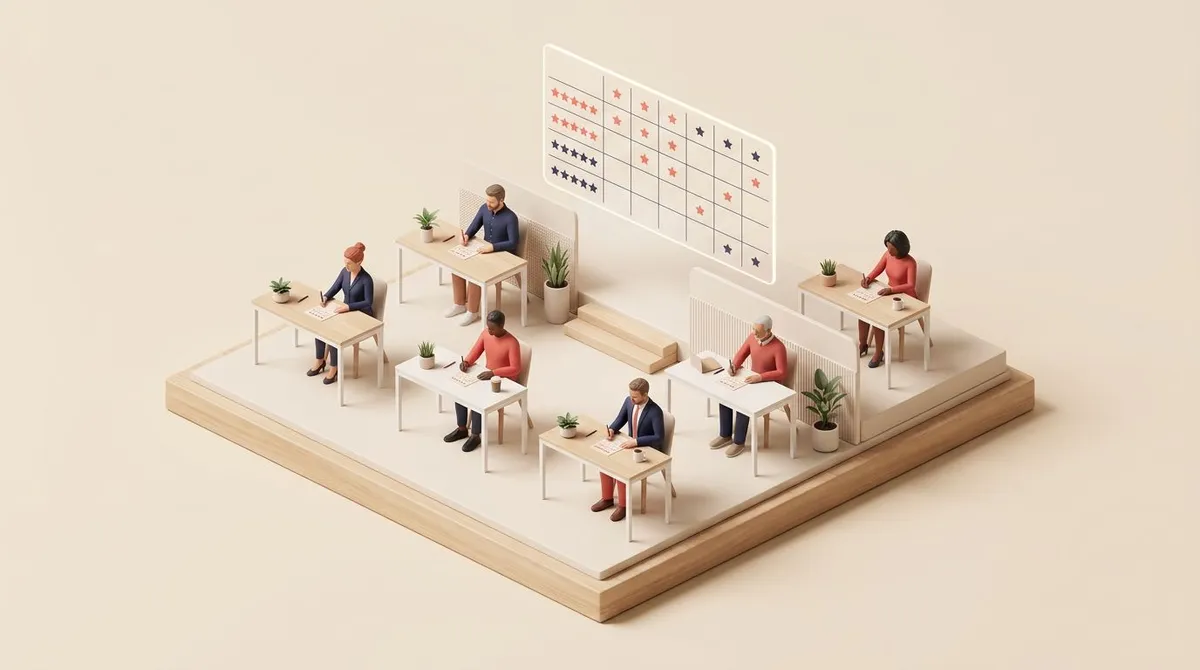
The single most important rule: panelists score on their own before they talk. If the loudest person shares their view first, everyone else leans toward it, and you have thrown away the whole point of a panel. Harvard Business Review makes the same case: structure and independent scoring are what strip bias out of interviews. Have each person fill out their scorecard in private, then compare.
Use a simple rubric. A five-point scale for each core skill works well and keeps scoring fast.
| Skill | 1 – Poor | 3 – Meets bar | 5 – Standout |
|---|---|---|---|
| Role skills | Missing key abilities | Can do the core job | Clearly above the role |
| Teamwork | Friction signals | Works well with others | Lifts the whole team |
| Communication | Hard to follow | Clear and tidy | Sharp and convincing |
| Judgment | Weak reasoning | Sound calls | Smart tradeoffs |
| Values fit | Off the mark | On the same page | Strengthens the culture |
Score each skill right after the matching question, not at the end. Ratings you jot down in the moment are far more accurate than ones you piece together after the candidate leaves.
Then run a set debrief:
- Collect every scorecard before talk starts.
- Have each panelist share their scores and one piece of proof.
- Dig into gaps. A 5 next to a 2 is a signal worth chasing, not averaging away.
- Make the call against the bar you set, not against the other candidates in the pipeline.
A steady scorecard is also your legal backup. If a turned-down applicant ever questions the choice, written, skill-based scores show it was about the job. Our interview scorecard template gives you a ready structure, and you can also build one live with the free interview scorecard builder.
Best practices for small teams
Small teams run panels differently than big companies. You do not have a recruiting team or a scheduling tool humming in the background. These tips are tuned for that.
Keep the panel to three people when you can. On a ten-person team, pulling four people offline for an hour is costly. Three well-briefed panelists beat five distracted ones.
Set it up once, reuse it forever. Write your skills list, questions, and scorecard for a role one time. The next time you hire for it, you are not starting from scratch. And every candidate across both hiring rounds stays easy to compare.
Calibrate your interviewers. Before the first panel, spend fifteen minutes agreeing on what a "3" versus a "5" looks like. SHRM backs regular calibration for a reason: untrained panelists drift apart on what "good" means.
Run panels as part of a set hiring process, not a one-off. A panel is one step in a chain: screen, skills test, panel, references. Slotting it into a repeatable hiring process is what makes it reliable, not lucky. If you are still building that process, the guide to the best ATS for small business walks through tools that keep candidates, notes, and scorecards in one place.
If you track candidates in a spreadsheet today, a light tool like Tiny Team keeps your pipeline, panel notes, and scorecards together. The whole team scores the same candidate against the same bar, with no files to email around. Tiny Team offers one-time lifetime access to HR and Document Spaces per organization. Choose one module or buy several in a single payment. Each module has its own 30-day free trial, starting when you activate it. No credit card, automatic charges or per-person fees. See current module pricing.
Common mistakes to avoid
Even seasoned managers trip on the same few things. Watch for these.
- No assigned roles. Without a lead and a facilitator, panels ramble and one voice takes over. Assign roles before the candidate arrives.
- Overlapping questions. Three people asking about teamwork wastes the candidate's time and leaves other skills untested. Split the questions.
- Talking about scores before writing them. This is the big one. It builds fake agreement and wipes out the range of views you built the panel to get.
- Too big a panel. Six interviewers put the candidate on edge and blur who owns the call. Cap it at four.
- Winging the questions. Different questions for different candidates make them hard to compare and hard to defend. Keep them the same.
- Skipping the candidate brief. A surprised, anxious candidate does worse, and you mistake nerves for lack of skill. Tell them what to expect.
- No debrief. Collecting scorecards and never talking them through wastes the panel. The debrief is where the call really gets made.
Dodging these is mostly about front-loading the prep. A steady hiring process, paired with clear job descriptions and solid reference checks, takes most of the guesswork out of the room.
Frequently asked questions
How many people should be on an interview panel?
For a small team, three to four panelists is ideal. Three gives you enough of a mix of views to cut personal bias without overwhelming the candidate. Bigger panels of five or more tend to put candidates on edge, blur who owns the call, and make scheduling much harder. Fewer than three loses the main perk of the format.
What is the difference between a panel interview and a group interview?
A panel interview has one candidate meeting several interviewers at once. A group interview has several candidates being interviewed together, usually by one or two people. Panels are used for high-stakes single hires. Group interviews are a volume tool for high-turnover or seasonal roles.
How do you conduct a panel interview effectively?
Name the core skills, give each panelist a role and a set of skills to probe, write the same questions ahead of time, and hand everyone a scorecard. During the interview, keep to the plan and take notes. After, have each panelist score on their own before any talk, then debrief against the bar you set. Structure at every step is what makes the panel reliable.
What questions are asked in a panel interview for managers?
Manager panels lean hard on behavioral and situational questions about leadership: how they've rallied a team through a rough stretch, how they handle a report who keeps missing deadlines, how they decide with little information, and how they give hard feedback. Each panelist should own a different skill so the questions probe leadership from several angles.
Are panel interviews better than one-on-one interviews?
For final-round and high-stakes hires, yes. A structured panel reads job performance more reliably than one interviewer, because several trained people cut personal bias. For early screens and high-volume junior roles, a one-on-one is faster and works fine. Match the format to the stakes.
How do you reduce bias in a panel interview?
Use the same questions and scorecard for every candidate. Build a panel with a mix of views and backgrounds. Have panelists score on their own before they talk. And agree upfront on what each rating means. Written, skill-based scores are also your best cover if a hiring choice is ever challenged.