This Deel review covers what the platform does well, where it falls short, what it costs in 2026, and who should look elsewhere. Deel is a global HR and payroll platform. It lets you hire, pay, and manage workers in more than 150 countries without opening a legal entity in each one. It's a strong fit for spread-out companies. But it's too much (and too pricey) for a small team in one country.
Most Deel reviews online are affiliate posts that read like brochures. This one is not. We pull from Deel's own published prices, real user feedback on G2 and Trustpilot, and the legal stories that don't usually make the highlight reel.
What is Deel?
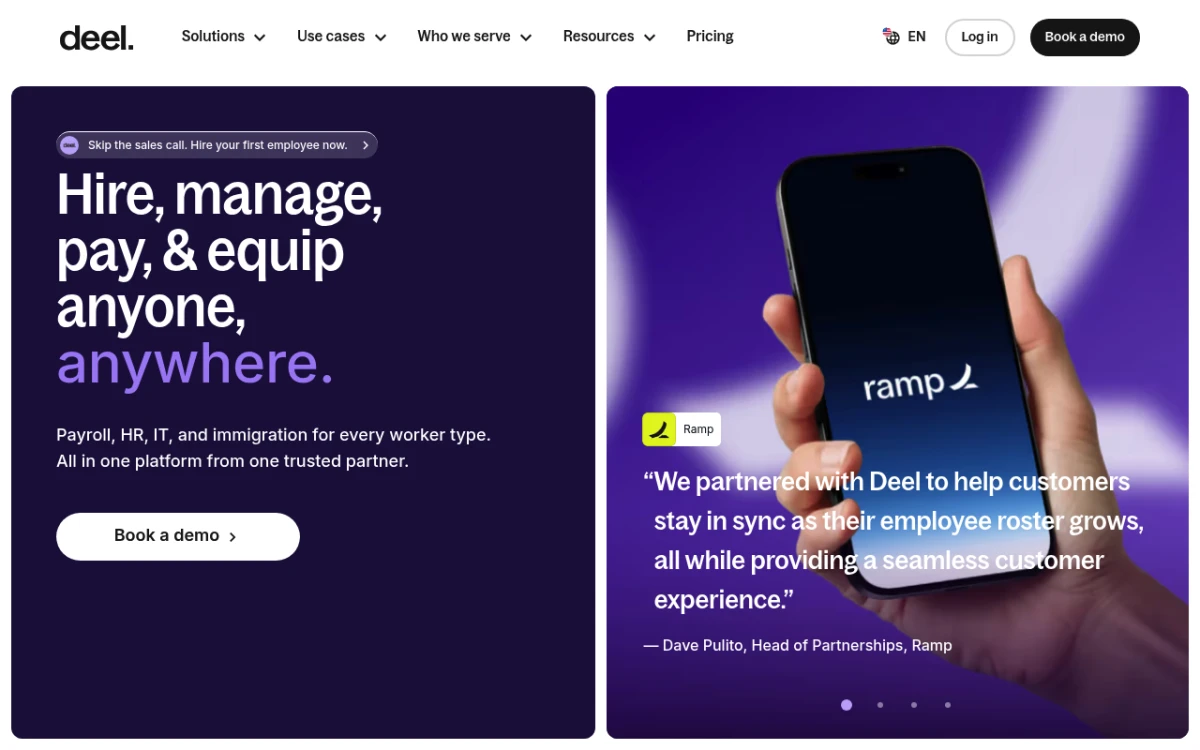
Deel's homepage pitches global hiring, payroll, and EOR from a single platform.
Deel is a global people platform. It combines contractor management, Employer of Record (EOR) services, global payroll, and a core HR system in one place. Founded in 2019, it has grown fast. The company reports more than 37,000 customers and over 1.5 million workers managed across 100+ countries.
The main problem Deel solves is legal red tape. Hiring someone in Portugal or the Philippines normally means setting up a local entity, learning local labor law, and running payroll in the local currency. Deel acts as the legal employer for you. So you can onboard that person in days instead of months.
If your whole team works in one country, none of that applies to you. That's the central tension this review keeps coming back to.
Who is Deel best for?
Deel earns its price tag when borders are involved. The companies that get the most value tend to share a few traits.
- Remote-first startups hiring abroad. You found a great engineer in Argentina and a designer in Poland, and you don't want to register a business in either country.
- Companies with a mix of contractors and employees. Deel handles 1099-style contractors and full EOR employees from the same dashboard.
- Teams worried about misclassification risk. Deel's contracts and compliance tooling reduce the odds of treating a contractor like an employee in the eyes of local law.
- Scale-ups consolidating tools. If you're juggling separate payroll, contracts, and HR systems across regions, one platform is appealing.
If you're a 12-person company where everyone is a W-2 employee in the same state, keep reading — Deel is probably more machine than you need.
Deel features overview
Deel is modular. You can use one piece (just contractor payments, say) or stack several. Here's what each part does.
Global payroll
Deel runs payroll in 100+ countries. It uses in-house payroll teams in many of them rather than leaning on third parties. It handles local tax filings, deductions, and payouts in many currencies. Native US payroll is also available. This is the core product for companies that already have entities abroad but want one system to run them.
Employer of Record (EOR)
The EOR product is Deel's headline feature. Deel's local entity becomes the legal employer. The worker still reports to you day to day. You get a legal employment contract, local benefits, and payroll in the right currency. And you don't have to register a company yourself. It's the fastest legal way to hire a full employee in a country where you have no presence.
Contractor management
For independent contractors, Deel creates local contracts, collects tax forms, and pays people in their currency of choice or even crypto. "Deel Shield" adds a layer of misclassification protection. Here Deel takes on some of the legal risk. This is the entry point most small companies use first.
HR and compliance
Beyond payroll, Deel offers a core HR system. That includes an employee directory, onboarding flows, time-off tracking, document storage, and equipment setup. There's also a performance and engagement module (Deel Engage). Reviewers often note these HR tools are solid but thinner than dedicated platforms. They're fine as an add-on, not the reason you'd buy.
Integrations
Deel connects to common accounting and HR tools. These include QuickBooks, Xero, NetSuite, BambooHR, Slack, and Greenhouse. The integration library is broad. That matters when payroll data needs to flow into your books on its own.
Deel pricing (2026)
Here's where the honest part of a Deel review matters most. Deel uses modular, per-worker pricing. The products that grab headlines are far cheaper than the ones that actually carry a global team. All figures below are Deel's own published starting prices.
| Product | Starting price | Billed |
|---|---|---|
| Contractor Management | $49 / contractor / month | Per contractor |
| Contractor of Record | $325 / contractor / month | Per contractor |
| Global Payroll | $29 / employee / month | Per employee |
| US Payroll | $29 / employee / month | Per employee |
| EOR (Standard) | $599 / employee / month | Per employee |
| EOR (Enterprise) | from $899 / employee / month | Per employee |
| US PEO | $125 / employee / month | Per employee |
| Deel HR (Core) | $5 / employee / month | Per employee |
| Deel HR (Full) | $56 / employee / month | Per employee |
A few things stand out. The "Deel is free HR" claim in affiliate posts refers to the bare-bones HR layer. You only get it when you already pay for payroll or EOR. It is not a free standalone product. And EOR at $599+ per employee per month adds up fast. Ten EOR employees runs roughly $72,000 a year before currency fees.
Watch the extras, too. Deel charges currency-conversion margins (often around 0.6%–2% over the mid-market rate, higher on some routes), small withdrawal fees, and entity-setup fees for some global payroll customers. The sticker price is rarely the final price. For a deeper look at the add-ons, see our Deel pricing guide.
Deel pros
What Deel genuinely does well:
- Speed of global hiring. You can onboard an employee in a new country in days, fully legal. That's the product's real magic. Few rivals match the coverage.
- One platform for a messy reality. Contractors, EOR employees, and global payroll sit in one dashboard. That cuts tool sprawl for spread-out teams.
- Strong compliance. Local contracts, required benefits, and misclassification protection are built in. That lowers legal risk when you hire across borders.
- High satisfaction scores. Deel holds strong public ratings, around 4.8/5 on G2 across thousands of reviews. Contractors and employees often praise the payout flow.
- Fast payouts in many currencies. Workers get paid on time in the currency they want. That's a real retention factor for global talent.
Deel cons
Now the parts the brochure skips:
- Pricey for what most small teams need. If you don't need EOR, you pay global-platform prices for HR features you could get cheaper elsewhere.
- Unclear pricing on key products. PEO, advanced payroll, and some add-ons still need a sales call. That makes budgeting harder than it should be.
- Thin HR and reporting tools. The core HR, analytics, and performance features work, but they're thinner than purpose-built tools.
- Hidden currency and withdrawal fees. Conversion margins and small per-payment fees quietly raise the true cost.
- Reputation questions. Deel has faced public claims worth knowing about before you commit (more below).
- Too much for domestic teams. A one-country, all-employee company pays for global plumbing it will never use.
Deel review: what users say (Reddit, G2, Trustpilot)
Aggregate scores are high. On G2, Deel averages roughly 4.8/5 across more than 13,000 reviews, and Capterra is similar. Contractors in particular tend to like getting paid quickly in their own currency. You can browse the raw feedback on G2's Deel reviews page and on Trustpilot.
The criticism is more nuanced than the star rating suggests. Common themes in user threads include support that can feel slow once you're past onboarding, reporting you can't customize much, and surprise fees on currency conversions. On Reddit, the most common warning is simply cost. Deel is powerful, but the bill grows with every worker and every conversion.
It's also worth knowing the company has faced real controversy. In March 2025, rival Rippling sued Deel. It claimed Deel paid an employee to act as a corporate spy. The case drew a lot of industry attention. Deel has also faced claims around contractor misclassification in California and a complaint over PEO licensing in Florida. Deel denies wrongdoing, and so far there have been no adverse rulings. Still, these stories are worth weighing in a vendor decision. For more context, the U.S. Department of Labor's guidance on worker classification explains why misclassification is a serious compliance issue.
Deel alternatives for small teams
Deel competes mostly with other global platforms, but small teams often have lighter, cheaper options. A few worth weighing:
- Rippling — a unified HR, IT, and payroll platform that also does global hiring. Strong if you want device management and apps in the mix. See our Rippling review and Rippling pricing breakdown, plus a head-to-head in Rippling vs Deel.
- Gusto — excellent US-focused payroll and benefits for domestic small businesses, with limited international reach. Our Gusto review and Gusto alternatives cover the trade-offs.
- BambooHR — a polished HR system without global payroll; pair it with a payroll provider. See BambooHR alternatives.
- HiBob — a modern HRIS for mid-market teams; check HiBob pricing.
If you want a structured shortlist, our roundup of the best HR software for small business compares these head to head with pricing notes for teams under 100 people.
Deel vs Tiny Team: when to choose which
These two tools solve different problems, and pretending otherwise would do you a disservice. Deel is a global payroll and Employer of Record platform. Tiny Team is a lightweight, all-in-one HR system for small domestic teams — it does not run payroll, handle EOR, or hire your overseas contractors. If borders and payroll are your core problem, Deel (or a competitor like Rippling) is the right category, not Tiny Team.
Where the two diverge is the everyday HR side: the employee directory, time-off tracking, documents, hiring pipeline, and performance reviews that every company needs regardless of where people sit. Here Deel's tools are an add-on to its payroll engine, while that's the entire product for Tiny Team.
| Factor | Deel | Tiny Team |
|---|---|---|
| Primary job | Global payroll + EOR | HR system for small teams |
| Pricing model | Per worker, per product | One-time lifetime modules |
| Payroll / EOR | Yes | No |
| Best for | Distributed, cross-border teams | Domestic teams up to 50 people |
| HR depth (directory, PTO, reviews) | Add-on | Core product |
The pricing contrast is the clearest line. Deel bills per worker per product, so costs climb as you grow. Tiny Team offers one-time lifetime access to HR and Document Spaces per organization. Choose one module or buy several in a single payment. Each module has its own 30-day free trial, starting when you activate it. No credit card, automatic charges or per-person fees. See current module pricing. Adding people never raises the bill (up to 50).
The honest takeaway: if you're hiring across borders, Deel is built for you. If your team is domestic and you mainly need the people-management side of HR without a payroll engine bolted on, a flat-rate tool will be simpler and far cheaper. Many growing companies even run both — Deel for international payroll, a focused HR system for everything else.
Frequently asked questions
Is Deel worth it for a small business?
It depends entirely on whether you hire internationally. For a small business paying contractors or employees abroad, Deel's compliance and speed are genuinely worth the cost. For a domestic-only team of W-2 employees, you're paying for global infrastructure you won't use — a US-focused payroll tool plus a lightweight HR system is usually cheaper.
How much does Deel cost per month?
Deel's published starting prices are $49 per contractor per month for contractor management, $29 per employee per month for global or US payroll, and $599 per employee per month for standard EOR. Add-ons, currency-conversion margins, and certain entity-setup fees can push the real total higher.
Is Deel safe and legitimate?
Deel is an established platform managing over 1.5 million workers with strong public review scores. It has faced notable controversies, including a 2025 lawsuit from Rippling and misclassification allegations, all of which Deel denies. There have been no adverse regulatory findings to date, but it's wise to weigh those stories alongside the product's strengths.
What's the difference between Deel EOR and contractor management?
Contractor management ($49/contractor/month) pays and contracts independent contractors who run their own businesses. EOR ($599+/employee/month) makes Deel the legal employer of a full-time worker on your behalf, providing local benefits and compliant employment in a country where you have no entity. EOR costs far more because it carries real employment liability.
Does Deel replace a full HR system?
Deel includes core HR tools — directory, onboarding, time off, documents — but reviewers find them shallower than dedicated HR platforms. It works as the HR layer for a global, payroll-centric setup. Teams that mainly need people management without global payroll often pair a focused HR tool with their payroll provider instead.
The bottom line
Deel is the strongest option in its category: hiring, paying, and managing workers across borders with compliance handled for you. If that's your reality, the price is justified and the platform delivers.
But "best global platform" is not the same as "best for every small team." If your people are domestic and your real need is a clean directory, time-off tracking, hiring pipeline, and review cycles — not international payroll — a flat-rate tool will save you money and complexity. Tiny Team's current module pricing offers one-time lifetime access per organization, with a separate 30-day free trial for each module. No card or automatic charges.