A Gusto alternative is any HR or people-management platform that replaces Gusto's payroll-centric approach with something better suited to how your team actually works. If you're a founder running a 10–50 person company and paying for payroll features you barely touch, you're not alone — and you have options.

Gusto starts at $49/month plus $6 per employee. For a 20-person team, that's roughly $169/month — over $2,000 a year. And most of that cost goes toward payroll processing that many startups outsource to their accountant anyway.
This guide compares five Gusto alternatives that take different approaches to HR. Some focus on people management. Others bundle everything. We'll break down what each one actually does well, what it doesn't, and who it's built for.
Why Teams Look for a Gusto Alternative

Not every company needs a payroll-first HR tool. According to the Society for Human Resource Management (SHRM), the biggest mistake small companies make is buying HR software based on features they might need instead of features they actually use.
Here's why teams typically outgrow — or never needed — Gusto in the first place:
You're paying for payroll you don't run. Many startups under 50 people use an accountant or a dedicated payroll provider like ADP Run. Gusto's base fee covers payroll whether you use it or not.
People management is an afterthought. Gusto added HR features over time, but its core is payroll processing. If what you really need is an employee directory, time-off tracking, and onboarding workflows, you're paying a premium for the wrong thing.
Per-employee pricing gets expensive fast. Every new hire increases your monthly bill. A 15-person team paying $6/head/month doesn't feel it. A 40-person team paying $6–$22/head/month absolutely does.
You don't need U.S.-only payroll. Gusto only processes payroll for U.S.-based employees. If you have contractors or team members abroad, you'll need a separate system anyway.
Top 5 Gusto Alternatives Compared
Here's a quick snapshot before we dive into each tool:
| Tool | Best For | Starting Price | Pricing Model | Payroll? |
|---|---|---|---|---|
| Tiny Team | Founders & small teams (5–100) | Free up to 10 · $79/mo up to 50 | Flat monthly (not per-seat) | No (compensation tracking only) |
| BambooHR | Growing mid-market teams | ~$13/employee/mo | Per-seat | Add-on |
| Rippling | IT + HR unified management | ~$8/employee/mo | Per-seat + modules | Yes |
| HiBob | Culture-focused mid-size orgs | ~$16/employee/mo | Per-seat | Via partners |
| Zoho People | Budget-conscious small teams | $1.25/employee/mo | Per-seat | Separate product |
Tiny Team — Best for Founders Who Want Simple HR
Most HR platforms are built for HR departments. Tiny Team is built for the founder who is the HR department.
It covers the essentials a small team actually needs: an employee directory with compensation tracking, time-off management with custom PTO policies, document storage for your handbook and policies, and a hiring pipeline to track candidates.
What stands out: Simple, flat pricing. Teams of up to 10 people use Tiny Team completely free — every feature, no credit card. Above that, there's a single paid plan: $79/month flat for teams up to 50 people. That's one price, all features, not per-seat — and the paid plan comes with a 30-day free trial (it does require a credit card; the free plan for up to 10 doesn't). No per-seat surprises.
What it doesn't do: Tiny Team doesn't process payroll. It tracks compensation data, but you'll still need a payroll provider. For many small teams, that's actually a plus — it keeps the tool focused and the price low.
Best for: Founders and operations managers at companies with 5–100 people who want people management without the payroll tax.
BambooHR — Best for Teams Ready to Professionalize HR
BambooHR has been a mid-market HR staple for over a decade. It's the tool companies graduate to when spreadsheets stop working but enterprise systems feel like overkill.
The platform covers employee records, onboarding workflows, performance management, and reporting. It recently added payroll as an optional module, though reviews on G2 suggest the payroll feature is still maturing compared to dedicated providers.
What stands out: The onboarding experience. BambooHR lets you build pre-boarding packets with tasks, e-signatures, and welcome messages that new hires complete before day one.
What to watch: Pricing is per-employee, and BambooHR doesn't publish exact numbers. Estimates land around $13/employee/month for the full suite. For a 30-person team, that's nearly $4,700/year — more than 4x what a flat-rate tool would cost.
Best for: Companies with 50–250 employees that have (or are hiring) a dedicated HR person.
Rippling — Best for IT-Heavy Teams
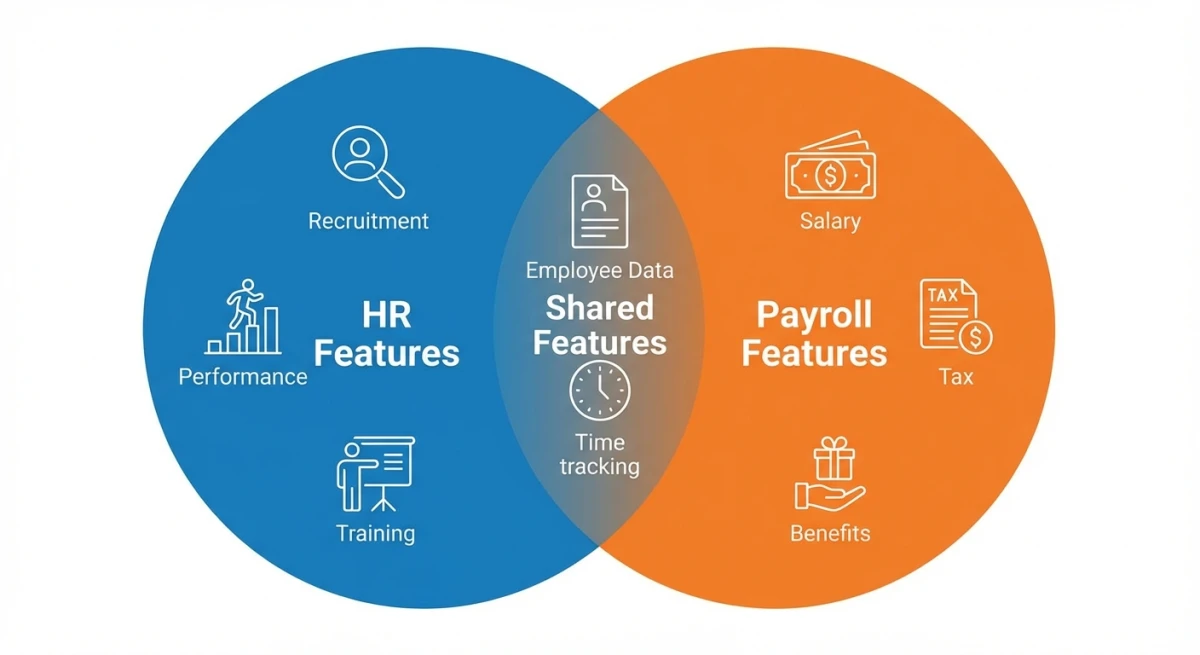
Rippling takes a different approach entirely. It unifies HR, IT, and finance into one system. When you onboard someone, Rippling can set up their payroll, ship their laptop, provision their Google Workspace account, and enroll them in benefits — all from one workflow.
That integration is genuinely impressive. Forbes Advisor calls it "the most ambitious HR platform for growing companies." But ambition comes with complexity.
What stands out: The unified employee lifecycle. Offboarding is just as smooth — deactivate an employee and Rippling revokes app access, recovers devices, and processes their final paycheck.
What to watch: Rippling's modular pricing means the base HR platform starts around $8/employee/month, but adding payroll, benefits, and IT management pushes costs significantly higher. You also need to go through a sales process — no self-serve signup for most plans.
Best for: Tech companies with 50+ employees that want HR and IT device management under one roof.
HiBob — Best for Culture-First Companies
HiBob (the platform is called "Bob") positions itself as the HR tool for companies that care about culture and engagement. It includes org charts, company social feeds, surveys, and analytics designed to help HR teams understand workforce trends.
The platform is popular in Europe and with companies that have distributed teams. Per Capterra reviews, users consistently praise the modern UI and employee self-service features.
What stands out: Workforce analytics. Bob's dashboards surface data about headcount trends, turnover risk, and compensation benchmarks that most small-business tools don't offer.
What to watch: Pricing isn't public, but estimates place it around $16/employee/month. That's the highest on this list. And Bob doesn't include native payroll — you'll need to connect a third-party provider.
Best for: Mid-size companies (100–1,000 employees) with a dedicated HR team that wants deep engagement and analytics tools.
Zoho People — Best Budget Option
Zoho People is part of the massive Zoho ecosystem (CRM, Books, Projects, and about 50 other products). As a standalone HR tool, it covers employee records, time-off tracking, attendance management, and basic performance reviews.
At $1.25/employee/month for the Essential plan, it's the cheapest option on this list. But the tradeoff is a steeper learning curve and an interface that feels more "enterprise admin panel" than "modern SaaS."
What stands out: If you already use Zoho for CRM or accounting, the integrations are seamless. The time and attendance tracking is also more robust than most competitors at this price point.
What to watch: Zoho People and Zoho Payroll are separate products with separate pricing. The HR tool alone doesn't include payroll. The interface also takes time to learn — it's functional but not intuitive. PCMag's review notes the complexity as a recurring theme.
Best for: Small businesses already in the Zoho ecosystem that want to keep everything under one vendor.
Pricing Comparison: The Real Cost for a 25-Person Team
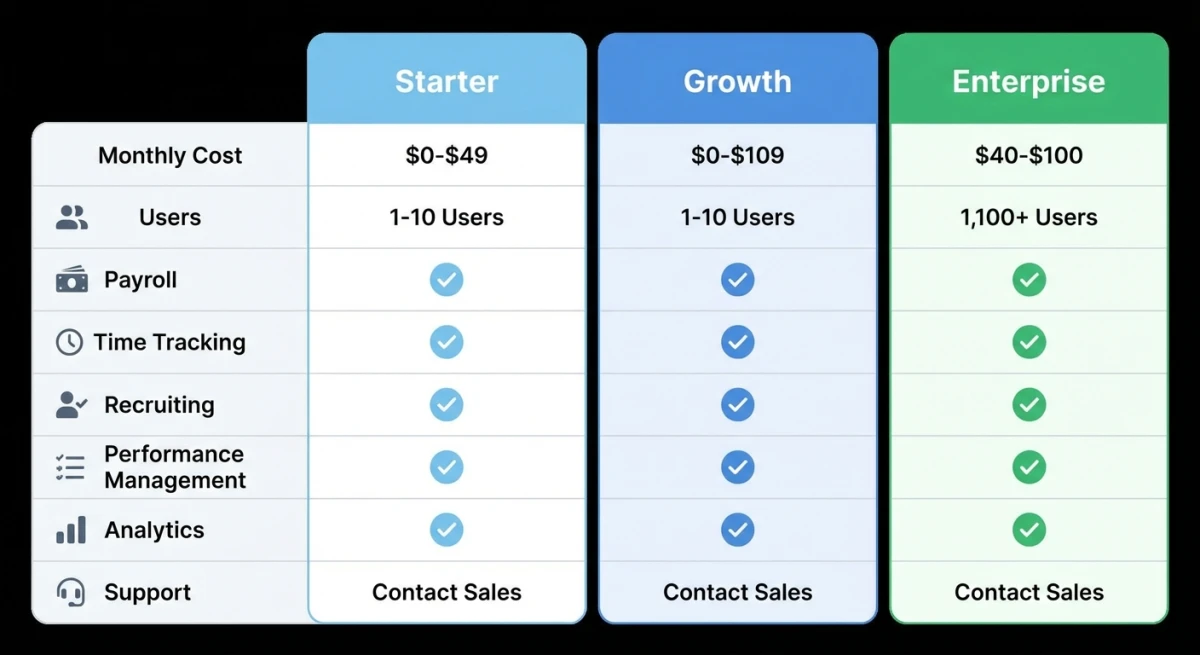
Raw per-seat pricing hides the true cost. Here's what each tool actually costs for a 25-person team over a year:
| Tool | Monthly Cost | Annual Cost | Includes Payroll? |
|---|---|---|---|
| Tiny Team | $79/mo (flat) | $948/year | No |
| Zoho People | ~$31/mo | ~$375/year | No (separate product) |
| Rippling | ~$200/mo | ~$2,400/year | Yes (base) |
| BambooHR | ~$325/mo | ~$3,900/year | Add-on |
| Gusto | ~$199/mo | ~$2,388/year | Yes |
| HiBob | ~$400/mo | ~$4,800/year | No |
A few things jump out. Zoho is cheapest per-seat but lacks payroll and has a steeper learning curve. Tiny Team offers the best value for teams that don't need built-in payroll. And Gusto's pricing is actually middle-of-the-pack — the issue isn't cost alone, it's paying for payroll when you may not need it.
Which Gusto Alternative Is Right for You?
The right choice depends on one question: what do you actually need an HR tool to do?
Choose Tiny Team if you're a founder or ops manager at a 5–100 person company. You want employee records, time-off tracking, documents, and hiring — without paying for payroll you don't use. The flat-rate pricing means your cost stays predictable as you grow. Check out the PTO calculator to see how much time-off tracking alone could save you.
Choose BambooHR if you have a dedicated HR person and need polished onboarding, performance reviews, and reporting. You're okay with per-seat pricing because your HR team will use every feature.
Choose Rippling if you need HR and IT management in one place. Your team uses company-managed devices, and you want one system to handle everything from provisioning laptops to running payroll.
Choose HiBob if culture and engagement analytics are a priority. You have 100+ employees and an HR team that wants data-driven insights about your workforce.
Choose Zoho People if you're already using Zoho products and want the cheapest possible HR add-on. You don't mind a learning curve in exchange for low cost.

For more on how different HR platforms compare, see our best HR software for small business roundup.
Frequently Asked Questions
What is the best free alternative to Gusto?
There's no full-featured free alternative to Gusto, but Tiny Team comes close: it's completely free for teams of up to 10 people, with every feature and no credit card required. Zoho People offers a free plan for up to 5 employees with limited features. Above 10 people, Tiny Team is a flat $79/month for up to 50 — often cheaper than Gusto's per-seat model once you have more than a handful of employees.
Can I use Gusto just for HR without payroll?
Not really. Gusto's plans bundle payroll as a core feature, and pricing reflects that. If you only need HR features like employee records and time-off tracking, a dedicated people-management tool like Tiny Team or BambooHR's core plan will be more cost-effective.
Is BambooHR better than Gusto?
It depends on your priorities. BambooHR has stronger HR features — better onboarding, more detailed reporting, and a cleaner employee self-service portal. Gusto has stronger payroll. If payroll is your main need, stick with Gusto. If HR management is the priority, BambooHR is likely the better choice.
How much does Gusto cost per month in 2026?
Gusto's Simple plan starts at $49/month plus $6 per employee. The Plus plan is $80/month plus $12 per employee. The Premium plan runs $180/month plus $22 per employee. For a 25-person team on the Plus plan, expect roughly $380/month.
What HR software is best for startups under 20 people?
For startups under 20, the priority is simplicity and cost. Tiny Team (free for up to 10 people, then a flat $79/month for up to 50) and Zoho People ($1.25/employee/month) are the most affordable options. Both skip payroll in favor of core people management, which is usually what startups this size actually need.
Do I need payroll software if I have an accountant?
Many small businesses run payroll through their accountant or a basic payroll service like ADP Run or OnPay. In that case, paying for payroll inside your HR tool is redundant. An HR-only platform lets you manage your team without doubling up on payroll costs.