An employee value proposition (EVP) is your organization's unique promise to employees — the specific benefits, experiences, and opportunities they'll receive in exchange for their skills and commitment. Think of it as your company's answer to the question: "Why should someone want to work here instead of anywhere else?"
Unlike generic job perks, a strong EVP captures what makes your workplace genuinely different and appealing. It's especially critical for growing companies competing against larger organizations with bigger budgets and brand recognition.
What Is an Employee Value Proposition (EVP)?
Your employee value proposition is the complete package of rewards, experiences, and opportunities you offer employees in return for their performance, talent, and loyalty. It encompasses everything from salary and benefits to company culture, growth opportunities, and work environment.
A well-crafted EVP serves multiple purposes:
- Attracts the right talent by clearly communicating what you offer
- Reduces recruitment costs by drawing in candidates who align with your values
- Improves retention by setting clear expectations about the employee experience
- Differentiates you from competitors in a crowded job market
- Guides internal decisions about benefits, policies, and workplace culture
Research from Gartner shows that organizations with a strong EVP can decrease annual staff turnover by 69% and increase new hire commitment by 29%. For small teams where every hire matters, these improvements can transform your business.
Consider Buffer, a social media management platform. Their EVP centers around transparency, remote work, and personal growth. They openly share salary formulas, revenue data, and diversity metrics. This transparency attracts candidates who value openness and accountability, creating a natural filter for cultural fit.
EVP vs Employer Branding: Key Differences
While closely related, your EVP and employer brand serve different purposes:
Employee Value Proposition is your internal promise — the specific value you deliver to employees. It's the substance behind your employer brand.
Employer Branding is how you communicate that promise externally. It's your reputation as an employer and how candidates perceive you.
Think of EVP as the product and employer branding as the marketing. You need a solid EVP before you can effectively brand yourself as an employer. Without substance behind your brand, you'll attract misaligned candidates and face retention issues.
| EVP | Employer Branding |
|---|---|
| Internal promise to employees | External perception and reputation |
| Defines what you offer | Communicates what you offer |
| Foundation for employee experience | Marketing strategy for talent attraction |
| Influences retention and engagement | Influences application rates and candidate quality |
The 5 Pillars of a Strong EVP
Most successful employee value propositions are built on five core pillars. While the specific offerings vary, these categories provide a framework for building your own EVP:
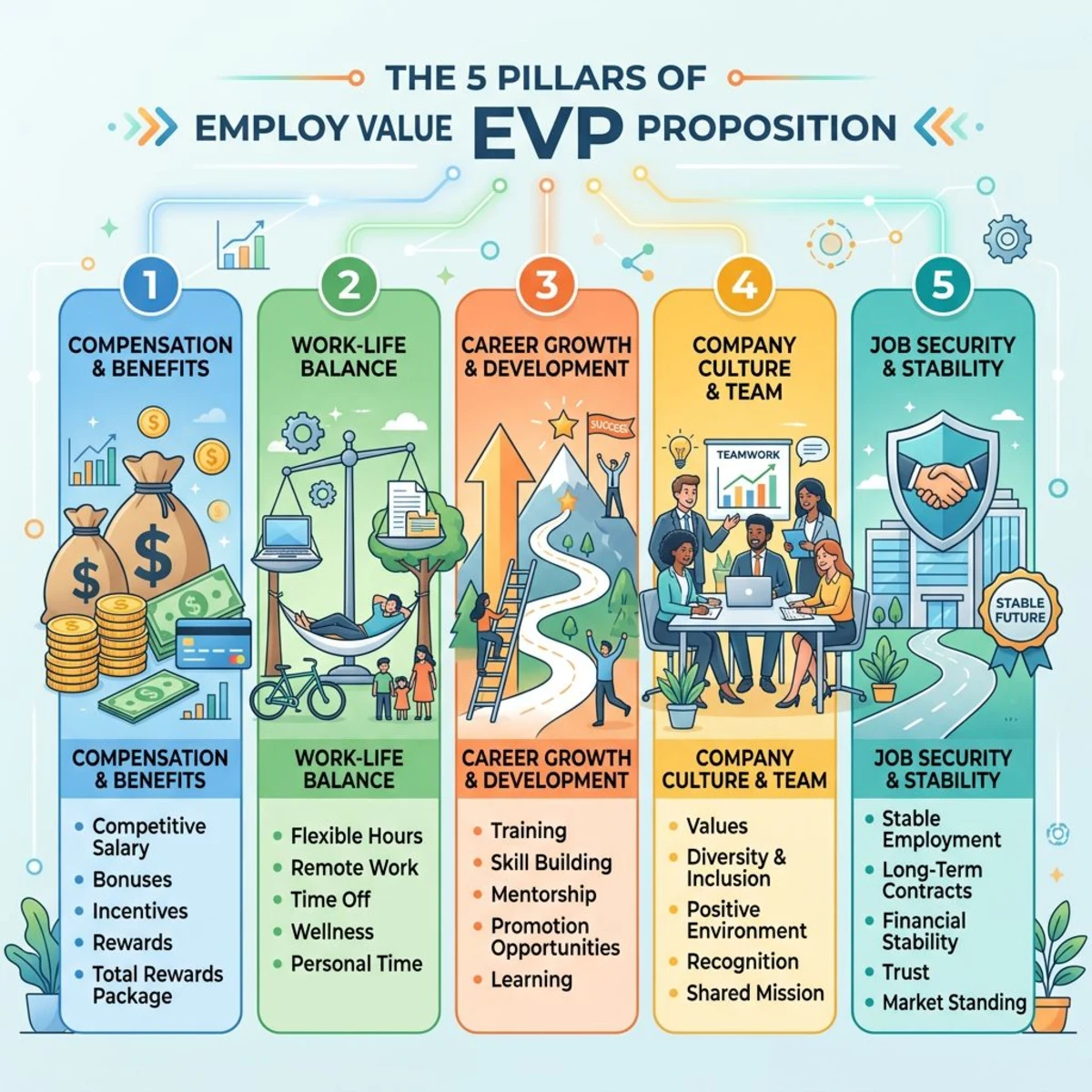
1. Compensation and Rewards
This includes base salary, bonuses, equity, and unique financial benefits. For small companies, compensation doesn't always mean the highest salary — it might mean profit-sharing, equity upside, or performance bonuses that larger companies can't match.
Small company advantages:
- Equity with real upside potential
- Performance bonuses tied directly to company success
- Flexible compensation structures (more equity vs. cash)
- Transparent pay policies without corporate bureaucracy
2. Work-Life Balance and Flexibility
Modern employees prioritize flexibility and autonomy. This pillar covers remote work options, flexible schedules, PTO policies, and respect for personal time.
Examples for small teams:
- Unlimited PTO with mandatory minimums
- Four-day work weeks or flexible daily schedules
- Remote-first policies with coworking stipends
- No-meeting days or quiet hours for deep work
3. Career Growth and Development
Employees want to see a clear path forward. This includes learning opportunities, mentorship, skill development, and advancement potential.
Small company advantages:
- Wearing multiple hats leads to diverse skill development
- Direct access to leadership and mentorship
- Rapid advancement opportunities due to company growth
- Budget for conferences, courses, or certifications
4. Company Culture and Values
This pillar encompasses your mission, values, team dynamics, and workplace environment. Culture is often a small company's strongest differentiator.
Cultural advantages of small teams:
- Every voice matters and contributes to decisions
- Strong sense of community and shared purpose
- Ability to pivot and experiment quickly
- Personal relationships with colleagues and leadership
5. Job Stability and Security
While small companies can't offer the same security as large corporations, they can provide different types of stability — like clear communication about company health, involvement in strategic decisions, and skill development that enhances employability.
Alternative stability approaches:
- Transparent financial health updates
- Diverse skill development reducing career risk
- Strong severance policies despite size constraints
- Open-book management and strategic involvement
How to Create Your EVP in 6 Steps
Building an authentic EVP requires honest self-assessment and employee input. Here's a systematic approach:
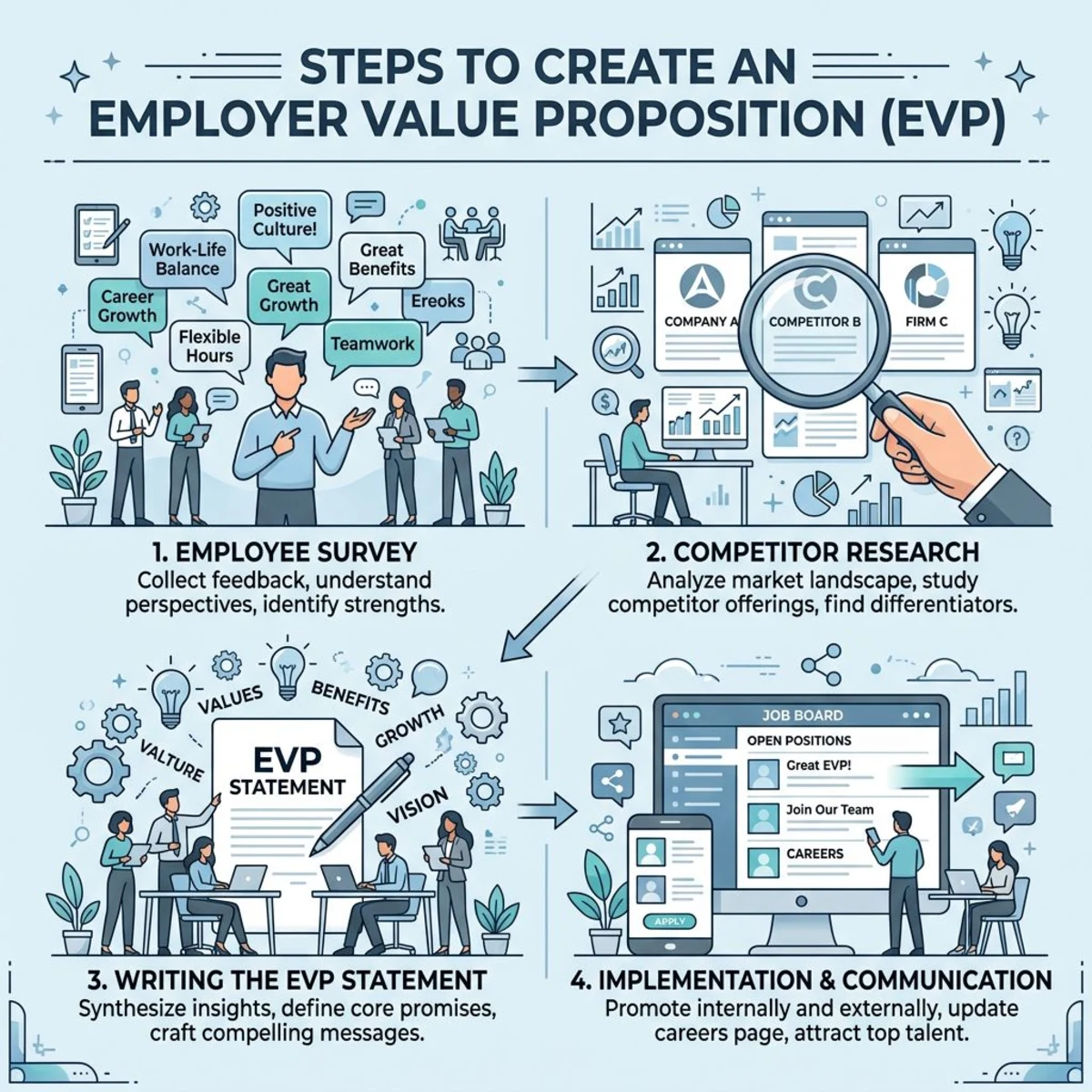
Step 1: Survey Current Employees
Start by understanding what your current team values about working for you. Send anonymous surveys asking:
- Why did you choose to work here?
- What keeps you here?
- What would you tell someone considering joining our team?
- How do we compare to your previous employers?
- What benefits or experiences matter most to you?
Look for patterns in responses. Often, what employees value most isn't what leadership thinks they value.
Step 2: Identify What Makes You Unique
Map out everything you offer employees, then identify what's unique or especially strong. Consider:
Tangible benefits:
- Compensation structure
- Health and wellness benefits
- Time off and flexibility policies
- Professional development budget
- Office environment or remote work setup
Intangible experiences:
- Company culture and values
- Growth and learning opportunities
- Autonomy and decision-making authority
- Mission and impact alignment
- Relationships with colleagues and leadership
Don't just list what you have — identify what makes these offerings different or better than competitors.
Step 3: Benchmark Against Competitors
Research what similar companies in your industry and market offer. Look at:
- Job postings and how they position opportunities
- Company websites and careers pages
- Employee review sites like Glassdoor
- Industry salary surveys and benefits benchmarks
Identify gaps where you exceed competition and areas where you need improvement.
Step 4: Write Your EVP Statement
Craft a clear, compelling statement that captures your unique value. Effective EVP statements are:
- Specific — Include concrete details, not generic benefits
- Authentic — Reflect your actual culture and offerings
- Differentiating — Highlight what makes you unique
- Employee-focused — Written from the employee's perspective
Example EVP statement:
"At [Company Name], you'll build skills across multiple disciplines while directly impacting our growth. You'll work closely with experienced founders, enjoy flexible schedules with four-day work weeks, and share in our success through meaningful equity. We're transparent about company performance and involve every team member in strategic decisions."
Step 5: Integrate Across Hiring Touchpoints
Your EVP should be consistent across every candidate interaction:
- Job descriptions — Lead with EVP elements, not just requirements
- Career page — Dedicate sections to each EVP pillar with specific examples
- Interview process — Train interviewers to discuss and demonstrate your EVP
- Offer letters — Reference your EVP and how the specific role delivers on it
- Onboarding — Reinforce EVP promises during the first-week experience
Consistency builds trust. If your job posting promises flexibility but your interview process is rigid and demanding, candidates will notice the disconnect.
Step 6: Measure and Refine
Track metrics that indicate EVP effectiveness:
- Quality of applicants — Are you attracting candidates who align with your values?
- Time to hire — Strong EVPs typically reduce time to hire for the right candidates
- Offer acceptance rates — Compelling EVPs improve acceptance rates
- Employee retention — Track retention rates, especially in the first year
- Employee satisfaction — Regular pulse surveys on job satisfaction and EVP delivery
Annually review your EVP based on company changes, market conditions, and employee feedback. Your EVP should evolve as your company grows.
Employee Value Proposition Examples (Small Companies)
Small companies have unique advantages in their EVP that larger corporations often can't match. Here's how successful growing companies leverage their size as a strength:
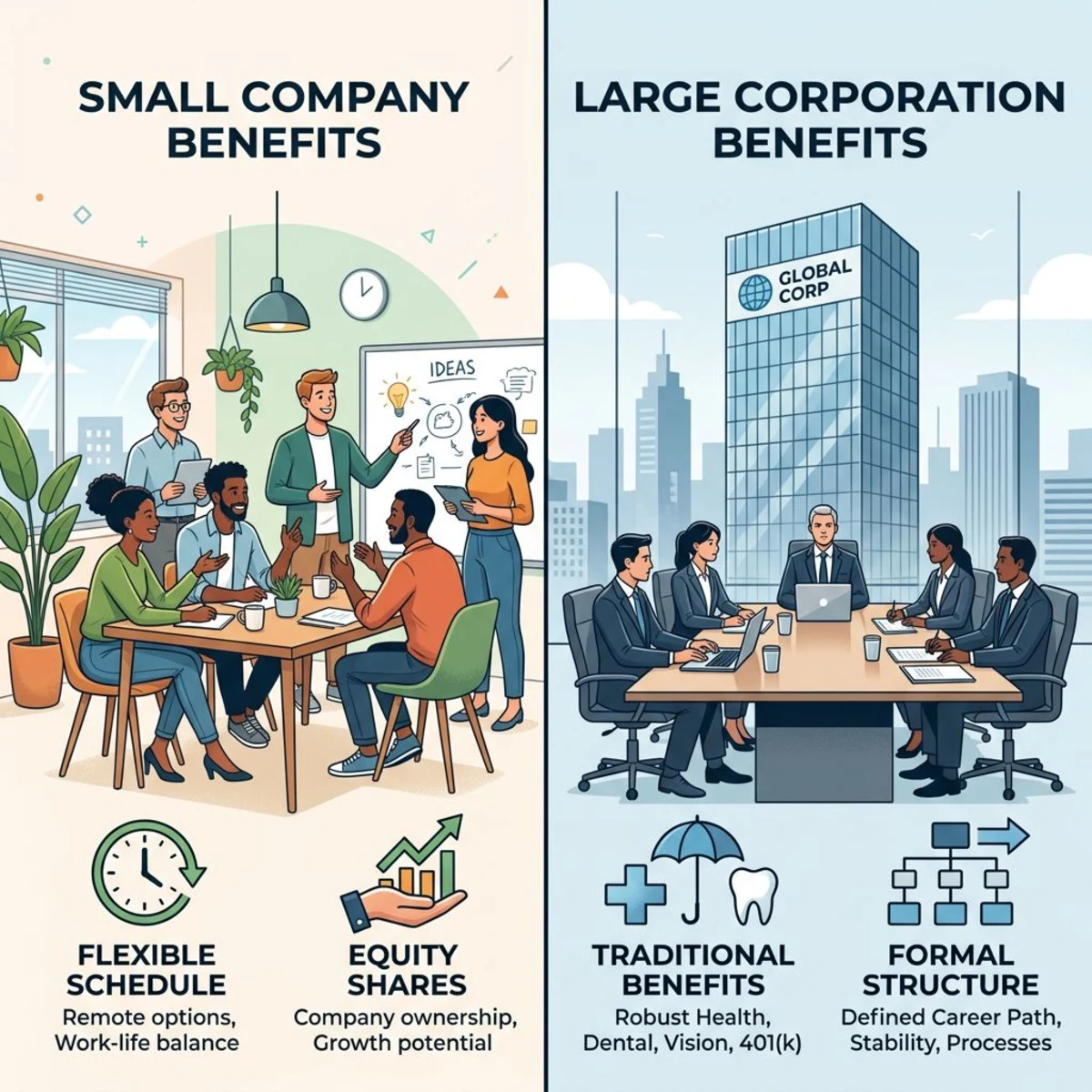
Here are real examples from successful small and growing companies:
GitLab (Remote-First Software Company)
EVP Focus: Radical transparency, remote work, and results-only culture
"Work from anywhere with a team that values results over hours. Access our public handbook, transparent compensation calculator, and contribute to open-source projects while building enterprise software used by millions of developers."
Key differentiators:
- 100% remote with co-working stipends
- Public salary calculator and transparent pay
- Open-source contribution time built into work schedules
- Comprehensive remote work equipment budget
Basecamp (Project Management Software)
EVP Focus: Work-life balance and sustainable business practices
"Join a profitable, bootstrapped company that prioritizes calm, sustainable work. Enjoy four-day summers, sabbaticals every three years, and work on products used by millions without the pressure of investor demands or exit timelines."
Key differentiators:
- Four-day work weeks during summer months
- Paid sabbaticals every three years
- No venture capital pressure or aggressive growth targets
- Focus on profitability and sustainability over rapid scaling
Zapier (Automation Software)
EVP Focus: Distributed work and personal growth
"Build the future of work automation while working completely remote. Take unlimited PTO with a $300 monthly bonus for taking time off, plus annual company retreats and a $2,000 annual budget for professional development."
Key differentiators:
- $300 monthly bonus for taking vacation days
- Annual company-wide retreats
- $2,000 per year professional development budget
- Completely distributed team with no headquarters
Small Agency Example
"At [Agency Name], you'll work directly with founders on diverse client challenges, gaining experience across industries most consultants never see. We offer profit-sharing bonuses, four-day work weeks, and cover 100% of your health insurance plus professional development."
Key differentiators:
- Direct access to company founders and leadership
- Diverse project work across multiple industries
- Profit-sharing tied to agency performance
- Four-day work weeks with full-time pay
Notice how each EVP is specific, authentic to the company's actual operations, and highlights genuine differentiators rather than generic benefits.
EVP Template: Fill-in-the-Blank Framework
Use this template to draft your own EVP statement:
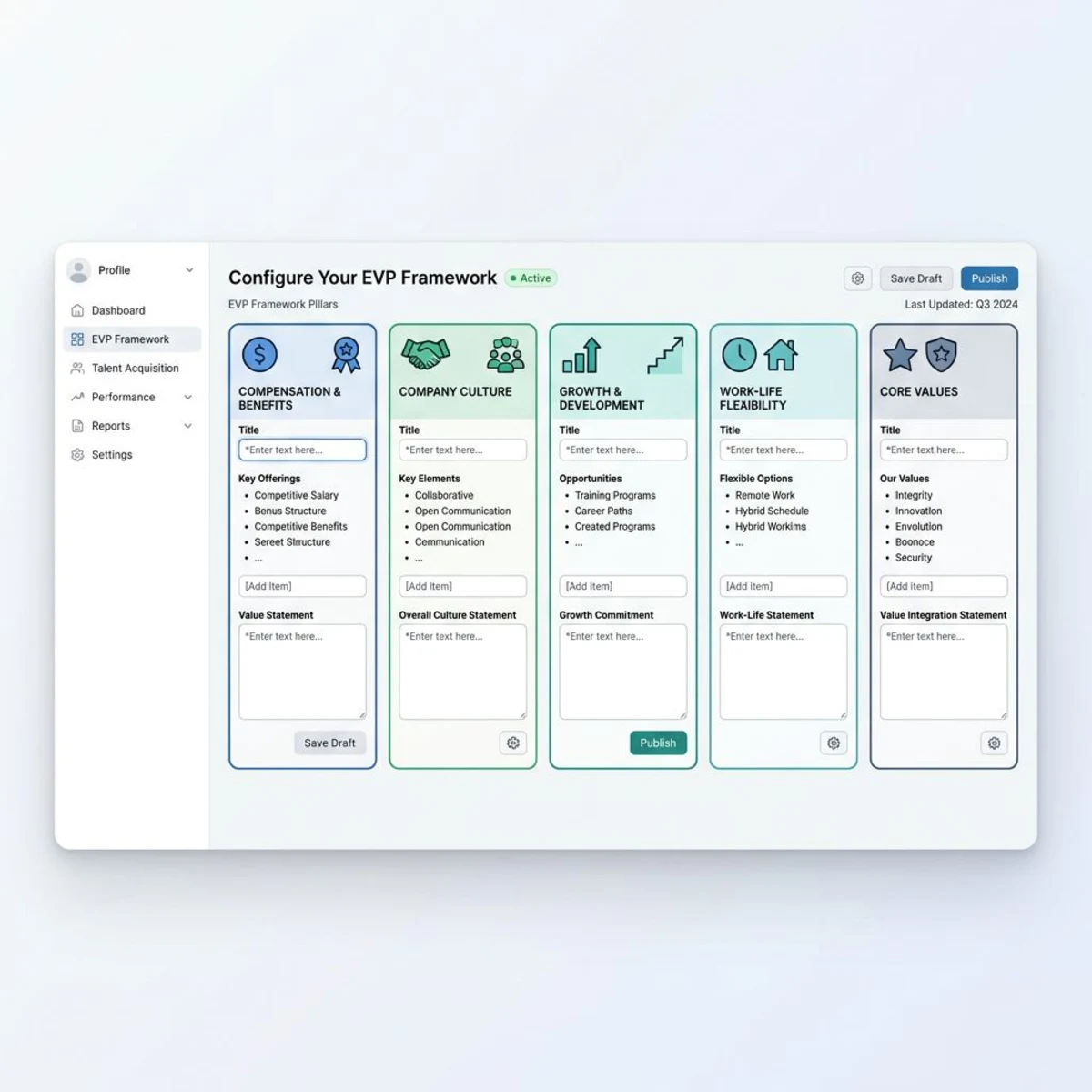
Basic Framework
"At [Company Name], you'll [unique work experience] while [career development opportunity]. We offer [specific flexibility/benefits] and [compensation differentiator]. Our [culture element] means [specific employee experience]."
Detailed Template
Opening Hook (What you do): "At [Company Name], you'll [work on specific projects/products] that [impact/reach/purpose]."
Growth & Learning: "You'll develop skills in [specific areas] while working directly with [level of leadership/expertise]."
Work Environment: "Our [remote/flexible/office] environment includes [specific policies] and [unique cultural elements]."
Compensation & Benefits: "We offer [specific compensation structure] plus [unique benefits] that [specific advantage]."
Company Mission/Impact: "Join us in [company mission] as we [specific business goals/impact]."
Example Using Template
"At TechStart, you'll build AI-powered healthcare tools that help patients access better care. You'll develop full-stack skills while working directly with our founding team of medical professionals and engineers. Our remote-first environment includes unlimited PTO with mandatory minimums and quarterly team retreats. We offer competitive salaries plus meaningful equity that shares in our success as we revolutionize patient care delivery."
When using this template, be specific. Instead of "competitive salary," specify "salaries benchmarked to top 25% of market plus equity." Instead of "great culture," describe "daily stand-ups, monthly all-hands, and no-meeting Fridays for focused work."
Implementation Best Practices
Start Internal First
Before promoting your EVP externally, ensure your current employees experience what you promise. Survey your team about whether they experience your stated EVP. Fix any gaps before launching external campaigns.
Make It Visual
Create infographics, videos, or interactive content that brings your EVP to life. Show real employees talking about their experience, not stock photos and generic testimonials.
Train Your Team
Everyone who interacts with candidates should understand and be able to articulate your EVP. This includes:
- Hiring managers and interviewers
- HR team members
- Current employees who might be references
- Leadership team members
Integrate with Onboarding
Your onboarding process should reinforce your EVP promises. If you promise mentorship, assign mentors during week one. If you promise flexibility, demonstrate it immediately.
Document Everything
Create a comprehensive EVP guide that includes:
- Your EVP statement and supporting messaging
- Specific examples and stories for each pillar
- Guidelines for consistent communication
- Metrics for measuring EVP effectiveness
Common EVP Mistakes to Avoid
Making unrealistic promises: Don't promise what you can't deliver consistently. One bad experience can destroy credibility.
Copying competitors: Your EVP should reflect your unique reality, not what works for other companies.
Being too generic: "Great culture" and "competitive benefits" don't differentiate you from anyone.
Ignoring employee input: Your EVP should reflect what employees actually value, not what leadership thinks they should value.
Set-and-forget mentality: EVPs need regular updates as your company, market, and workforce evolve.
Focusing only on benefits: EVP includes experience, culture, growth, and mission — not just perks and compensation.
Measuring EVP Success
Track these metrics to evaluate your EVP effectiveness:
Recruitment Metrics
- Application quality and cultural fit
- Time to hire for key positions
- Offer acceptance rates
- Cost per hire
- Referral rates from current employees
Retention Metrics
- Overall employee turnover rate
- First-year retention rates
- Exit interview themes
- Internal promotion rates
Engagement Metrics
- Employee Net Promoter Score (eNPS)
- Job satisfaction survey results
- Participation in company events and initiatives
- Performance review feedback on company culture
Brand Metrics
- Glassdoor ratings and reviews
- Social media mentions and sentiment
- Industry recognition and awards
- Unsolicited candidate applications
The most successful small companies typically see improvement in these metrics within 6-12 months of implementing a strong EVP strategy.
For tools to help build and manage your employer brand and hiring processes, consider platforms like Tiny Team that integrate people management with hiring workflows, making it easier to deliver on your EVP promises from day one.
Frequently Asked Questions
How often should we update our EVP?
Review your EVP annually and update it when there are significant changes to your business model, benefits, or company culture. Minor updates can happen quarterly based on employee feedback, but major overhauls should be less frequent to maintain consistency.
Can small companies compete with large corporate EVPs?
Absolutely. Small companies often have advantages large corporations can't match: direct leadership access, rapid advancement opportunities, meaningful equity, flexible policies, and strong team relationships. Focus on your unique strengths rather than trying to match corporate benefits.
Should our EVP be the same for all roles?
Your core EVP should be consistent across roles, but you can emphasize different aspects for different positions. Sales roles might highlight commission structures and growth opportunities, while engineering roles might emphasize technical challenges and learning opportunities.
How do we handle EVP promises during tough times?
Be transparent about temporary changes while reinforcing your long-term commitments. If you need to reduce benefits temporarily, explain the situation honestly and provide timelines for restoration. Maintain the cultural and growth elements of your EVP even during financial constraints.
What if our current reality doesn't match our desired EVP?
Start with an honest assessment of where you are today, then create a roadmap to close gaps. You might launch with a "Version 1" EVP that reflects your current reality while working toward your ideal. Avoid promising what you can't deliver in the short term.
How detailed should our EVP statement be?
Your primary EVP statement should be concise (2-3 sentences) but supported by detailed examples and specifics. Think of it like a tagline backed by comprehensive supporting materials that provide depth and evidence for each claim.