PTO accrual is a system where employees earn paid time off gradually over time, rather than receiving their entire annual allowance upfront. This approach helps businesses manage cash flow while ensuring employees build up vacation days, sick leave, and personal time proportional to their tenure and hours worked.
Understanding PTO accrual is crucial for small business owners navigating the complex landscape of employee benefits. According to the Bureau of Labor Statistics, 79% of private industry workers receive paid vacation time, with accrual-based systems being the most common method for distributing these benefits fairly and predictably.
For growing teams, PTO management is just one component of comprehensive HR software for small businesses. Effective time-off policies work best when integrated with broader employee management systems that handle everything from onboarding to performance reviews.
In this comprehensive guide, we'll walk through everything you need to know about PTO accrual: how it works, calculation methods, industry benchmarks, and best practices for implementation in your organization.
What Is PTO Accrual?
PTO accrual represents a systematic approach to earning time off that differs fundamentally from lump-sum allocation. Instead of granting employees their full annual vacation allowance on January 1st, accrual systems distribute time off proportionally based on time worked.
The core principle is simple: employees earn PTO based on their hours worked, pay periods completed, or months of service. A typical example might see an employee earning 1.25 vacation days per month of full-time work, accumulating 15 days over a full year.
This system serves multiple business purposes beyond simple accounting. Maria Santos, HR Director at a 45-person software company, explains the transition from lump-sum to accrual: "We switched after an employee took their entire vacation allotment in February and then quit in March. Accrual protects both the company and encourages employee retention."
Accrual vs. lump-sum comparison:
Accrual systems require employees to "earn" their time off, creating natural guardrails against abuse while ensuring new hires don't immediately access benefits they haven't yet worked for. Lump-sum systems, conversely, provide the full annual allotment immediately, which can create cash flow and retention challenges for employers.
The choice between systems often reflects company culture and industry norms. Startups and smaller companies frequently prefer accrual for cash flow management, while established enterprises might use lump-sum systems to simplify administration.
How PTO Accrual Works
The mechanics of PTO accrual follow straightforward mathematical principles, though implementation can vary significantly based on company policy and local regulations.
Basic accrual mechanics involve three core components: the accrual rate (how much PTO is earned per time period), the earning period (daily, weekly, bi-weekly, monthly), and any applicable caps or limits on accumulation.
Consider this real-world example from a mid-sized consulting firm: Full-time employees earn 0.0769 hours of PTO per hour worked, which equals approximately 20 days annually for a 2,080-hour work year (40 hours × 52 weeks). This hourly rate ensures part-time employees receive proportional benefits while maintaining fairness across the workforce.
Timing considerations play a crucial role in accrual systems. Some companies allow immediate PTO usage as it accrues, while others implement waiting periods. The Society for Human Resource Management (SHRM) reports that 65% of companies allow PTO usage as soon as it's earned, while 35% require waiting periods ranging from 30 to 90 days.
State law implications add complexity to accrual systems. California, for instance, treats accrued PTO as earned wages that must be paid out upon termination, as outlined by the Department of Labor. Meanwhile, states like Florida allow "use-it-or-lose-it" policies that reset unused PTO annually.
PTO Accrual Methods (With Formulas)
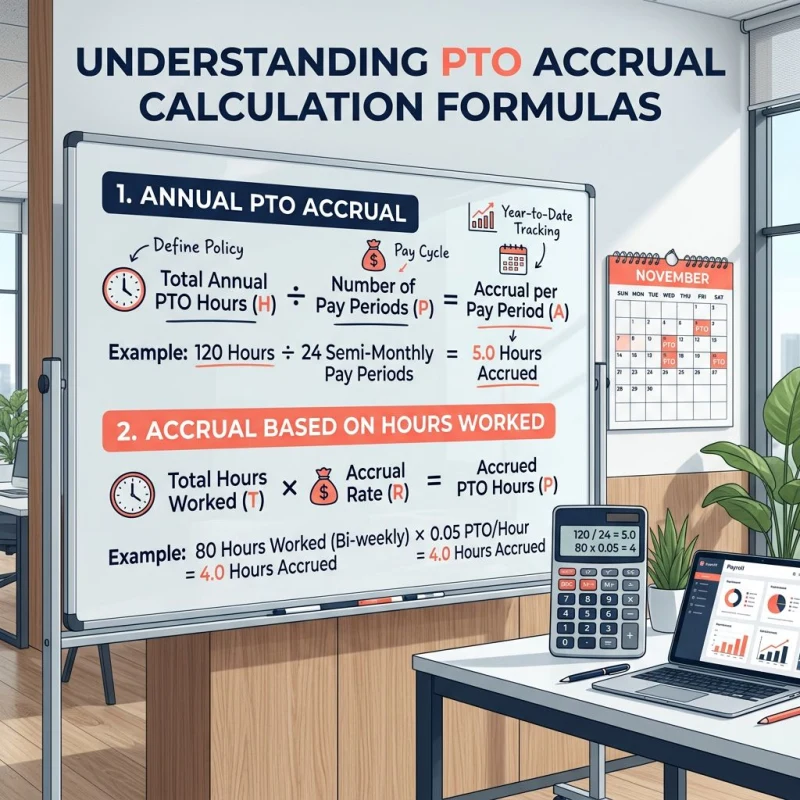
Different accrual methods suit different business models and administrative preferences. Here are the four most common approaches with precise formulas:
Per Pay Period Method
This method distributes PTO evenly across pay periods, creating predictable accrual patterns.
Formula: Annual PTO Days ÷ Number of Pay Periods = PTO Earned per Period
Example: 15 annual vacation days ÷ 26 bi-weekly pay periods = 0.577 days per pay period
Implementation: Employee earns 0.577 vacation days every two weeks, reaching 15 days after a full year of employment.
Hourly Accrual Method
The most precise method, particularly valuable for companies with varied schedules or part-time employees.
Formula: Annual PTO Hours ÷ Annual Work Hours = Accrual Rate per Hour
Example: 120 annual PTO hours ÷ 2,080 annual work hours = 0.0577 hours per hour worked
Implementation: Employee earns approximately 0.058 hours of PTO for every hour worked. A 40-hour week generates 2.31 PTO hours.
Monthly Accrual Method
Simplified administration with monthly PTO grants, popular among smaller organizations.
Formula: Annual PTO Days ÷ 12 Months = Monthly Accrual
Example: 18 annual vacation days ÷ 12 months = 1.5 days per month
Implementation: Employee receives 1.5 vacation days on the first of each month, contingent on active employment.
Annual Accrual Method
Front-loads the entire annual allowance, typically on the employee's anniversary date or calendar year start.
Formula: Full Annual Allowance = January 1st Grant (or Anniversary Date Grant)
Example: Employee receives 20 vacation days on January 1st, regardless of start date
Implementation: Simpler administration but requires prorating for mid-year hires and managing potential abuse.
How to Calculate PTO Accrual (Step by Step)
Let's work through detailed examples to illustrate practical PTO calculations:
Example 1: Full-Time Employee with 15 Annual Vacation Days
Given information:
- Annual vacation: 15 days
- Work schedule: Full-time (40 hours/week)
- Pay frequency: Bi-weekly
Step 1: Calculate accrual per pay period 15 vacation days ÷ 26 pay periods = 0.577 days per pay period
Step 2: Calculate accrual per hour worked 15 days × 8 hours per day = 120 annual PTO hours 120 PTO hours ÷ 2,080 annual work hours = 0.0577 hours per hour worked
Step 3: Track monthly accumulation After 6 months (13 pay periods): 13 × 0.577 = 7.5 days accrued After 9 months (19.5 pay periods): 19.5 × 0.577 = 11.25 days accrued
Example 2: Part-Time Employee (24 hours/week)
Given information:
- Pro-rated vacation based on full-time equivalent of 20 days
- Work schedule: 24 hours/week (60% of full-time)
- Pro-rated entitlement: 20 × 0.6 = 12 days annually
Calculation: 12 days × 8 hours per day = 96 annual PTO hours 96 PTO hours ÷ (24 hours/week × 52 weeks) = 96 ÷ 1,248 = 0.077 hours per hour worked
Practical result: Part-time employee earns 1.85 PTO hours per week
Example 3: Mid-Year Hire (Starting July 1st)
Given information:
- Annual entitlement: 18 vacation days
- Start date: July 1st (6 months remaining in year)
- Pro-rated calculation needed
Calculation: 18 annual days ÷ 12 months × 6 remaining months = 9 days for remainder of year Monthly accrual rate: 9 days ÷ 6 months = 1.5 days per month
Implementation: Employee earns 1.5 vacation days per month starting July 1st
PTO Accrual Rates by Industry
Industry benchmarks provide valuable context for establishing competitive PTO policies. Based on 2024 data from the Bureau of Labor Statistics and private compensation surveys:
Technology Sector
- Average annual PTO: 22-25 days
- Typical accrual rate: 1.83-2.08 days per month
- Additional notes: Often includes separate sick leave and personal days
- Startup variation: 15-20 days (higher equity compensation trades off with time)
Healthcare Industry
- Average annual PTO: 18-22 days
- Typical accrual rate: 1.5-1.83 days per month
- Additional notes: Strict scheduling requirements often limit flexible usage
- Nursing variation: Higher rates due to burnout prevention needs
Financial Services
- Average annual PTO: 20-24 days
- Typical accrual rate: 1.67-2.0 days per month
- Additional notes: Often includes additional personal/mental health days
- Executive level: Can reach 25-30 days annually
Manufacturing/Retail
- Average annual PTO: 10-15 days
- Typical accrual rate: 0.83-1.25 days per month
- Additional notes: Lower rates offset by predictable schedules
- Union environments: Rates determined by collective bargaining agreements
Regional variations also influence these benchmarks. West Coast companies typically offer 15-20% more PTO than national averages, while European-style policies (25+ days) are becoming more common among competitive employers.
PTO Accrual Policy Best Practices
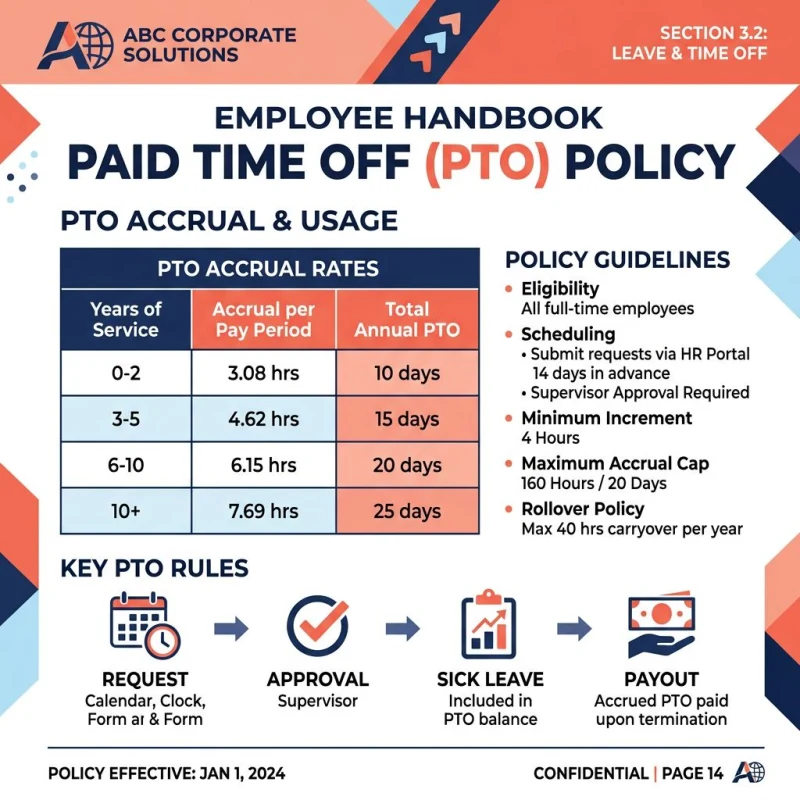
Crafting effective PTO accrual policies requires balancing employee satisfaction with operational needs and legal compliance.
Establish clear accrual caps: Most companies implement maximum accrual limits to prevent excessive accumulation. Common approaches include:
- Rolling caps: Employees can accrue up to 1.5-2x their annual allowance
- Annual caps: Accrual stops at the yearly maximum, resuming January 1st
- Use-or-lose provisions: Unused PTO expires annually (where legally permitted)
Rachel Kim, who manages HR for a 75-person marketing agency, shares their approach: "We cap accrual at 240 hours (30 days) and send quarterly reminders when employees approach the limit. It encourages time off while preventing administrative headaches."
Implement carryover rules strategically: Rather than all-or-nothing approaches, consider graduated carryover policies:
- Years 1-2: Carry over up to 5 days
- Years 3-5: Carry over up to 8 days
- Years 5+: Carry over up to 10 days
Address termination payouts clearly: Policy language should specify whether accrued PTO is paid upon termination, resignation, or termination for cause. This varies significantly by state law and should be reviewed with employment counsel.
Consider frontloading for retention: Some companies provide a portion of annual PTO upfront (5-10 days) with the remainder accruing normally. This approach demonstrates trust while maintaining accrual benefits.
Common PTO Accrual Mistakes to Avoid
Even well-intentioned PTO policies can create legal and administrative problems without careful planning.
Ignoring state and local regulations: PTO laws vary dramatically by jurisdiction. California treats accrued PTO as earned wages that must be paid out, while other states allow forfeiture. Montana requires specific language for use-or-lose policies, and several cities have mandatory sick leave requirements that affect PTO calculations.
Setting unrealistic accrual caps: Caps that are too low frustrate employees and may violate state regulations. Too high, and companies face significant financial liability. The sweet spot typically falls between 1.5-2x annual accrual amounts.
Manual tracking errors: Spreadsheet-based PTO tracking creates multiple failure points. Common issues include:
- Forgotten accrual calculations during pay periods
- Miscalculating proration for part-time employees
- Failing to account for unpaid leave periods
- Inconsistent application of company policies
Inadequate communication: Employees need clear understanding of how accrual works. Create simple documentation explaining:
- When PTO begins accruing (immediate vs. waiting period)
- How the accrual rate is calculated
- Any caps or limitations
- Carryover and forfeiture rules
Mixing PTO types incorrectly: Companies offering separate vacation, sick, and personal time need distinct accrual rules for each category. Conflating different time-off types can create compliance issues and employee confusion.
How to Track PTO Accrual Automatically

Modern PTO tracking has evolved far beyond manual spreadsheets, offering automated solutions that ensure accuracy while reducing administrative burden.
Spreadsheet limitations become apparent quickly for growing teams. While a simple Excel template might work for 5-10 employees, manual calculation errors, version control issues, and time-intensive updates make spreadsheets impractical for larger organizations.
Software-based solutions offer several compelling advantages:
- Automated calculations: Software handles complex accrual formulas, proration, and state-specific requirements automatically
- Employee self-service: Team members can view balances, request time off, and track accrual progress without HR intervention
- Integration capabilities: Modern platforms connect with payroll, calendar, and project management tools
- Compliance support: Built-in features for state regulations, reporting, and audit trails
Features to prioritize when evaluating PTO tracking software:
Real-time balance updates: Employees and managers see current accrual balances instantly, reducing back-and-forth communication about available time off.
Approval workflows: Customizable approval chains ensure proper authorization while maintaining visibility into team availability.
Calendar integration: Two-way sync with popular calendar applications prevents scheduling conflicts and improves team coordination.
Reporting capabilities: Generate insights on PTO usage patterns, accrual liabilities, and policy effectiveness.

For small teams seeking an integrated solution, Tiny Team's Team Calendar combines PTO accrual tracking with broader HR management. Rather than managing separate systems for time off, employee data, and team coordination, integrated platforms streamline administration while ensuring consistency across people management functions.
The transition to automated tracking typically pays for itself within 3-6 months through reduced administrative time and fewer calculation errors. Sarah Chen, operations manager at a 40-person consulting firm, notes: "We were spending 8-10 hours monthly on PTO administration. Automated tracking cut that to maybe 30 minutes of oversight."
State-Specific PTO Accrual Considerations
PTO accrual policies must account for varying state regulations that can significantly impact implementation and costs.
"Earned wage" states like California, Colorado, and Montana treat accrued PTO as earned compensation that cannot be forfeited. This means:
- Accrued PTO must be paid upon termination
- "Use-it-or-lose-it" policies are prohibited
- Accrual caps must be reasonable and applied consistently
"At-will" states may allow more flexibility in PTO forfeiture, but specific language requirements often apply. Even in permissive jurisdictions, employee relations benefits from generous policies.
Local mandates add another layer of complexity. Cities like San Francisco, Seattle, and New York have mandatory sick leave requirements that may affect overall PTO calculations. Some jurisdictions require separate sick leave accrual in addition to general PTO.
For multi-state employers, the safest approach often involves adopting the most employee-friendly policy across all locations to ensure compliance and maintain consistency.
Frequently Asked Questions
How does PTO accrual work for new employees?
PTO accrual for new employees typically begins immediately upon hire, though some companies implement waiting periods of 30-90 days before accrual starts. The specific timing should be clearly outlined in the employee handbook. For mid-year hires, annual PTO allowances are usually prorated based on their start date, ensuring fair treatment regardless of when someone joins the team.
What's the difference between accruing PTO and getting it all at once?
Accrual systems distribute PTO gradually over time (e.g., earning 1.25 days per month), while lump-sum systems provide the entire annual allowance immediately (typically on January 1st or the employee's anniversary date). Accrual systems protect employers from employees taking extended time off early in the year and then leaving, while lump-sum systems simplify administration but create potential cash flow and retention risks.
Can employers set limits on how much PTO employees can accrue?
Yes, most employers implement accrual caps to prevent excessive accumulation. Common limits range from 1.5 to 2 times the annual PTO allowance. However, state laws vary significantly - some states require payout of accrued time regardless of caps, while others allow "use-it-or-lose-it" policies. Check your local regulations before implementing accrual limits.
How should part-time employees accrue PTO?
Part-time employees typically accrue PTO proportionally based on their scheduled hours compared to full-time equivalents. For example, an employee working 20 hours per week (50% of full-time) would earn 50% of the standard PTO accrual rate. The calculation should be clearly defined in policy documents and applied consistently across all part-time staff.
What happens to accrued PTO when an employee is terminated?
This depends on state law and company policy. Some states require payout of all accrued PTO upon termination, while others allow forfeiture under specific circumstances. Many companies choose to pay out accrued PTO regardless of legal requirements to maintain positive employee relations and avoid potential legal challenges.
How often should PTO accrual be calculated and updated?
Most companies calculate PTO accrual with each pay period to ensure accuracy and provide employees with current balances. Automated systems can perform these calculations instantly, while manual tracking should occur at least monthly. Real-time tracking helps employees plan time off effectively and reduces administrative confusion.
Implementing an effective PTO accrual system requires careful consideration of legal requirements, industry standards, and your company's specific needs. While the initial setup may seem complex, automated tracking solutions can simplify ongoing administration while ensuring accuracy and compliance. Remember that generous, clearly communicated PTO policies serve as valuable recruitment and retention tools that often pay for themselves through improved employee satisfaction and reduced turnover.
As your organization matures, you'll likely want to complement PTO accrual with other essential HR processes like structured performance review cycles and comprehensive employee onboarding programs to create a complete people management framework.