Employee feedback tools help teams collect, organize, and act on feedback from their workforce through surveys, pulse checks, 360 reviews, and ongoing performance conversations. These platforms turn informal feedback into structured data that drives better management decisions and stronger team culture.
For small teams (5-100 employees), the right feedback tool provides valuable insights without the complexity of enterprise software. We tested over 15 platforms to find the best options that balance functionality, ease of use, and reasonable pricing for growing teams.
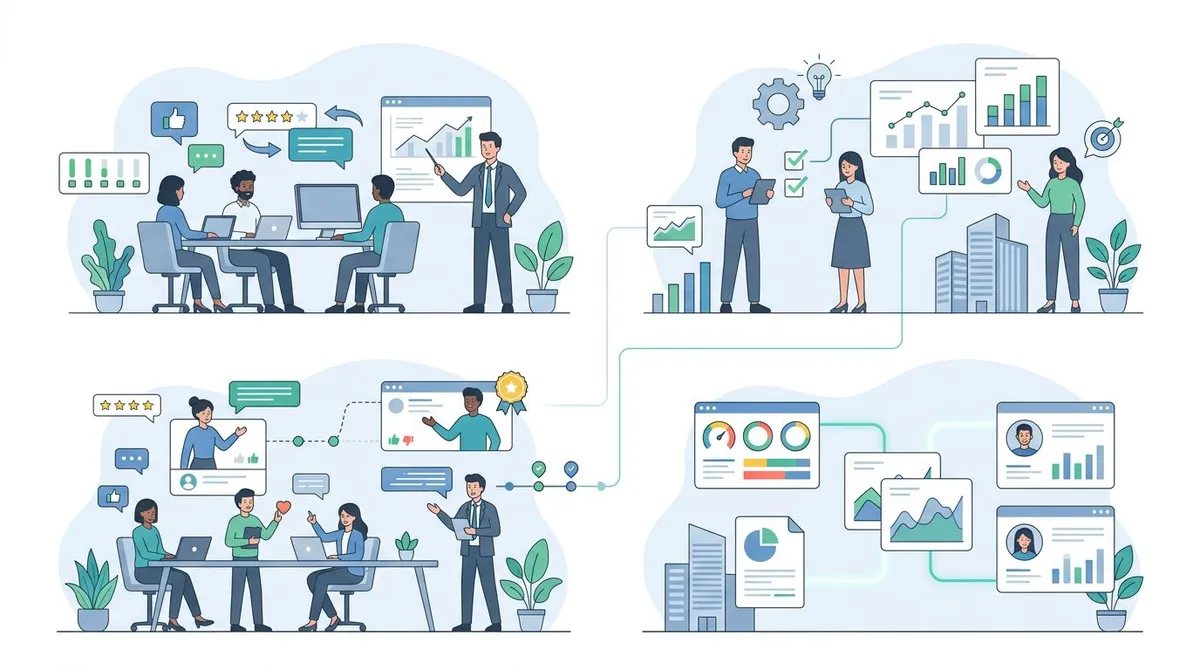
Best Employee Feedback Tools at a Glance
| Tool | Best For | Starting Price | Annual Cost (20 people) | Key Features |
|---|---|---|---|---|
| Culture Amp | Data-driven insights | $4/employee/mo | $960/year | Analytics, benchmarks, pulse surveys |
| 15Five | Weekly check-ins | $4/user/mo | $960/year | OKRs, 1-on-1s, continuous feedback |
| Lattice | Performance + feedback | $11/user/mo | $2,640/year | 360 reviews, goals, career development |
| Officevibe | Team pulse surveys | $3.50/user/mo | $840/year | Real-time feedback, manager insights |
| Leapsome | All-in-one performance | €8/user/mo | ~$2,080/year | 360s, OKRs, learning management |
| SurveyMonkey | Survey flexibility | $25/mo | $300/year | Custom surveys, advanced analytics |
| Tiny Team | Small team HR | Free up to 10 · $79/mo up to 50 | $948/year | Built-in feedback + full HR platform |
| Deel Engage | Global teams | $4/employee/mo | $960/year | Multi-language, compliance features |
| BambooHR | HR suite + feedback | $13/employee/mo | $3,120/year | HRIS integration, eSignatures |
| Small Improvements | Simple 360s | $3/user/mo | $720/year | Easy setup, manager coaching |
Why Small Teams Need Feedback Software
Regular feedback drives employee engagement, but most small teams struggle with consistency. Without a structured approach, feedback becomes sporadic — limited to annual reviews or when problems arise.
Research from Gallup shows that employees who receive weekly feedback are 2.7 times more likely to be engaged at work. For small teams where each person's contribution matters significantly, this engagement directly impacts business results.
Feedback tools solve three common problems for growing teams:
Consistency: Automated reminders ensure feedback happens regularly rather than sporadically.
Documentation: Conversations create paper trails for performance reviews and development planning.
Insights: Anonymous surveys reveal issues that might not surface in direct conversations, especially around management or culture.

How We Evaluated These Tools
We tested each platform based on criteria that matter most to small teams:
Ease of Setup: Can HR or founders implement without IT support? We prioritized simple onboarding and intuitive interfaces.
Pricing Transparency: Many enterprise tools hide pricing behind "contact sales." We focused on platforms with clear, published rates and calculated actual annual costs for a 20-person team.
Feature Balance: Small teams need core functionality without enterprise bloat. We looked for tools that cover essential feedback types without overwhelming complexity.
Integration Capabilities: Does it work with HR systems, Slack, or Google Workspace? Standalone tools requiring context-switching lose adoption quickly.
Support Quality: Small teams often lack dedicated HR staff. We tested customer support responsiveness and self-help resources.
Detailed Reviews: Top 10 Employee Feedback Tools
1. Culture Amp — Best for Data-Driven Insights
Culture Amp specializes in employee engagement analytics with robust benchmarking against industry standards. Their platform transforms feedback into actionable insights through heat maps, trend analysis, and predictive recommendations.
What sets Culture Amp apart is its research-backed approach. Survey questions are validated against organizational psychology research, and results compare against thousands of companies in their database. This benchmarking helps small teams understand if their engagement scores are actually good or just feel good.
The platform includes pulse surveys, annual engagement surveys, exit interviews, and 360 feedback. The analytics dashboard shows engagement trends, identifies flight risks, and recommends specific interventions.
Pricing: $4/employee/month with annual billing. No free trial, but offers demos.
Best for: Teams with dedicated HR staff who want deep analytics and benchmarking.
Drawbacks: Complex setup and high learning curve. Analytics can overwhelm teams new to feedback programs.
2. 15Five — Best for Weekly Check-ins
15Five built their platform around a simple concept: employees spend 15 minutes each week answering questions, managers review responses in 5 minutes. This cadence creates consistent communication between weekly meetings.
Beyond basic check-ins, 15Five includes OKR tracking, peer recognition, and 1-on-1 meeting templates. The platform encourages continuous feedback rather than quarterly surveys, which research shows drives better outcomes.
A standout feature is their "High Fives" system for peer recognition. Team members can celebrate wins publicly, creating positive momentum that counterbalances the feedback-heavy environment.
Pricing: Starts at $4/user/month (Engage plan) with a 14-day free trial.
Best for: Teams wanting to establish regular feedback rhythms with minimal time investment.
Drawbacks: Limited analytics compared to specialized tools. Can feel repetitive if not customized properly.
3. Lattice — Best for Performance + Feedback
Lattice combines performance management with continuous feedback in a single platform. It's designed for companies that want formal review cycles plus ongoing conversations between reviews.
The 360 feedback module allows custom question sets for different roles and seniority levels. Managers can request specific feedback on projects, while executives might focus on leadership effectiveness. The platform aggregates responses and highlights themes automatically.
Slack integration enables lightweight feedback through reactions while formal reviews happen in the full platform.
Pricing: Performance plan starts at $11/user/month annually. Includes performance reviews, goal setting, and basic feedback tools.
Best for: Companies with established performance review processes looking to add continuous feedback.
Drawbacks: Expensive for basic feedback needs. Feature depth can overwhelm smaller teams.

4. Officevibe — Best for Team Pulse Surveys
Officevibe (now part of Workleap) focuses specifically on pulse surveys and team engagement measurement. Their approach emphasizes quick, frequent surveys over comprehensive annual assessments.
The platform sends automated weekly pulse questions covering different aspects of engagement: management quality, workload, company direction, and peer relationships. Employees answer 2-3 questions weekly, maintaining high response rates through brevity.
Manager dashboards provide real-time team health scores with specific recommendations. If engagement drops in a particular area, the platform suggests conversation starters and improvement resources.
Pricing: $3.50/employee/month with annual commitment. 21-day free trial available.
Best for: Managers who want regular team temperature checks without complex analytics.
Drawbacks: Limited to pulse surveys — no 360 feedback or performance review features.
5. Leapsome — Best for All-in-One Performance
Leapsome provides comprehensive performance management including 360 feedback, goal tracking, and learning management. It's designed for European companies but serves global teams effectively.
The platform's strength lies in connecting feedback to development actions. After 360 reviews, employees can automatically enroll in relevant learning modules or set development goals. This closes the loop between feedback collection and improvement.
Custom review cycles accommodate different team needs. Sales teams might need quarterly feedback aligned with targets, while product teams prefer continuous feedback tied to sprint cycles.
Pricing: Starts at €8/user/month (~$8.75 USD) for the performance module. Learning features cost extra.
Best for: European companies or those wanting integrated performance and development.
Drawbacks: Euro-centric features and compliance may be overkill for US small teams.
6. SurveyMonkey — Best for Survey Flexibility
While not exclusively an HR tool, SurveyMonkey's employee feedback templates and advanced analytics make it viable for teams wanting maximum survey customization.
The platform includes pre-built templates for employee satisfaction, exit interviews, 360 feedback, and pulse surveys. Advanced logic allows complex survey flows — different questions based on previous answers or employee attributes.
Integration capabilities are extensive. Results can flow into Slack, email specific managers based on scores, or trigger workflows in other platforms. For teams with technical resources, this flexibility is powerful.
Pricing: Team plan at $25/month supports unlimited surveys and 3 users. No per-employee fees.
Best for: Teams wanting complete survey control without per-employee pricing.
Drawbacks: Requires manual setup and maintenance. No pre-built HR workflows or analytics.
7. Tiny Team — Best for Small Team HR
Tiny Team takes a different approach by including feedback tools within a comprehensive HR platform designed specifically for small teams (5-100 employees).
The performance review feature includes 360 feedback capabilities alongside goal setting and development planning. Since employee data is already in the system through people management, feedback connects directly to performance history and career progression.
Unlike per-seat pricing that grows with your team, Tiny Team is free for teams up to 10 people (every feature, no credit card) and a flat $79/month for teams up to 50 — one paid plan, all features, not per-seat. This makes it dramatically more affordable than specialized feedback tools as teams grow.
Pricing: Free for up to 10 people, or a flat $79/month for up to 50 people (~$948/year). The paid plan includes a 30-day free trial (credit card required); the free plan needs no card.
Best for: Small teams wanting feedback tools integrated with full HR management.
Drawbacks: Less specialized than dedicated feedback platforms. Newer product with fewer integrations.
8. Deel Engage — Best for Global Teams
Deel Engage (formerly Hofy) provides employee feedback tools designed for distributed, international teams. The platform handles multi-language surveys, timezone-aware scheduling, and regional compliance requirements.
Features include pulse surveys, eNPS tracking, 360 feedback, and exit interviews. The global dashboard shows engagement patterns across countries and time zones, helping identify region-specific issues.
Integration with Deel's broader HR platform provides context around local labor laws, cultural norms, and compensation benchmarks — valuable for teams managing international employees.
Pricing: $4/employee/month as part of Deel's HR suite. Standalone pricing available on request.
Best for: Companies with employees across multiple countries and time zones.
Drawbacks: Overkill for US-only teams. Requires broader Deel platform for full value.
9. BambooHR — Best for HR Suite + Feedback
BambooHR includes feedback tools within their comprehensive HRIS platform. Since employee data, performance history, and feedback live in one system, managers get complete context for development conversations.
The platform supports custom feedback forms, 360 reviews, and goal tracking. Automated workflows can trigger feedback requests based on tenure milestones, project completions, or review cycles.
Reporting capabilities show feedback trends alongside other HR metrics like turnover, promotion rates, and engagement scores. This holistic view helps identify patterns between feedback quality and retention.
Pricing: Starts around $13/employee/month for the full HRIS platform including feedback tools.
Best for: Teams already using or planning to implement a full HRIS system.
Drawbacks: Expensive if you only need feedback tools. Complex setup requires HR expertise.
10. Small Improvements — Best for Simple 360s
Small Improvements focuses specifically on 360-degree feedback and manager coaching. Their approach emphasizes simplicity — straightforward setup, clear reports, and actionable recommendations.
The platform includes feedback request workflows, anonymous response collection, and automated report generation. Managers receive coaching tips based on specific feedback themes, helping translate insights into behavior changes.
Custom question libraries accommodate different roles and review purposes. The platform suggests research-backed questions while allowing complete customization for company-specific needs.
Pricing: $3/user/month with annual billing. Free trial available.
Best for: Teams wanting simple, effective 360 feedback without complex features.
Drawbacks: Limited to 360 feedback — no pulse surveys or broader engagement measurement.
Types of Employee Feedback for Small Teams
Understanding different feedback types helps choose the right tool and implementation strategy:
360-Degree Feedback collects input from supervisors, peers, and direct reports — often paired with self-evaluations. Most valuable for leadership development and promotion decisions. Best frequency: annually or biannually.
Pulse Surveys ask 2-5 quick questions weekly or monthly to gauge team sentiment, similar to an employee engagement survey. Perfect for identifying emerging issues before they impact performance. Tools like Officevibe specialize in this approach.
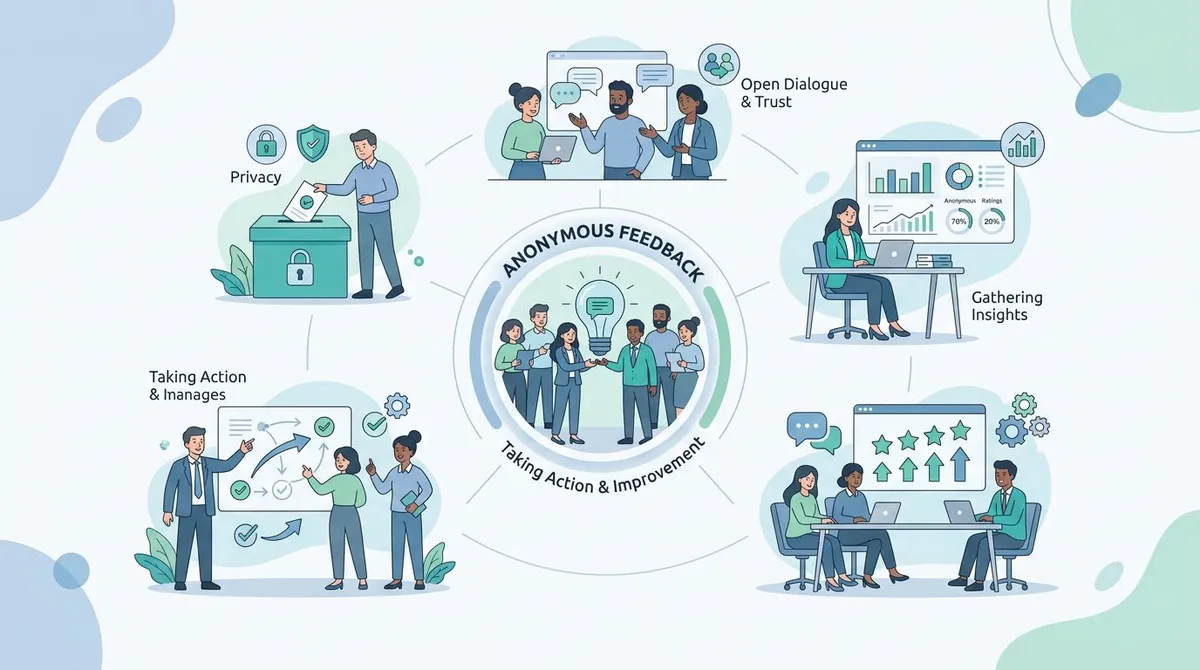
Anonymous Feedback provides safe channels for sensitive topics like management quality or workplace culture. Essential for honest feedback in small teams where everyone knows each other.
Continuous Feedback happens through informal conversations, Slack reactions, or brief weekly check-ins. Platforms like 15Five excel at making this systematic rather than sporadic.
According to Harvard Business Review research, the most effective feedback combines frequent recognition (what's working) with specific development suggestions (what could improve). Tools that balance both approaches see higher adoption rates.

How to Choose the Right Feedback Tool
Your team size and maturity level determine which features matter most:
5-15 employees: Start simple with tools like Small Improvements or the basic tier of 15Five. Focus on establishing feedback habits rather than complex analytics. Since everyone knows each other, anonymous channels become crucial for honest input.
16-50 employees: Consider platforms with manager dashboards and trend analysis like Officevibe or Culture Amp. You'll have enough data for meaningful insights, and managers need tools to track multiple team members effectively.
51-100 employees: Invest in comprehensive platforms like Lattice or Leapsome that connect feedback to performance management and development planning. Integration with HRIS becomes valuable for compliance and record-keeping.
Consider these decision factors:
| Factor | Questions to Ask |
|---|---|
| Budget | Can you afford per-seat pricing as you grow? Calculate 2-3 year costs. |
| Current HR Tools | Does your HRIS include feedback features? Would integration save money? |
| Management Maturity | Are managers trained in giving feedback? Some tools include coaching resources. |
| Team Distribution | Remote teams benefit from structured feedback more than co-located teams. |
| Compliance Needs | Do you need documentation for performance improvement or termination processes? |
The Society for Human Resource Management recommends starting with basic pulse surveys and adding complexity as feedback processes mature. Over-engineering early feedback programs leads to poor adoption.
Implementation Best Practices for Small Teams
Successful feedback programs require more than just software — they need cultural commitment and clear processes.
Start with Manager Training: Even the best feedback tools fail if managers don't know how to act on insights. Invest in coaching before rolling out software. Many employees cite poor manager response as the top reason feedback programs fail.
Set Response Expectations: Anonymous feedback creates expectations for action. If you collect input about workload but can't address staffing, explain the constraints rather than ignoring feedback. Transparency builds trust even when problems can't be immediately solved.
Mix Feedback Types: Combine anonymous surveys for sensitive topics with named feedback for development conversations. Anonymous input identifies problems; named feedback drives individual improvement.
Close the Loop: Share survey results and planned actions with the entire team. Employees stop participating if feedback disappears into a void. Even small changes deserve recognition.
Measure What Matters: Track feedback program effectiveness through response rates and subsequent engagement scores rather than just satisfaction ratings. High satisfaction without behavior change indicates a broken feedback loop.
A 45-person software company started with monthly pulse surveys, added quarterly 360 reviews after six months, then integrated into BambooHR at 50 employees. This gradual approach maintained adoption while building competency.
Check existing HR platform capabilities before buying standalone tools. Many platforms include unused feedback features that meet current needs.
Frequently Asked Questions
What's the difference between employee feedback tools and HR software?
Employee feedback tools focus specifically on collecting and analyzing feedback through surveys, pulse checks, and 360 reviews. HR software provides broader functionality including payroll, time-off tracking, and employee records — many include basic feedback features. For small teams, all-in-one HR platforms often provide sufficient feedback capabilities at better value than standalone tools.
How much should small teams spend on feedback software?
Budget $3-15 per employee monthly for dedicated feedback tools, or consider feedback features within existing HR platforms. Calculate total annual costs including setup, training, and administration time. Tools with flat-rate pricing become more economical as teams grow beyond 20-30 employees.
How often should we collect employee feedback?
Start with monthly pulse surveys (2-3 questions) and quarterly deeper surveys (10-15 questions). Annual comprehensive surveys work for performance reviews, but quarterly or monthly input helps identify issues before they impact retention. Weekly check-ins work well for project-based teams but can create survey fatigue in stable environments.
Do we need anonymous feedback in a small team?
Yes, especially in teams under 20 people where everyone knows each other. Anonymous channels allow honest feedback about management, compensation, or team dynamics that employees might not share directly. Combine anonymous surveys for sensitive topics with named feedback for individual development.
Can we use free tools for employee feedback?
Google Forms or SurveyMonkey's free tier can handle basic pulse surveys, but lack analytics, automated workflows, and integration capabilities. For teams under 10 people, free tools plus manual follow-up might suffice. Growing teams benefit from dedicated platforms that automate reminders and consolidate responses.
What if employees don't respond to feedback requests?
Low response rates usually indicate poor communication about purpose and follow-up. Explain how feedback creates positive changes and share previous improvements driven by employee input. Anonymous surveys typically see higher participation than named feedback. Consider survey fatigue if you're asking too frequently or requesting too much time investment.
Successful employee feedback requires consistent collection, transparent communication, and demonstrated action on insights. Choose a platform that fits your team's size and budget, then focus on building feedback habits that drive workplace improvement.