Paycor pricing is quote-based, but third-party benchmarks put it at roughly $19 to $27 per employee per month (PEPM) for mid-market teams, with small-business bundles that historically started near $99 per month plus a per-employee fee. On top of that, you should budget a one-time implementation fee of about 10 to 20% of your annual software spend. This guide breaks down what Paycor actually costs, what each bundle includes, and where the hidden fees hide.
It's also a full Paycor review: the features, the real pros and cons, who it fits, and the cheaper alternatives for teams that don't need heavy payroll machinery. If you're a founder pricing out your first HR system, the math at the end matters more than the brochure.
How Paycor pricing works
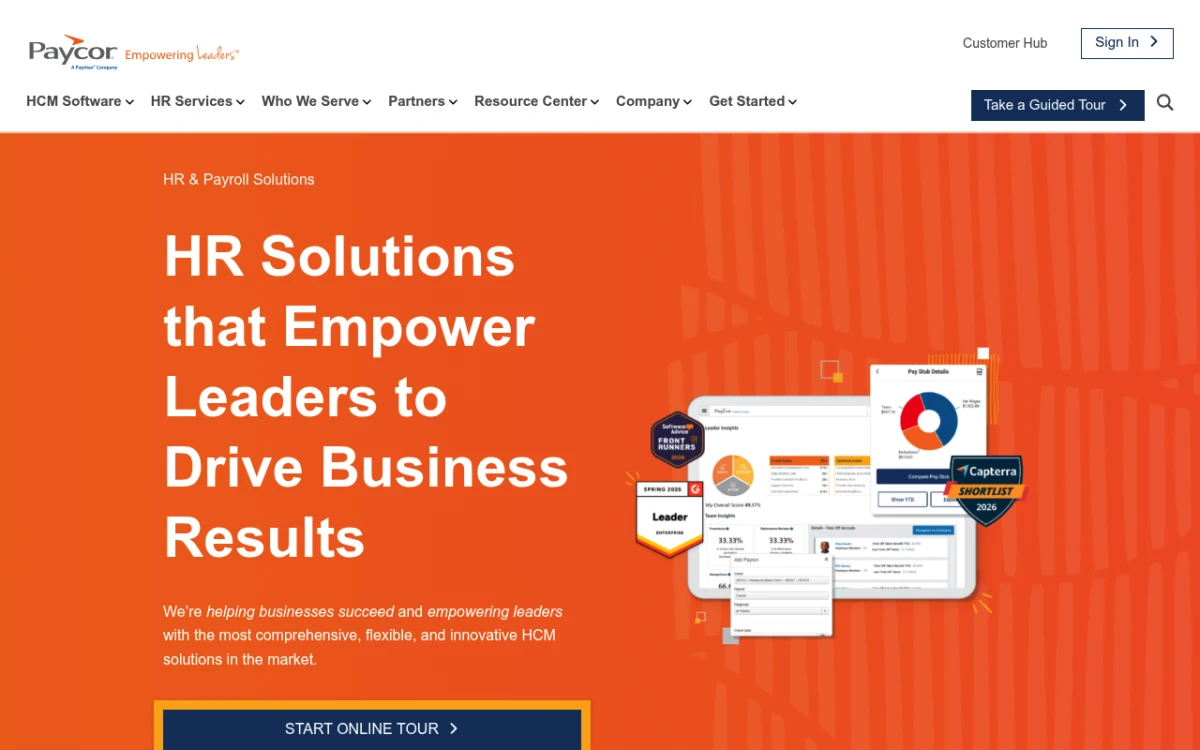
Paycor's homepage, where the old public pricing page now routes to a "request a quote" form.
Paycor sells an all-in-one HR and payroll platform. It prices the way most big vendors do: a base fee plus a per-employee-per-month charge, bundled into tiers. The more modules you turn on, the higher your PEPM.
Here's the catch. Paycor pulled its public pricing page in 2025, so the numbers on its site now route to a "request a quote" form. Every real price comes from a sales conversation, which means two companies of the same size can pay different rates depending on how they negotiate.
That lack of clear pricing is the most common complaint in Paycor reviews. It also makes budgeting hard. You can't model costs the way you can with a vendor that publishes a rate card. To make sense of it, split Paycor into two markets: small business (under ~50 employees) and mid-market (50 to 1,000+).
Estimated Paycor costs for small teams
For businesses under 50 employees, Paycor historically offered four bundles. The company no longer lists these prices publicly, but third-party trackers and archived figures give a reliable shape. Treat these as estimates to anchor a quote, not gospel.
| Plan | Base fee (est.) | Per employee/mo (est.) | What it adds |
|---|---|---|---|
| Basic | ~$99/mo | ~$6 | Payroll, tax filing, wage garnishments |
| Essential | ~$159/mo | ~$9 | Onboarding, time-off, ATS (3 jobs), HR support center |
| Core | ~$199/mo | ~$12 | HR analytics, expense management, ATS (5 jobs) |
| Complete | ~$299/mo | ~$16 | Compensation planning, talent development, unlimited ATS |
Run the math on a 15-person team. On the Core bundle, that's roughly $199 base plus 15 × $12, or about $379 per month — close to $4,548 per year before implementation and add-ons. The same team on Basic payroll-only lands near $189 per month, but you lose onboarding, time-off tracking, and the applicant pipeline.
One bright spot: Paycor often runs a new-customer discount of around 50% off for the first six months. That softens year one, but model your costs on the full rate, because the discount expires and renewal increases are common.
What is included in each bundle
Paycor's pitch is breadth. A full subscription can cover nine core HR functions: payroll, benefits administration, HR and employee files, time and attendance, onboarding, recruiting (ATS), performance management, compensation, and learning.
The tiers gate those modules. Payroll and tax filing sit in every plan. Hiring tools start at Essential but stay capped — three open jobs on Essential, five on Core, and unlimited only on Complete. Compensation planning and talent development are reserved for the top tier.
Mid-market customers (50 to 1,000 employees) get a different motion. Pricing there runs $19 to $27 PEPM. It scales with headcount and module count. Paycor positions itself as one system of record for HR, payroll, and talent. For a 100-person team on a Core-equivalent package, benchmarks put the annual figure around $22,000 to $27,000 before extras.
If you want to understand where Paycor sits in the broader category, our explainer on what an HRIS is covers how these all-in-one systems differ from point tools.
A quick feature tour
It helps to know what you're paying for. Here's what the platform actually does, module by module:
- Payroll and tax. Multi-state payroll, automatic tax filing, and wage garnishments. This is Paycor's strongest area and the reason most buyers choose it.
- Time and attendance. Clock-ins, scheduling, and timesheets that feed straight into payroll. On the lowest tier this can be an add-on.
- Onboarding. New-hire paperwork, e-signatures, and e-verify, so day one runs without a stack of PDFs.
- Recruiting (ATS). A hiring pipeline with public job posts. Note the caps: three jobs on Essential, five on Core, unlimited on Complete. There's no candidate-sourcing database at any tier.
- Performance and compensation. Review cycles, goals, and pay planning — but compensation planning is gated to the top tier.
- Analytics. Reports and dashboards on headcount, turnover, and labor cost, with deeper analytics on higher plans.
The breadth is real. The question is whether a small team uses enough of it to justify the price. Many don't, which is why the alternatives section below matters.
Hidden costs: implementation, add-ons, contracts, overages
Sticker PEPM is only part of the bill. The line items below are where Paycor quotes tend to grow.
- Implementation. Expect a one-time setup fee. For small business it can run from a few hundred dollars to a few thousand; for mid-market it's commonly 10 to 20% of your annual software spend — so a $100,000 contract can carry a $10,000–$20,000 implementation charge. Some buyers reduce it by using a third-party implementation partner instead of Paycor's own team.
- Add-on modules. Benefits administration, premium support, and (on lower tiers) full time and attendance are often priced separately. Each one nudges your effective PEPM up.
- Contracts and renewals. Deals typically run on annual terms. Several reviewers report unexplained increases at renewal, so confirm caps in writing before you sign.
- Integrations. API access and custom integrations can be billed as extras depending on your package.
The takeaway: the number a salesperson quotes for software is rarely the number you pay in year one. Build a buffer of 15 to 25% for setup and add-ons, then compare that all-in figure — not the headline PEPM — against alternatives.
Paycor vs Gusto, BambooHR, and Tiny Team on price
Price comparisons only mean something at a fixed team size, so here's a 25-person company across four tools. Numbers are list-price estimates and exclude implementation.
| Tool | Pricing model | ~Annual cost (25 people) | Best at |
|---|---|---|---|
| Paycor | Base + PEPM (quote) | ~$7,000–$11,000+ | Full payroll + HR + talent in one |
| Gusto | Base + per employee | ~$3,400–$8,000 | Modern payroll for SMBs |
| BambooHR | Per employee (quote) | ~$4,000–$8,000 | Polished core HR + reporting |
| Tiny Team | One-time lifetime modules | One-time lifetime module pricing; see current prices | Lightweight core HR, no payroll |
A few honest notes. Gusto leads with payroll and publishes its rates, which makes it far easier to budget than Paycor — see our Gusto pricing breakdown for the tiers. BambooHR is also quote-based and per-seat; our BambooHR pricing guide and BambooHR alternatives cover the details.
Tiny Team is the outlier on the list because it isn't a payroll processor. It's flat-rate, core-HR software — directory, PTO and time-off, documents, hiring pipeline, performance reviews — billed at a one-time module price instead of per seat. Tiny Team offers one-time lifetime access to HR and Document Spaces per organization. Choose one module or buy several in a single payment. Each module has its own 30-day free trial, starting when you activate it. No credit card, automatic charges or per-person fees. See current module pricing. More on that fit below.
Who Paycor is best for
Paycor earns its price tag when you actually use the breadth. It's a strong fit if you:
- Run payroll and benefits in-house and want them in the same system as HR records and time tracking.
- Sit in the mid-market — roughly 50 to 350 employees — where a consolidated system of record beats stitching point tools together.
- Need compliance depth, like multi-state payroll, garnishments, and tax filing handled by the vendor.
- Are willing to negotiate and can absorb implementation plus annual renewal management.
Reviewers rate Paycor solidly on payroll and compliance. It scores around 4.4/5 on Capterra across thousands of ratings, which reflects a mature platform. Worth flagging: Paychex closed its acquisition of Paycor in 2025, so expect product and roadmap shifts as the two teams integrate.
Where Paycor is a poor fit: very small teams watching every dollar, companies that want transparent published pricing, and teams doing high-volume hiring (the ATS has no candidate-sourcing database at any tier).
A quick example. Say you're a 12-person startup. You already run payroll through your accountant. You sign up for Paycor's Core bundle anyway, because you want HR records and PTO in one place. You pay roughly $199 base plus 12 × $12 a month, or about $343 — close to $4,100 a year, plus a setup fee. But you barely touch the payroll engine you're paying for. For that team, a lighter HR tool would cover the same daily work for a fraction of the cost. That gap is the whole point of the next section.
Cheaper alternatives for teams that don't need payroll-heavy complexity
If you're under 100 people and your real need is core HR — not a full payroll engine — you're likely overpaying for Paycor's complexity. A few directions to consider.
Keep payroll separate, run HR flat-rate. Plenty of small teams already process payroll through Gusto, an accountant, or a PEO, and just need a clean place to manage people. Tiny Team's current module pricing offers one-time lifetime access per organization, with a separate 30-day free trial for each module. No card or automatic charges. It does not run payroll or administer benefits, so it pairs with a payroll provider rather than replacing one.
The pricing contrast is the point. Paycor's PEPM model gets pricier as you add people. Tiny Team's current module pricing offers one-time lifetime access per organization, with a separate 30-day free trial for each module. No card or automatic charges. Picture a 40-person team. The other charges $19 to $27 PEPM. For the HR layer alone, that's the gap between under a thousand dollars and well over ten thousand a year.
Want a published-rate payroll suite? Gusto and BambooHR are the usual SMB picks; both are easier to budget than Paycor. Just starting out? Our roundup of free HR software and the broader guide to the best HR software for small business lay out the trade-offs by team size. For DIY payroll specifically, the SHRM resource library and a payroll provider like Gusto are better starting points than a full enterprise platform.
The honest rule: buy for the team you have, not the team you might become. You can always upgrade when payroll-in-one genuinely pays for itself.
Frequently Asked Questions
How much does Paycor cost per employee?
Paycor doesn't publish rates, but third-party benchmarks estimate $19 to $27 per employee per month (PEPM) for mid-market teams. Small-business bundles historically started around $99/month plus roughly $6 to $16 per employee depending on the tier. Your real number comes from a sales quote and depends on headcount and modules.
Does Paycor have a free trial or free plan?
No. Paycor does not offer a free plan, and there's no self-serve free trial. Pricing and any demo run through its sales team. If you want no-cost options, see our guide to free HR software.
What is Paycor's implementation fee?
Expect a one-time setup charge. For small business it can range from a few hundred to a few thousand dollars; for mid-market it's commonly 10 to 20% of your annual software spend. Some buyers reduce it by using a third-party implementation partner.
Is Paycor cheaper than Gusto or BambooHR?
Not usually for small teams. Gusto publishes transparent rates and is easy to budget, while Paycor and BambooHR are both quote-based and per-seat. Compare the all-in cost — software plus implementation plus add-ons — rather than the headline PEPM. See our Gusto pricing and BambooHR pricing breakdowns.
What are the main pros and cons of Paycor?
Pros: strong payroll and compliance, broad bundled HR and talent modules, mature and stable platform. Cons: no public pricing, per-seat costs that climb with headcount, capped applicant tracking on lower tiers, implementation fees, and reports of renewal increases.
Do I need Paycor if I only want core HR?
Probably not. Paycor's value is payroll-plus-HR-plus-talent in one system. If you already run payroll elsewhere and just need a directory, PTO tracking, docs, hiring, and reviews, a flat-rate core-HR tool like Tiny Team covers that for far less and pairs with your existing payroll provider.