The Gusto vs ADP choice comes down to one question. Do you want simple payroll you can run yourself? Or a big platform built to scale across many states? Gusto leads with clean pricing and a modern look aimed at small US teams. ADP is the older giant. It has deeper compliance tools and 24/7 support. But its pricing is quote-based, so you don't know the real cost until you call sales.
This guide compares both on price, payroll, HR features, ease of use, and support. You get real numbers, honest trade-offs, and a clear way to pick based on your team size. No vendor spin.
Gusto vs ADP: quick comparison table
If you only have two minutes, here's the short version. Both are solid payroll providers; they just serve different ends of the small-business spectrum.
| Factor | Gusto | ADP RUN |
|---|---|---|
| Starting price | $49/mo + $6/employee | Quote-based (~$79+/mo) |
| Pricing transparency | Published online | Custom quote required |
| Best for | Teams under ~50, US-based | Growing teams, multi-state, scaling |
| Ease of use | Consistently rated easiest | Steeper learning curve |
| Setup time | Days, mostly self-serve | Often 2–4+ weeks |
| Support hours | 8am–8pm ET (weekdays) | 24/7 phone and chat |
| Unlimited payroll runs | Included on all plans | Restricted on lower tiers |
| Benefits in all 50 states | 38+ states | All 50 states |
| Contractor payments | Strong, global options | Available, less emphasized |
The pattern holds across every review. Gusto wins on simplicity and clear pricing. ADP wins on scale, compliance depth, and round-the-clock support. The rest of this guide shows where those differences actually matter.
Gusto overview: what it does well
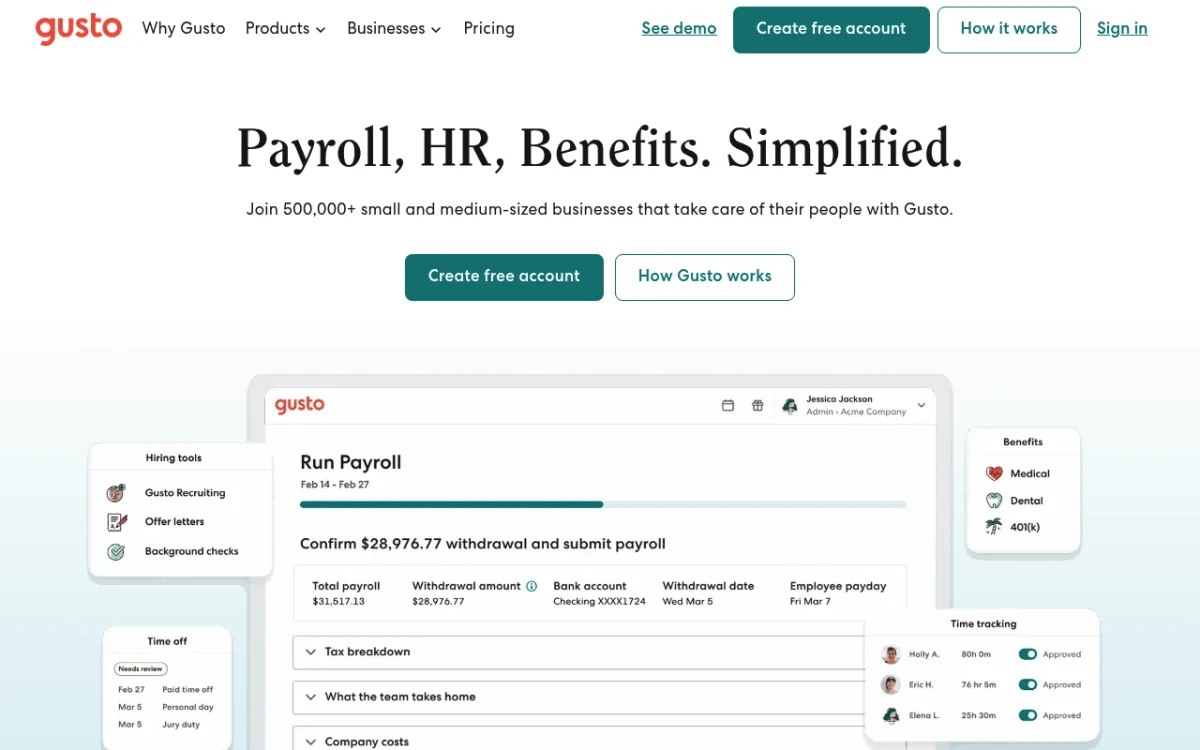
Gusto's homepage leads with the clean, modern payroll experience small teams know it for.
Gusto made its name by making payroll feel almost pleasant. The interface is clean. The setup flow walks you through taxes step by step. Most small teams run their first payroll within a few days of signing up.
What Gusto does well:
- Transparent, published pricing — you see the numbers before you commit
- Unlimited payroll runs on every plan, including off-cycle and bonus runs
- Automatic tax filing for federal, state, and local taxes (W-2 and 1099)
- Full-service onboarding with self-service employee enrollment
- Built-in benefits — health insurance, 401(k), and commuter benefits through licensed advisors
- Strong contractor support for businesses that pay freelancers
Gusto is best for US-based small businesses that want to run payroll themselves. You don't need to learn enterprise software. Founders, agencies, restaurants, and early-stage startups make up the core audience. If your whole team is in one or two states, and you want a tool you can set up without a consultant, Gusto is hard to beat.
The trade-off is simple. Gusto is payroll-first. Its HR features work, but they stay light. As your team grows past 50 people or into many states, you may start to feel the ceiling.
ADP overview: what it does well
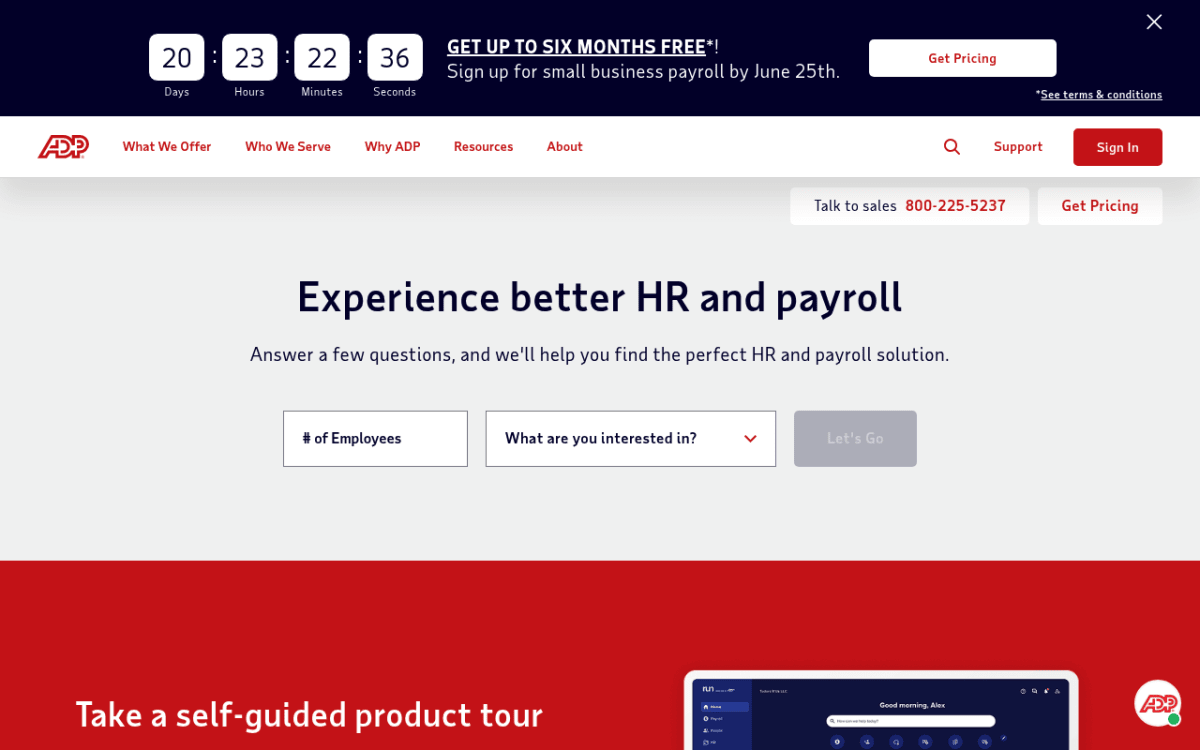
ADP's homepage reflects its broader payroll and HR platform built to scale across states.
ADP has run payroll since before "SaaS" was a word, and that shows. ADP RUN is the product aimed at small businesses. Workforce Now serves the mid-market, and Vantage HCM handles enterprise. That tiered family means ADP can grow with you in a way few rivals match.
Here's where ADP pulls ahead. Its compliance engine is deeper. It offers tax-accuracy guarantees. It handles complex multi-state and international payroll. Higher tiers add live HR advisors and handbook builders. And support runs 24/7, which helps when a payroll question hits you at 11pm on a Sunday.
ADP is best for companies that plan to scale, work across many states, or employ workers abroad. It also gives you a name that reassures investors and auditors. But the flip side is real. ADP's pricing is quote-only. Setup often takes several weeks. And users often call the interface dated, with a steeper learning curve. You trade simplicity for power.
Pricing comparison: the real numbers
Pricing is where the two diverge most sharply — and where buyers get tripped up.
Gusto pricing (published)
Gusto lists its plans openly:
| Plan | Base price | Per employee | Key inclusions |
|---|---|---|---|
| Simple | $49/mo | $6/mo | Single-state payroll, unlimited runs, tax filing, basic PTO |
| Plus | $80/mo | $12/mo | Multi-state payroll, next-day pay, time tracking |
| Premium | $180/mo | $22/mo | Dedicated advisor, HR experts, performance and comp tools |
A 10-person team on Gusto Simple pays about $109/month ($49 + $60). You can confirm that before you ever talk to a salesperson. For a deeper breakdown, see our full Gusto pricing guide.
ADP pricing (quote-based)
ADP doesn't publish RUN pricing. Third-party estimates put the base around $79–$150/month plus a per-employee charge. There are four general tiers: Essential, Enhanced, Complete, and HR Pro. As you move up, they add background checks, HR advisors, handbook builders, and compliance training.
The catch is what isn't included up front. ADP is known for add-on fees. Year-end W-2 processing, some off-cycle runs, and setup can carry separate charges. Two businesses of the same size can get very different quotes based on how they negotiate.
Bottom line on cost: Gusto is cheaper and more predictable for most teams under 50. ADP can compete at scale, but you need a sales call to learn what you'll actually pay. If predictability matters, that's a real factor. You can estimate your true employer cost — including the payroll taxes neither sticker price shows — with our free employer payroll tax calculator.
Payroll features compared
This is the core job, and both platforms do it reliably. The differences are at the edges.
Automatic tax filing: Both file federal, state, and local payroll taxes for you. Both handle W-2s and 1099s. ADP adds a tax-accuracy guarantee that pays back penalties from ADP errors. That reassures businesses with complex filings.
Unlimited payroll runs: Gusto includes unlimited runs on every plan. So off-cycle bonuses and fixes cost nothing extra. ADP limits unlimited runs on lower tiers and may charge per extra run.
Multi-state and international: ADP wins here. It handles payroll for workers abroad and complex multi-state setups more smoothly. Gusto supports multi-state payroll on Plus and above. But it does not run payroll for employees outside the US.
Contractor payments: Gusto makes paying contractors simple, with global options and automatic 1099s. ADP supports contractor pay too, but pushes it less. If you've outgrown manual payroll, our guide on how to run payroll for a small business covers the basics both tools automate.
HR features compared
Neither tool is HR-first. Payroll is the anchor. But both bundle HR features, and the depth differs.
Gusto covers the basics cleanly. You get onboarding with e-signature, self-service employee profiles, simple PTO tracking, and a job-posting feature that hits multiple boards. Its Premium tier adds performance and pay management. For most teams under 50, that's enough.
ADP goes deeper on compliance-heavy HR. Higher tiers add live HR advisors, a handbook builder, and compliance training libraries. That helps if you work in many states with different labor laws. ADP's hiring tools lean on a ZipRecruiter partnership rather than a full in-house ATS.
Here's the honest summary. If you need real performance reviews, a polished directory, or a knowledge base, both tools treat HR as a bolt-on. Payroll is the main event. That gap is worth noting. It's also where a dedicated HR layer can sit beside either payroll provider.
Benefits administration
Benefits are a real point of difference. Gusto includes access to licensed benefits advisors and offers health insurance in 38-plus states, plus 401(k) and commuter benefits. The catch: coverage isn't nationwide, so check your state first.
ADP offers benefits in all 50 states, which helps multi-state employers. But ADP often charges separately for benefits administration rather than bundling advisor access into the base plan. As with everything ADP, the real cost shows up in the quote. The SHRM total rewards resources are a good reference if you want to benchmark what a competitive benefits package should include before you compare vendors.
Ease of use and setup
This is the clearest win for Gusto.
Gusto ranks among the easiest payroll platforms to use. Setup is mostly self-serve. The dashboard is clean. A non-technical founder can get running in days. Employees onboard themselves, entering their own tax and bank details.
ADP is more powerful but heavier. Setup often takes two to four weeks or more. It usually comes with a guided onboarding specialist. That's helpful, but it's a sign of the complexity. Reviewers often call the interface dated and the learning curve steep. That's the cost of a platform built to handle nearly any case.
If your team is small and you want to go live this week, pick Gusto. If you're setting up payroll for a fast-growing, multi-entity company and can spend the setup time, ADP's depth pays off later.
Customer support comparison
Support is where ADP's scale shows its best side.
ADP offers 24/7 phone and chat support plus a well-organized resource center. Higher tiers add dedicated HR advisors. When payroll breaks at an odd hour, someone picks up.
Gusto offers support 8am–8pm ET on weekdays, with strong benefits-advisor access built in. The quality is good, and the benefits help is a real strength. But the hours are shorter, and weekend coverage is thin.
For most small teams running weekday payroll, Gusto's window works fine. If you run a 24/7 operation, or you value round-the-clock help, ADP has the edge.
When to choose Gusto vs when to choose ADP
Here's the decision framework, stripped to the essentials.
Choose Gusto if you:
- Run a US-based team, mostly in one or a few states
- Want transparent pricing you can verify online
- Value a fast, self-serve setup and a modern interface
- Have fewer than ~50 employees
- Want built-in benefits without enterprise overhead
Choose ADP if you:
- Expect to scale past 50–100 employees soon
- Operate across many states or employ international workers
- Need deep compliance support and tax-accuracy guarantees
- Want 24/7 support and dedicated HR advisors
- Can invest several weeks in implementation
Reviews echo a simple rule of thumb. Under 100 employees with simple domestic payroll? Pick Gusto. Growing headcount, staff abroad, or a need for HR advisors? Pick ADP. If you're still torn, our Gusto alternatives roundup and Gusto review dig deeper into the trade-offs.
A lighter HR layer alongside your payroll
There's a third angle worth naming. Both Gusto and ADP are payroll platforms first, and their HR tools come second. Maybe what you really need is solid people management. A clean employee directory, custom PTO policies, documents, hiring pipelines, and performance reviews. Neither tool is built for that.
This is where a focused, lightweight HR tool can sit beside your payroll provider. Tiny Team is built for the HR side. It handles time-off tracking, an employee directory with pay records, an internal knowledge base, a hiring pipeline, and performance reviews. Tiny Team offers one-time lifetime access to HR and Document Spaces per organization. Choose one module or buy several in a single payment. Each module has its own 30-day free trial, starting when you activate it. No credit card, automatic charges or per-person fees. See current module pricing. It doesn't run payroll, so you'd keep Gusto or ADP for that. But for teams who want their people data, PTO, and reviews in one simple place — without paying per seat — it works beside either payroll choice rather than against it.
The point isn't to replace your payroll engine. It's that "payroll software" and "HR software" are different jobs. You don't have to force one tool to do both. For the full landscape, see our guide to the best HR software for small business.
Frequently asked questions
Is Gusto cheaper than ADP?
For most small teams, yes. Gusto's published pricing starts at $49/month plus $6 per employee. You can check the total before you sign up. ADP uses quote-based pricing (estimated $79+/month plus per-employee fees) and is known for add-on charges. So the real cost is harder to predict and often higher for small businesses.
Is ADP better than Gusto for payroll?
ADP is stronger for complex payroll. Think multi-state operations, workers abroad, and firms that need a tax-accuracy guarantee. Gusto is better for simple US payroll, where ease of use and clear pricing matter most. For teams under 50 in one or two states, Gusto usually wins. For scaling, multi-entity companies, ADP's depth pays off.
Can Gusto and ADP handle contractor payments?
Both can pay contractors and file 1099s for you. Gusto puts more weight on contractor payments and offers global options. That makes it a popular pick for businesses that work heavily with freelancers. ADP supports contractor pay too, but markets it less.
How long does setup take for Gusto vs ADP?
Gusto setup is mostly self-serve and takes a few days. Employees enter their own details. ADP setup usually takes two to four weeks or longer. It often comes with a dedicated onboarding specialist, because the platform is more complex.
Do Gusto or ADP include full HR software?
Both bundle HR features, but payroll is the main product. Gusto covers onboarding, basic PTO, and light hiring tools. ADP adds deeper compliance features and HR advisors on higher tiers. Neither is a dedicated HR platform. So teams that want strong directories, documents, and reviews often pair payroll with a separate HR tool.
Which is better for a small business under 50 employees?
Gusto is usually the better fit for teams under 50. You get lower, clearer pricing, faster setup, and an easier interface. ADP gets more compelling as you near 100 employees, expand across states, or need 24/7 support and stronger compliance coverage.
The bottom line
Gusto vs ADP isn't about which platform is "better" in the abstract. It's about matching the tool to your stage. Gusto gives you clear pricing, fast setup, and a modern feel that fits most small US teams. ADP brings scale, compliance depth, and 24/7 support that growing and multi-state companies grow into.
Pick Gusto if you want simple, predictable payroll today. Pick ADP if you're building for scale and complexity. And if your real gap is HR rather than payroll, pair either one with a focused, flat-rate HR tool. That way each system does the job it's built for. Compare the wider market in our best HR software for small business guide before you commit.