SMART goals examples for work turn vague ambitions into concrete, measurable objectives that drive real results. Whether you're preparing for performance reviews, setting quarterly targets, or helping new hires build a 30-60-90 day plan, SMART goals eliminate ambiguity and create clear accountability.
For small teams, structured goal setting is especially critical — every individual's contribution directly impacts business success. Research from Harvard Business School shows that people who write down specific goals are 42% more likely to achieve them, while Dominican University studies found individuals with written, measurable goals achieve 76% more than those with vague intentions.
This guide provides over 50 ready-to-use SMART goals examples organized by role, along with a free template and step-by-step writing process you can implement immediately.
What Are SMART Goals?
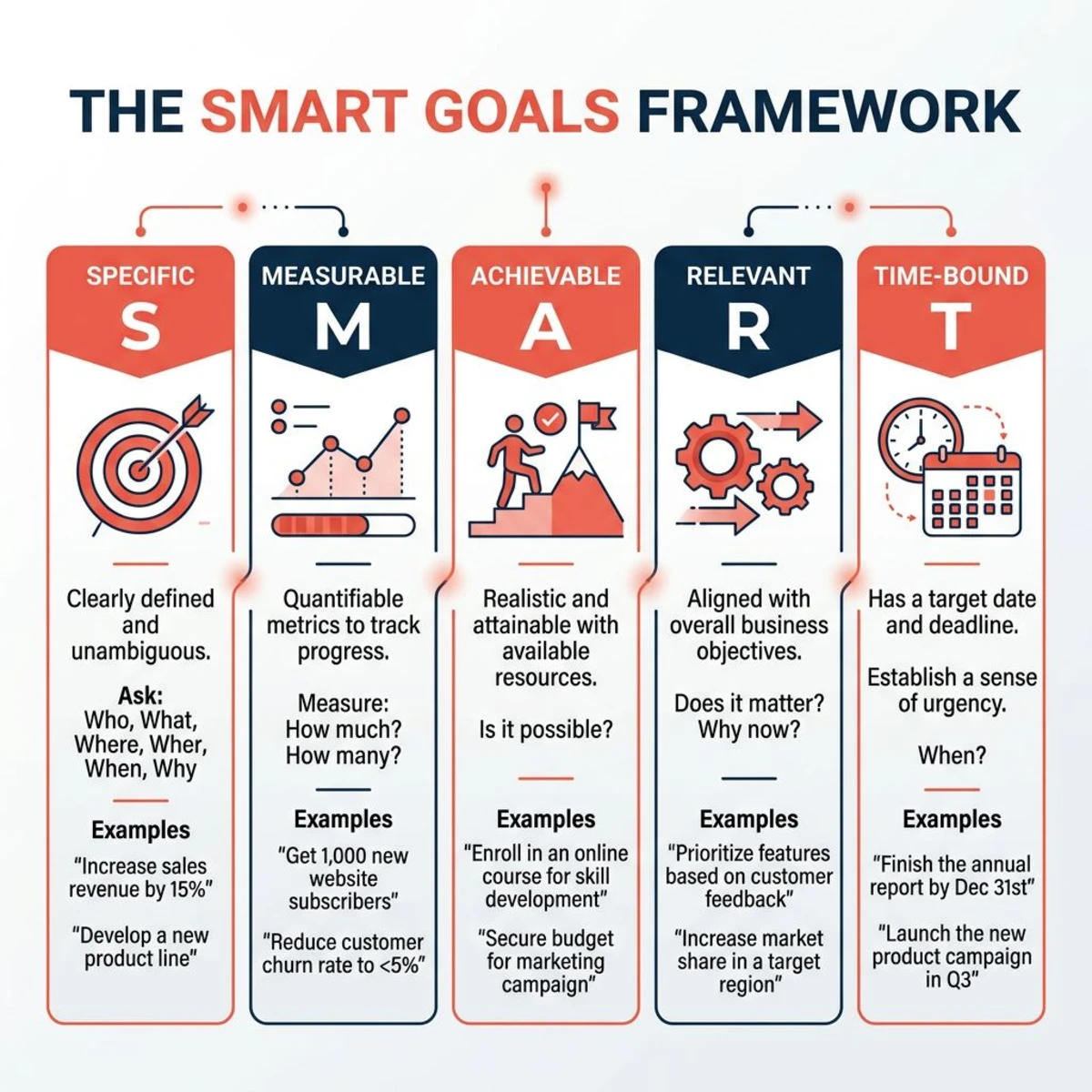
SMART is an acronym that provides a framework for creating clear, achievable objectives. Each letter represents a crucial element:
| Letter | Meaning | Key Question |
|---|---|---|
| S | Specific | What exactly will be accomplished and by whom? |
| M | Measurable | How will progress and success be tracked? |
| A | Achievable | Is this realistic with current resources? |
| R | Relevant | Does it align with business objectives? |
| T | Time-bound | When must it be completed? |
The framework forces clarity about what success looks like. Instead of "improve performance," a SMART goal reads: "Increase monthly sales calls from 50 to 75 by June 30, 2026." That's something people can actually execute against.
SMART goals also improve communication between managers and employees. When expectations are specific and measurable, performance review conversations shift from subjective impressions to objective progress discussions. The result is fairer evaluations and more productive feedback.
Why SMART Goals Matter for Small Teams
A 25-person marketing agency implemented quarterly SMART goals across all roles and saw 31% improvement in project completion rates, 22% increase in client satisfaction, and 18% reduction in missed deadlines — all within six months. Here's why the framework works particularly well for growing companies — and why having practical smart goals examples for work is essential.
Resource optimization. Small teams must make every hour count. SMART goals help prioritize work that directly moves the needle. When multiple projects compete for attention, specific targets provide objective criteria for tough prioritization decisions.
Objective evaluations. Concrete metrics remove bias from employee reviews. Rather than subjective assessments, managers can point to measurable outcomes during review cycles. This makes conversations about performance, raises, and promotions more productive and fair.
Early problem detection. Regular progress tracking against specific metrics surfaces issues early — when they're easier to fix. This is especially valuable when building employee development plans, because you can see skill gaps before they become performance problems.
Team alignment. When everyone understands specific objectives and deadlines, coordination happens naturally. A 40-person SaaS startup found that after implementing SMART goals company-wide, cross-team project delays dropped by 35% because individual goals were explicitly linked to team objectives.
Scaling preparation. Well-defined goals and processes make it easier to onboard new team members during rapid growth periods. Clear expectations mean new hires ramp faster and contribute sooner.
SMART Goals Examples for Work by Role
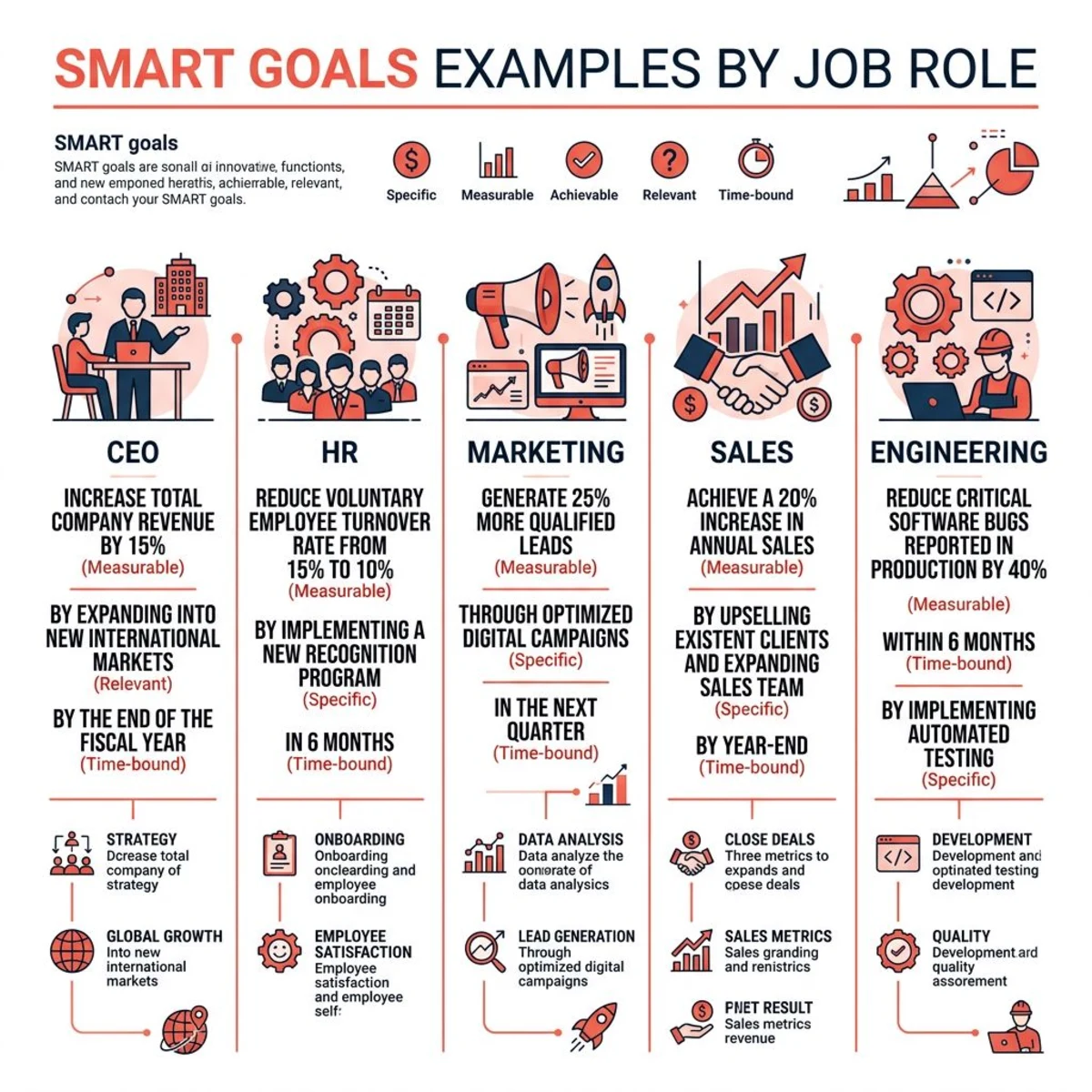
These role-specific examples demonstrate how to apply the SMART framework across functions common in small teams. Each goal is ready to customize for your context.
Founders and CEOs
Founder goals should focus on strategic activities that only the CEO can accomplish — revenue growth, team building, and organizational development.
- Increase monthly recurring revenue from $45,000 to $60,000 by Q4 2026 through new customer acquisition and existing customer expansion
- Hire and onboard 5 new team members (2 engineers, 2 sales, 1 marketer) by September 1, 2026, maintaining 90-day retention rate above 95%
- Implement a formal performance review process for all 18 employees, completing first cycle by March 31, 2026, with 100% participation
- Close $150,000 in Series A funding by June 30, 2026, by presenting to 25 qualified investors and completing due diligence
- Launch product in 3 new markets by December 31, 2026, achieving $15,000 MRR from new markets within 6 months
- Build strategic partnerships with 3 complementary software providers by Q3 2026, generating at least $25,000 in referral revenue
- Define and document 3-year strategic plan by August 31, 2026, including market expansion, product roadmap, and hiring projections
HR Managers
HR goals should center on talent operations, compliance, and culture building that enables the team to scale effectively.
- Reduce time-to-hire from 35 days to 25 days by Q2 2026 by streamlining interview processes and maintaining pre-qualified candidate pipeline
- Create individualized development plans for 100% of employees by Q3 2026, including skill assessments and career pathing
- Increase employee satisfaction scores from 7.2 to 8.0 (out of 10) by year-end through monthly pulse surveys and targeted improvement initiatives
- Update employee handbook and policy documentation by March 31, 2026, ensuring compliance with all state and federal requirements
- Implement comprehensive onboarding program reducing new hire time-to-productivity from 60 to 45 days by Q4 2026
- Achieve 95% offer acceptance rate throughout 2026 by improving candidate experience and ensuring competitive compensation packages
- Establish mentorship program pairing 12 junior employees with senior team members, launching by April 1, 2026
- Achieve 98% completion rate on required compliance training by maintaining quarterly reminders and automated tracking
Sales Teams
Sales goals should focus on revenue generation, pipeline building, and customer relationships that directly contribute to business growth.
- Generate $180,000 in new business revenue in Q2 2026 by closing 15 deals with an average value of $12,000
- Build and maintain a sales pipeline worth $500,000 by December 31, 2026, with at least 60 qualified prospects across all stages
- Increase average deal size from $8,500 to $12,000 by Q4 2026 through better needs assessment and solution packaging
- Schedule 20 qualified discovery meetings per month in Q2-Q3 2026, focusing on prospects with $50,000+ annual revenue potential
- Achieve 35% conversion rate from initial meeting to proposal stage by improving discovery process and qualification criteria
- Generate $45,000 in expansion revenue from existing customers by December 2026 through upselling and cross-selling initiatives
- Complete account reviews with all major clients by Q3 2026, identifying growth opportunities and renewal risks
Marketing Teams
- Generate 150 marketing qualified leads per month by Q4 2026 through content marketing, paid advertising, and SEO optimization
- Publish 48 high-quality blog posts in 2026 (weekly cadence) focusing on customer pain points and target SEO keywords
- Improve website conversion rate from 2.1% to 3.5% by Q3 2026 through A/B testing landing pages, CTAs, and user experience
- Build email subscriber list from 2,400 to 5,000 contacts by December 31, 2026, through content upgrades and lead magnets
- Achieve 25% conversion rate from MQL to sales opportunity by improving lead scoring and nurturing processes by July 2026
- Reduce cost per acquisition by 20% across all paid channels while maintaining lead quality standards by year-end 2026
- Create video content library with 24 educational videos by Q4 2026, achieving average of 500 views per video within 30 days
Operations Managers
Operations goals bridge strategy and execution, focusing on efficiency gains and process improvements that free the team to do their best work.
- Reduce project delivery time by 20% (from 45 to 36 days average) by Q3 2026 through implementing standardized workflows and weekly sprint reviews
- Decrease operational costs by $15,000 per quarter by December 2026 through vendor renegotiations and elimination of redundant tool subscriptions
- Achieve 99.5% uptime on customer-facing systems by Q4 2026, reducing average incident response time from 45 to 15 minutes
- Implement inventory management system by May 2026, reducing stockouts by 40% and overstock by 25%
- Create standard operating procedures for all core business processes by Q3 2026, covering 100% of repeatable workflows
- Improve cross-department project handoff success rate from 70% to 90% by July 2026 through standardized handoff checklists and automated notifications
Engineering Teams
Engineering goals balance technical excellence with business impact, ensuring the team delivers value while maintaining code quality and system reliability.
- Reduce average bug resolution time from 4 days to 2 days by Q2 2026 through improved triage processes and dedicated bug-fix sprints
- Achieve 90% code test coverage on all new features by Q3 2026, with automated CI/CD checks blocking merges below threshold
- Ship 4 major feature releases per quarter throughout 2026, maintaining current quality standards (fewer than 3 critical bugs per release)
- Reduce deployment time from 45 minutes to 10 minutes by June 2026 through CI/CD pipeline optimization and automated testing
- Complete migration from legacy monolith to microservices architecture by December 2026, covering 6 core services
- Implement automated monitoring and alerting for 100% of production services by Q2 2026, reducing mean time to detection to under 5 minutes
New Hires / First 90 Days
New hire goals set the foundation for long-term success. Use these alongside a structured 90-day review template for best results.
- Complete all onboarding training modules and assessments within first 30 days, achieving minimum 85% scores on knowledge checks
- Schedule one-on-one meetings with all direct team members and key stakeholders by day 45
- Successfully complete first assigned project by day 60, meeting all requirements and deadlines while requesting help when needed
- Achieve independence in daily tasks by day 75, requiring minimal supervision for routine responsibilities
- Contribute at least 2 process improvement suggestions based on onboarding experience by day 90
- Identify a mentor within the organization by day 30 and schedule bi-weekly check-ins for guidance and support
- Establish personal development plan with manager including 6-month and 1-year career objectives by day 90
How to Write SMART Goals (Step-by-Step)
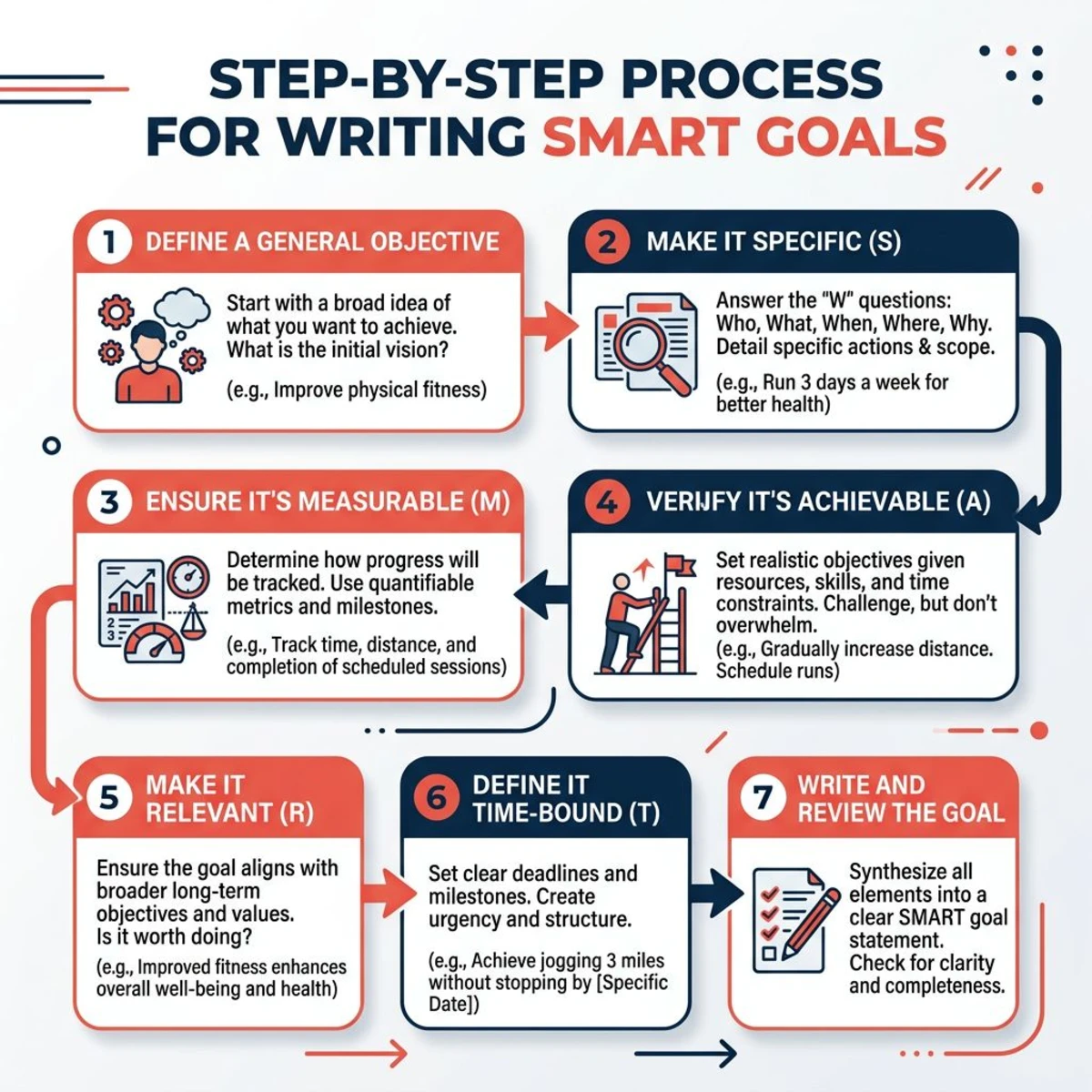
Let's walk through transforming a vague objective into a fully-formed SMART goal.
1. Start with the outcome. What business objective does this goal support? What does success look like concretely? A marketing manager wanting to improve lead generation should connect that desire to specific sales revenue targets.
2. Make it specific. Replace "improve our lead generation" with "increase monthly marketing qualified leads through content marketing, paid advertising, and email campaigns." Name exactly what will be done.
3. Add numbers. Define the baseline and target: "from 75 to 120 MQLs (60% improvement)." Without numbers, there's no way to know if the goal was achieved.
4. Reality-check it. Consider resources, competing priorities, and timeline constraints. A 60% improvement in lead generation might need additional budget or headcount. Is that available? Stretch goals motivate — impossible ones frustrate.
5. Confirm alignment. Does this goal ladder up to team and company priorities? Increasing MQLs directly supports sales revenue targets. If the company is focused on retention over acquisition, this goal might be misaligned.
6. Set a deadline. Use specific dates — "by September 30, 2026" — not "soon" or "this quarter." Include interim milestones for goals longer than one month to maintain momentum.
Final result: "Increase monthly marketing qualified leads from 75 to 120 by September 30, 2026, through content marketing and email campaigns, with monthly progress reviews."
SMART Goals Template (Free)
Use this template alongside the smart goals examples for work above to create goals for any role or time period:
Goal Title: (Brief, descriptive name)
Specific: I will (action) by (method/approach)
Measurable: Success = (metric) improving from (current) to (target)
Achievable: Realistic because (resources/skills/support available)
Relevant: Supports (broader business objective or team priority)
Time-bound: Complete by (specific date) with check-ins on (milestone dates)
Action Steps:
- (First key action)
- (Second key action)
- (Third key action)
Potential Obstacles: (Challenge + mitigation plan)
Sample Completed Template
Goal Title: Increase Customer Retention Rate
Specific: Improve retention by implementing proactive outreach and addressing top three churn reasons
Measurable: Retention rate from 78% to 85% (7-point improvement)
Achievable: Top 3 churn reasons identified, retention tool budget allocated ($200/month), dedicated time assigned
Relevant: Supports Q3 revenue growth targets and company's sustainable growth strategy
Time-bound: By September 30, 2026, with monthly reviews on the 15th
Action Steps:
- Create customer risk scoring system from churn data
- Implement automated email sequence for at-risk customers
- Schedule quarterly check-in calls with high-value accounts
Potential Obstacles: Customer resistance to outreach (mitigation: focus on value-add communications, not sales pitches)
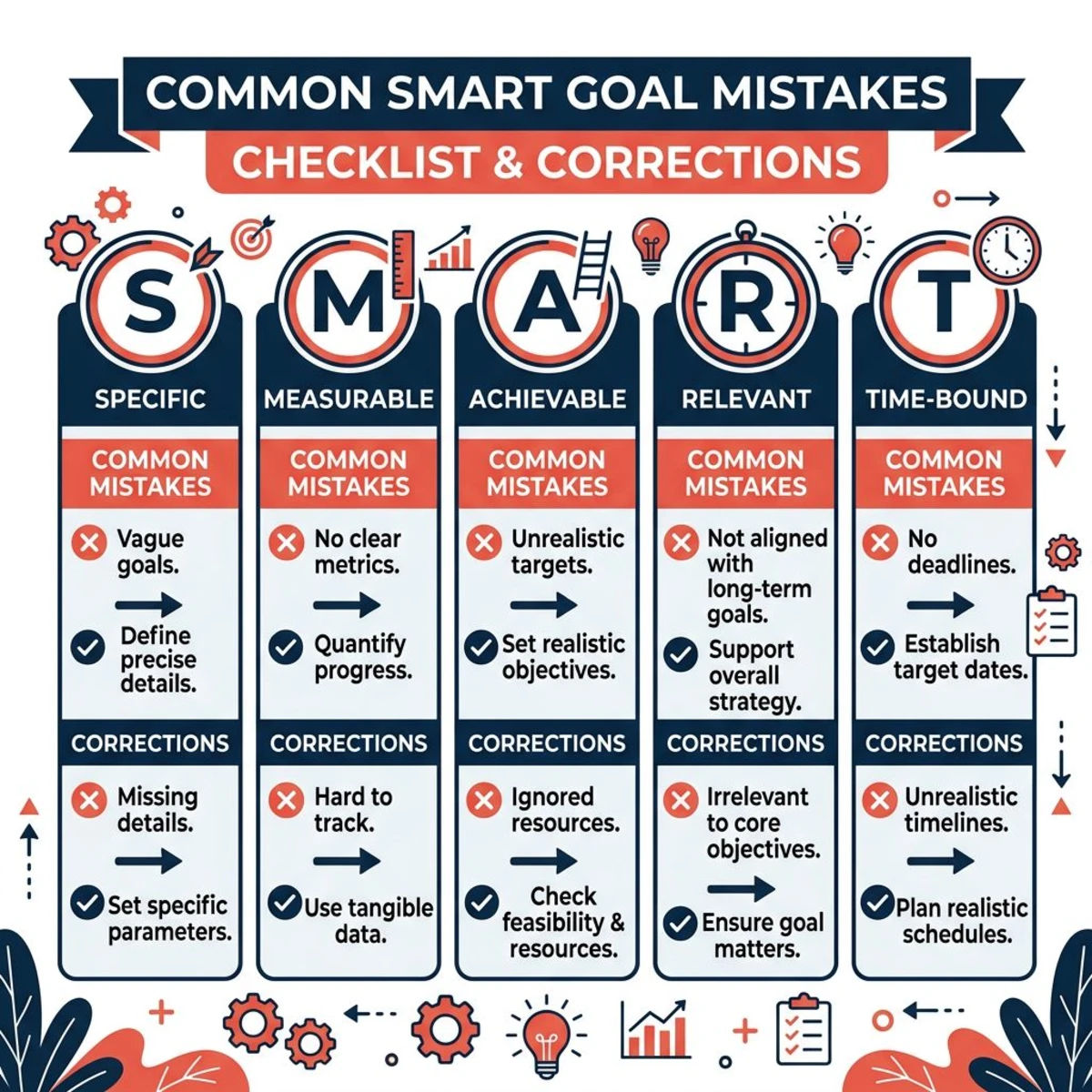
Common SMART Goal Mistakes to Avoid
| Mistake | Example | Fix |
|---|---|---|
| Too vague | "Improve marketing" | "Increase website traffic by 25% in Q2 2026" |
| Unrealistic | "Triple revenue in 6 months" | "Grow revenue 15% in Q3 through conversion optimization" |
| No deadline | "Launch new feature soon" | "Launch by April 15, 2026 with beta testing by March 15" |
| Not aligned | "Learn Python" (no business context) | "Master React by June 2026 to lead dashboard project" |
| No tracking plan | Set and forget | Weekly self-checks, monthly manager reviews |
| All-or-nothing | 80% achievement = failure | Celebrate progress, analyze gaps, adjust for next cycle |
The biggest mistake? Setting goals once and never revisiting them. According to the Society for Human Resource Management, regular check-ins on goal progress are the single strongest predictor of goal achievement. Partial progress isn't failure — it's data. Analyze what worked, what didn't, and use those insights to improve the next round.
How to Track SMART Goals
Tracking doesn't need to be complex. Here's a lightweight system that works for small teams without creating administrative overhead.
Weekly self-assessment (10 minutes). Each team member reviews their own progress: What moved forward? What's stuck? What support is needed? This builds self-awareness and surfaces blockers early.
Monthly manager check-ins. Discuss goal progress during one-on-one meetings, focusing on achievements and obstacles rather than just status updates. These conversations should be forward-looking — what needs to happen next month to stay on track?
Quarterly team reviews. Zoom out to identify patterns across the team. Which goals are on track? Where are consistent struggles? Celebrate wins and adjust goals based on changing business priorities. This is also a good time to review if goals still align with company direction.
Annual performance reviews. Use goal achievement as a key input for performance evaluations, alongside self-evaluations and 360 feedback. Focus on growth and learning, not just hit/miss outcomes.
Choosing a Tracking Tool
For teams under 20, a shared Google Sheet with columns for goal description, target metric, current progress, and status works fine. As you scale, integrated platforms like Tiny Team combine goal tracking with performance reviews and employee development plans so everything lives in one system. The key is picking something your team will actually use consistently.
When reviewing constructive feedback examples, tie feedback directly to specific goal progress. "Your Q2 MQL target was 120 and you hit 95 — let's figure out what happened and how to close the gap" is far more useful than "you need to improve lead generation."
Frequently Asked Questions
How many SMART goals should each employee have?
Three to five major goals at any time. This allows focus while covering different aspects of their role — performance, development, and collaboration. Mix short-term (monthly/quarterly) and longer-term (annual) goals for balanced planning. Too many goals dilute attention; too few don't provide enough direction.
Can SMART goals change during the review period?
Yes — and they should when circumstances change significantly. If business priorities shift or resources become unavailable, modify goals rather than pursue irrelevant objectives. Document changes and discuss with managers to maintain alignment and capture learning from the adjustment.
How do you write SMART goals for creative work?
Focus on deliverables, timelines, and business impact rather than subjective quality. "Complete 12 blog posts by Q3 2026 with engagement rates 25% higher than previous quarter" is perfectly measurable. Output quantities and impact metrics work better than trying to quantify creative quality.
What should managers do when employees consistently miss goals?
Analyze root causes first: Are goals unrealistic? Are resources lacking? Are priorities conflicting? Consistent misses across multiple team members often signal system problems — not individual failures. Address through training, resource allocation, goal adjustment, or priority clarification before assuming it's a performance issue.
How do SMART goals work in fast-changing environments?
Use shorter goal cycles (monthly instead of quarterly) and focus on outcomes rather than methods. This lets teams adapt their approach while maintaining clear targets. Think rolling goals that get reviewed and updated frequently, rather than rigid annual targets that become outdated by Q2.
SMART goals transform vague intentions into measurable achievements. For small teams where every contribution matters, this framework provides the structure needed to align individual efforts with business success.
Start with these smart goals examples for work and the template in this guide, adapt them to your specific roles and context, and establish regular review cycles that keep goals visible and actionable. The investment in structured goal setting pays off through better performance, clearer communication, and stronger accountability across your entire team.