A 30-60-90 day plan is a simple roadmap. It maps out what a new hire should do in their first three months. The plan breaks big goals into small steps. It helps new team members settle in fast. It also gives managers a clear way to track how things are going.
Why does this matter? The Brandon Hall Group found that good onboarding lifts new hire keeping rates by 82%. It also boosts output by over 70%. The key is clear goals, set check-ins, and a solid plan from day one.
What Is a 30-60-90 Day Plan?
A 30-60-90 day plan splits a new hire's first three months into three parts:
- Days 1-30: Learn and watch how things work
- Days 31-60: Start doing real work on the team
- Days 61-90: Take the lead on tasks and projects
This goes far beyond a basic onboarding checklist. That checklist covers forms and tools. A 30-60-90 day plan covers real goals and growth. It tracks what the new hire can do, not just what they've read.
The plan helps both sides. New hires know what to focus on each week. Managers can see if things are on track. When Sarah joined a 40-person startup as their first HR lead, her plan was the key. She went from watching to leading in three months. She cut their hiring time in half.
Why Every New Hire Needs This Plan
They Get Up to Speed Faster
Without a clear path, new hires drift. They spend weeks just trying to figure out what matters most. A set plan fixes this. The Society for Human Resource Management says it well. Workers with a formal plan reach full speed 34% sooner than those without one.
More People Stay Long Term
The first 90 days make or break keeping new hires. Gallup found that only 12% of workers feel their firm onboards them well. That's a huge gap. Firms that use 30-60-90 day plans see keeping rates rise by up to 58%. A clear plan shows the new hire you care about their growth. It tells them "we thought about your first days here." That feeling matters a lot. A warm welcome email starts things right. The plan keeps the ball rolling.
Goals Are Crystal Clear
When Marcus started as a sales lead at a 25-person SaaS firm, his plan had hard targets. Month 1: learn the product inside and out. Month 2: sit in on sales calls. Month 3: close his first deal. This clear path helped him beat his first quarter goal by 23%.
Reviews Are Based on Facts
These plans give solid proof for reviews. No more vague takes like "doing great." Instead, you can say: "Finished all training, helped with 3 projects, and found a way to save 2 hours each week." That's real, useful input.
30-60-90 Day Plan Template
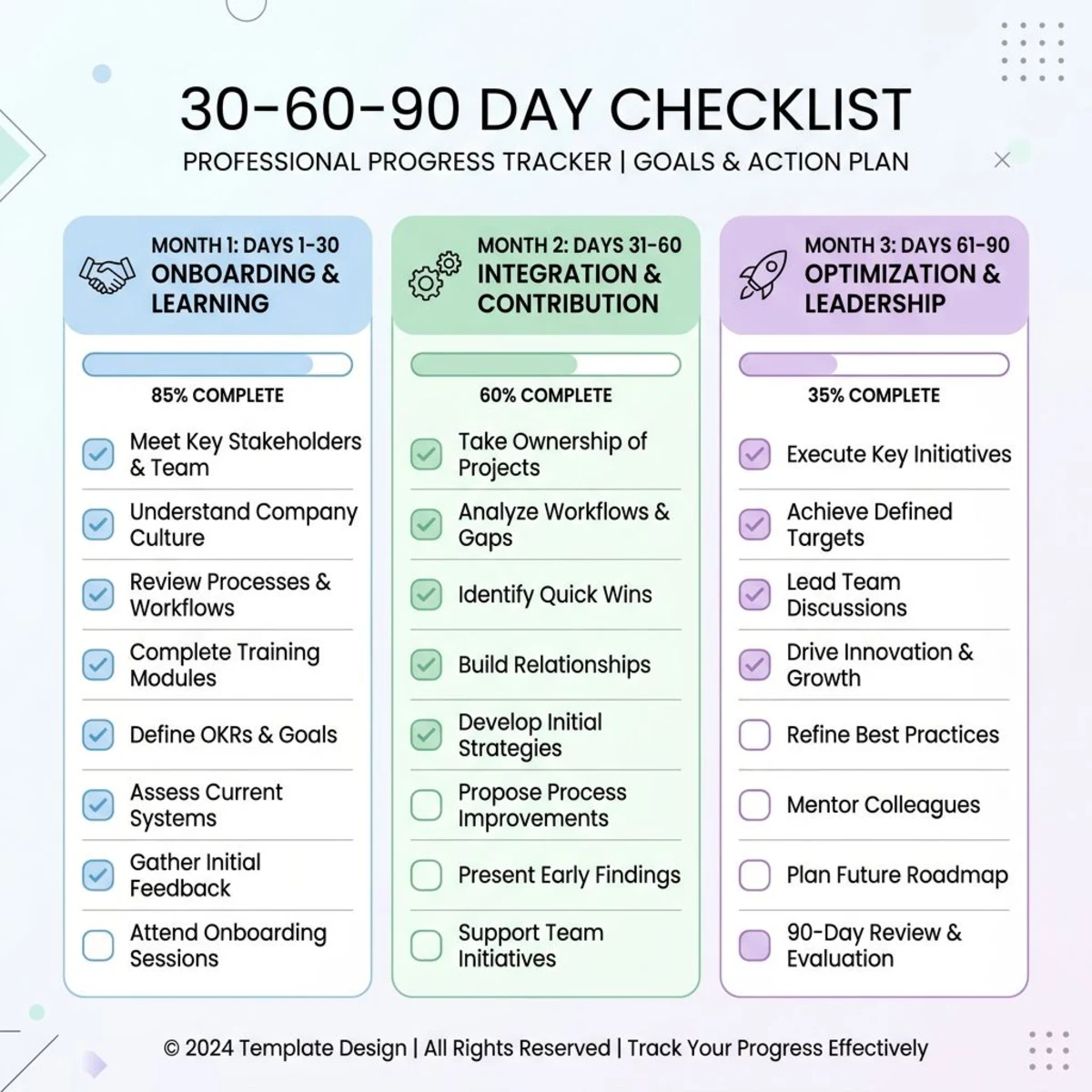
Here is a full template you can tweak for any role.
Days 1-30: Learn and Absorb
Main Goal: Get to know your role, your team, and how things work here.
What to Learn:
- Finish all required training
- Meet every team member one on one
- Read up on firm rules, values, and norms
- Learn what your team is working toward
- Watch how skilled team members do their work
What to Hand In:
- Proof of finished training
- Notes from team meetings
- A list of questions for your boss
- First thoughts on how things run
How We'll Measure It:
- All training done, no gaps
- Met with every direct teammate
- Can use the main tools on your own
Days 31-60: Start Doing Real Work
Main Goal: Begin adding value while still learning the ropes.
What to Do:
- Own a few tasks or a small project
- Speak up in team meetings
- Start building ties with clients or partners
- Suggest at least one way to make things better
What to Hand In:
- Your first solo project, done
- A short talk or write-up for the team
- New or updated docs based on what you've learned
How We'll Measure It:
- Projects done on time
- Good feedback from peers
- Can use key tools with ease
Days 61-90: Take the Lead
Main Goal: Work on your own and drive new things forward.
What to Do:
- Lead a project or big task
- Help newer team members learn
- Join talks about team plans and goals
- Find and fix a team problem
What to Hand In:
- A project you led from start to end
- Training notes or guides for future hires
- Your goals for the next three months
How We'll Measure It:
- Hit the bar for your role
- Got praise from more than one person
- Led at least one thing that helped the team
Real Examples by Role
Software Developer
Month 1: Go through the code base. Set up your dev tools. Fix 3 small bugs. Month 2: Build new features. Join code reviews. Add more tests. Month 3: Lead a new feature build. Help a junior dev. Pitch a better way to build things.
Marketing Manager
Month 1: Look at what campaigns are live. Study the rivals. Learn the tool stack. Month 2: Launch your first campaign. Clean up old workflows. Set up tracking. Month 3: Build a full quarter plan. Run a campaign that brings 20% more leads.
Sales Rep
Month 1: Finish product training. Sit in on 20 sales calls. Learn the CRM. Month 2: Make 30 calls to new leads. Book 10 meetings. Close your first deal. Month 3: Hit 75% of your quota. Build a pipeline worth 3x your target. Train a new hire.
Ops Manager
Month 1: Map how things work now. Find the slow spots. Talk to each team lead. Month 2: Fix one broken process. Set new KPIs. Build a live dashboard. Month 3: Lead a project across teams. Cut process time by 15%.
How to Build a Great Plan: Step by Step
Step 1: Set Clear Targets
Start with what "done" looks like. What should be true at 30, 60, and 90 days? Be exact.
Bad: "Get to know the product." Good: "Pass the product quiz with 90% or higher. Then walk a peer through three key selling points."
Step 2: List Key People to Meet
Write down everyone the new hire should talk to:
- Their boss and direct teammates
- People on other teams they'll work with
- Big clients or partners
- Senior leaders
Book the most vital meetings first. Spread them out over two weeks.
Step 3: Rank What to Learn First
Not all info matters the same. Focus on what they need for week one first. Then add skills for month two. Save big-picture stuff for later.
Step 4: Set Up Check-ins
Frequent reviews keep plans on track. Here's a good rhythm:
- Week 1: Daily 15-minute chats
- Weeks 2-4: Twice a week, 30 minutes each
- Months 2-3: Once a week, 45 minutes
Use these talks to shift goals and clear blocks. If you run a remote team, video calls work best for this.
Step 5: Tie It to Yearly Reviews
The new hire plan should link to long-term goals. Early wins should feed into bigger targets. At Tiny Team, our review system tracks these goals. It ties the first 90 days to the full year ahead.
Plans for New Managers
New managers face a unique challenge. They must do their own work and lead others at the same time.
Month 1: Get to Know Your Team
- Hold deep one-on-ones with each person
- Read past reviews and growth plans
- Learn what projects are in play right now
- Watch how the team works day to day
Month 2: Set Your Style
- Share your rules for how the team will work
- Start coaching talks with each team member
- Spot skill gaps and growth areas
- Join the broader leadership meetings
Month 3: Drive Results
- Act on what you saw in months one and two
- Set team goals for the next quarter
- Deal with any problems head on
- Build ties with other team leads
Real Story: Jen became an engineering lead at a 60-person startup. Her plan showed the real issue fast. It wasn't bad code. It was fuzzy specs from the product team. By month three, she fixed the spec review process. Bugs fell by 40%.

How to Track Progress

Weekly Review Questions
Ask these four things each week:
- What did you get done?
- What got in the way?
- What do you need for next week?
- How sure do you feel about your role (1-10)?
Monthly Score Card
Rate each goal in simple terms:
- ✅ Beat the target
- ✅ Hit the target
- ⚠️ Partly done
- ❌ Not done
Use an HR Tool to Help
The right platform makes tracking easy. With Tiny Team's goal tracking, you can:
- Set clear 30-60-90 day targets
- See progress in real time
- Get reminders for check-ins
- Link early goals to yearly reviews
Mistakes to Watch Out For
Packing Too Much into Week One
Bad move: Five days of back-to-back meetings and training. Better: Cap it at 3-4 hours of planned stuff per day in week one. Give them time to breathe and read on their own.
Fuzzy Goals
Bad move: "Learn about our clients." Better: "Talk to 5 clients. Share their top 3 pain points with the team."
No Check-ins
Bad move: "They look fine. I'll check in at the 30-day mark." Better: Weekly 15-minute chats. Catch small issues before they grow.
Skipping Culture
Bad move: Only focus on tasks and skills. Better: Add team lunches, company traditions, and casual mentoring. Culture matters just as much as output.
Same Plan for Everyone
Bad move: One plan for all roles and skill levels. Better: Tailor it. One tech firm used the same plan for seniors and juniors. Seniors felt talked down to. Juniors felt lost. Custom plans raised happy scores by 45%.
Special Cases
Remote Hires

Remote workers need extra care. Add these to their plan:
Month 1: Daily video calls for the first two weeks. Virtual coffee chats with peers. Clear written guides for every process. Home desk setup done.
Month 2: Lead one virtual team call. Pick their best chat and video tools. Join all online team events. Finish remote work training.
For managing time off during onboarding, a good leave system helps remote hires know the rules from day one. This avoids the awkward "can I take a day off?" chat in month two.
Tech Roles
Use hands-on targets for tech hires:
- Week 2: Send first code review
- Month 1: Ship first feature to live users
- Month 2: Guide a peer through a code review
- Month 3: Design a fix for a hard problem
Client-Facing Roles
Focus on building bonds with clients:
- Month 1: Sit in on 20 client calls
- Month 2: Handle 30 client talks on your own
- Month 3: Write a plan to improve client ties
The Payoff: Why This Is Worth It
Good onboarding plans pay for themselves. The data speaks for itself:
| What We Measure | How Much It Helps |
|---|---|
| Time to full speed | 34% faster |
| 90-day keeping rate | 58% higher |
| Team spirit | 2.3x higher |
| Manager happiness | 53% better |
Making a plan takes 10-15 hours of a manager's time. Losing a team member costs 50-200% of their yearly pay. If just one person stays because of a good plan, the math works out fast.
Link Your Plan to Your HR System
A plan works best when it lives inside your HR tools. Key links to set up:
- HR platform: Store plans in each person's profile
- Goal tracking: Tie to your review system
- Training tools: Mark courses as done
- Chat tools: Set up auto check-in reminders
Tiny Team's people hub does all of this in one spot. Store plans, track progress, and set up reviews with no extra tools.
When team members move on later, the plan still helps. You'll have clear records for exit talks and smooth handoffs.
Common Questions
Who writes the 30-60-90 day plan?
The hiring manager builds the first draft. But the best plans are team efforts. Ask the new hire to help shape the goals in week one. This gets their buy-in and makes the plan fit their skills.
How much detail should it have?
Mix structure with breathing room. Add clear tasks and due dates. But leave space for the new hire to explore. A good split: 70% set goals, 30% free time to dig in on their own.
What if someone falls behind at day 30?
First, check if the goals were fair. If they were, add more help. Give them extra training or a mentor. Shift duties if you need to. Use this to make future plans better.
Should remote and in-office plans differ?
Yes. Remote hires need more planned touch points. They need clearer written guides. They also need more chances to bond with the team. In-office hires can lean on informal chats and hallway learning.
How do you change a plan mid-way?
Treat the plan as a living doc. Review it each month. Adjust based on how the person is doing, what the team needs, and feedback from both sides. Always write down what changed and why.
Do these plans work for people who get promoted?
Yes, and they often help even more. A new role means new duties and new ties. Focus on what's changed. Skip the basic company info they already know. Help them grow into the bigger role with clear steps.
Roll This Out Across Your Firm
Ready to make this a company-wide habit? Here's how:
Step 1: Build Role Templates. Make base plans for your most common jobs. Add company-wide items and role-based goals.
Step 2: Train Your Managers. Managers need to know how to make and track these plans. Run a quick training each quarter on best methods. Using an org chart tool helps new hires see where they fit in the team. It also shows them who to go to for what.
Step 3: Ask for Input. Survey new hires at 45 and 90 days. Find out what helped and what didn't. Use their input to make the next plan better.
Step 4: Track the Numbers. Watch time to full speed, keeping rates, team spirit, and manager happiness. Use real data to make your plans better each quarter.
A strong 30-60-90 day plan changes how you onboard people. New hires get clear direction. Managers get a system that works. And your firm gets skilled team members faster. Start with the template above. Tweak it for each role. Then track what happens and keep making it better.
Want a simple way to track new hire plans and run your full onboarding process? Tiny Team puts people management, reviews, and goal tracking in one easy tool—free for teams up to 10, then $79/month flat for up to 50.