UserVoice Alternatives & Competitors (2026): 8 Options
The best UserVoice alternatives for small teams in 2026 are Canny, Savio, Featurebase, Frill, Sleekplan, UserJot, Fider and Tiny Team Feedback. Unlike UserVoice, which quotes a price only after a sales demo, each one lets you sign up and try it yourself. Fider is open source, and most of the others publish their prices.
Every competitor price below was checked on the vendor's own pricing page on 25 October 2026.
Quick picks:
- Canny: the closest like-for-like swap, with a free UserVoice migration.
- Savio: ranking requests by revenue on a small budget.
- Featurebase: feedback boards plus a help desk in one plan.
- Frill: a flat price with unlimited admins.
- Sleekplan: the cheapest monthly plan here, with NPS, CSAT and a free UserVoice import.
- UserJot: the strongest free plan for a public board.
- Fider: open source and self-hosted.
- Tiny Team Feedback: choose a module plan for the whole organization.
This guide covers customer feedback tools. If you want a place for staff ideas instead, see the guide to the best employee feedback tools.
Why Teams Look for UserVoice Alternatives
UserVoice is mature product feedback software, and large companies run serious programs on it. Small teams tend to leave for four reasons.
No public price and no self-serve trial
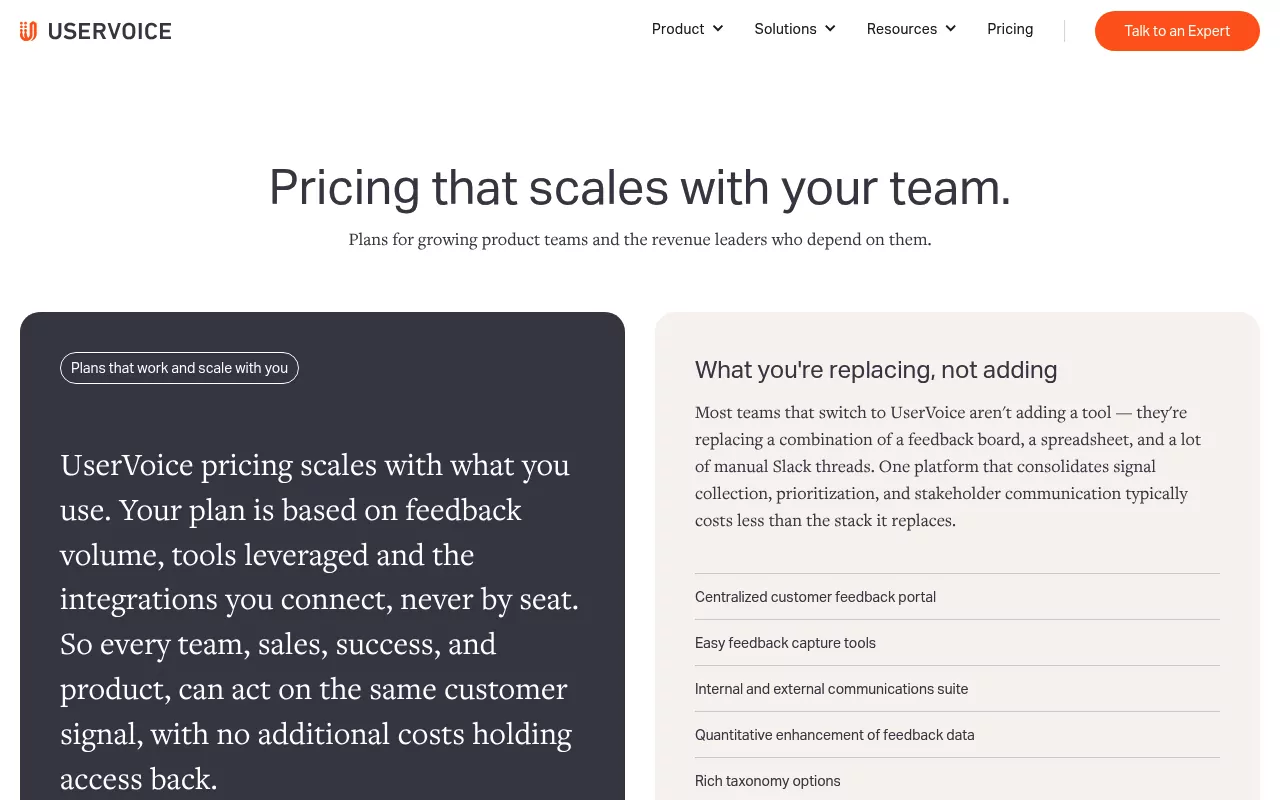
UserVoice's pricing page shows no figures as of October 2026. It says your plan is based on feedback volume, tools and integrations, "never by seat." The 30-day trial is set up after you book a demo.
The last price UserVoice published was "Starting at $16,000 per year," in an Internet Archive snapshot from 24 June 2026. The cost section below has the detail.
A four to six week launch
The same page says most teams launch in four to six weeks, with one to two weeks of technical setup. A dedicated success manager guides onboarding, and professional services are on offer.
That helps a large rollout. For a five-person team that wants a board live this week, it is overhead.
Built for revenue-weighted feedback at larger companies
UserVoice's own comparison page says AI analysis, revenue-based ranking, SSO, role-based access and SOC 2 Type II come standard. It links each request to the account behind it and weights it by revenue. If your team mostly uses the portal, voting and status updates, you pay for layers you do not use.
New owner, same sales-led buying
Curious announced it had bought UserVoice on 13 November 2025. It said it would bring back a self-service model. As of 25 October 2026, the site still sends every buyer to a demo or a call.
First, List the UserVoice Features You Actually Use
Most alternatives to UserVoice cover the basics. The real split is in five jobs, and in the plan that unlocks each one. Check which of these your team uses today, then shortlist only the tools that cover all of them.
- A public board with voting. Every option below has one.
- A public roadmap and a changelog. Canny, Featurebase (changelog from Growth), Frill, Sleekplan (roadmap from Starter) and UserJot. Savio lists roadmaps but no public changelog. Fider's site lists neither.
- Capture by sales and support on behalf of customers, like UserVoice's Contributor Console. Canny, Savio and Featurebase on every plan, Frill on every paid plan, and Sleekplan from Starter.
- Revenue or account weighting. Canny from Pro, with HubSpot and Salesforce on Business. Savio from Professional, with the CRMs on Business. Featurebase from Growth, with the CRMs from Professional. Sleekplan on Business.
- Private boards behind single sign-on for B2B customers. Canny and Savio on every plan, and Frill on paid plans (private boards need its Privacy add-on below Growth). Sleekplan from Starter, Featurebase from Professional, and UserJot with SSO on Professional.
Tiny Team Feedback covers the first two jobs and none of the last three.

UserVoice Alternatives: Quick Comparison
Prices were checked on each vendor's own pricing page on 25 October 2026. Each paid price is the lowest listed plan, with its billing basis.
| Tool | How you pay | Free plan or trial | Paid plans from (as listed) | Moving from UserVoice | Revenue or account data | Roadmap and changelog | Best for |
|---|---|---|---|---|---|---|---|
| UserVoice (reference) | Feedback volume and tools, never by seat | No free plan; 30-day trial after a demo | Quote only (last listed from $16,000 a year) | n/a | Yes | Roadmap, status emails | Large orgs |
| Canny | Tracked users | Free: 25 tracked users | Pro $79/mo billed yearly | Free migration by Canny | From Pro | Yes, yes | Like-for-like |
| Savio | Per paid user | 14-day trial | $39/mo billed annually, 1 paid user | No importer listed | From Professional | Roadmap; changelog not listed | Revenue on a budget |
| Featurebase | Per seat | Free: 1 seat; 10-day trial | $29 per seat/mo billed yearly | CSV import | From Growth | Yes; changelog from Growth | Feedback plus help desk |
| Frill | Flat | 14-day trial | $25/mo billed monthly ($22 yearly) | CSV import | No CRM listed | Yes, yes | Many admins |
| Sleekplan | Flat, seat caps | Free: 1 admin; 30-day trial | $13/mo billed yearly | Free UserVoice import | On Business | Roadmap from Starter; changelog yes | Budget, NPS |
| UserJot | Flat | Free: 2 boards | $29/mo | Ideas and Voters CSV | Not listed | Yes, yes | Free board |
| Fider | Open source or hosted | Hosted free to 250 items | $25/mo, month to month | No importer listed | Not listed | Not listed | Self-hosting |
| Tiny Team Feedback | Per-module plan for the organization | See current module plans | See current module plans and prices | No import | No | Yes, yes | No per-seat fees |
How These Tools Were Compared
Each tool was checked against public sources only: its pricing page, plan limits, billing unit, import docs and help center. UserVoice was checked against its own pricing page, comparison page and export help articles.
All checks were made on 25 October 2026. No accounts or trials were used, so this guide makes no hands-on claims.
8 UserVoice Alternatives for Small Teams
1. Canny: Best Like-for-Like UserVoice Replacement
Canny is the closest match to UserVoice's portal. It has boards, voting, status updates, a roadmap and a changelog, plus AI capture it calls Autopilot.
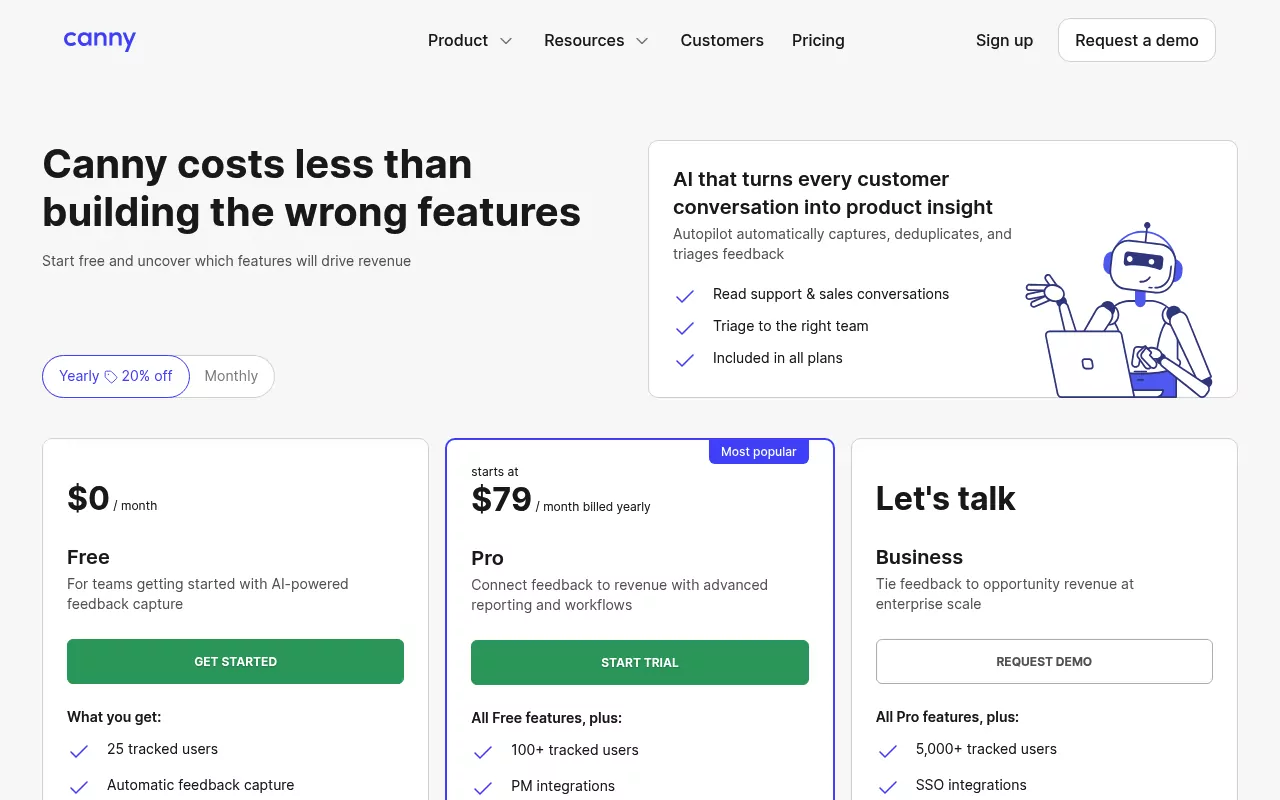
Pricing: Free covers 25 tracked users and 5 managers. Pro starts at $79 a month billed yearly on Canny's pricing page. Its billing help article lists $99 billed monthly for 100 tracked users.
Business is a custom quote. A tracked user is anyone who posts, votes or comments. Canny moves you up a tier unless you set a spend limit (as of October 2026). The Canny pricing guide breaks down each plan.
Moving from UserVoice: Canny's UserVoice comparison page says its team moves your UserVoice data for free within 48 hours.
Where it beats UserVoice: self-serve signup, a published price and a free plan. Private boards, portal single sign-on and vote on behalf come on every plan.
Where it falls short: HubSpot and Salesforce sit on Business, which is a custom quote again. The bill also grows as more customers post and vote.
Best for: teams that want UserVoice's portal without the sales cycle.
2. Savio: Best for Revenue-Weighted Prioritization on a Small Budget
Savio is feature request software built for sales and success teams that log requests for customers. Product managers then sort those requests by customer data such as MRR and plan.
Pricing: Essential costs $39 a month billed annually ($49 billed monthly) with one paid user. Each extra paid user adds $23 ($29). Professional is $79 ($99) and Business is $249 ($299).
Only owners, admins and managers count as paid users, per Savio's pricing page (October 2026). The 14-day trial needs no card.
Moving from UserVoice: Savio imports customer data from tools like Segment and Intercom. Its pricing page and UserVoice page list no UserVoice idea importer, so ask Savio before you plan the move.
Where it beats UserVoice: free, unlimited contributors, close to UserVoice's never-by-seat model. Vote on behalf, a private board and board SSO come on every plan.
Where it falls short: segments start on Professional, and HubSpot and Salesforce on Business. No public changelog is listed.
Best for: teams that rank requests by revenue but cannot fund an enterprise contract.
3. Featurebase: Best for Feedback and a Help Desk in One Tool
Featurebase sells feedback boards, roadmaps and a changelog in the same plan as a help desk with an AI agent called Fibi.
Pricing: Free has one seat. Growth costs $29, Professional $59 and Enterprise $99 per seat a month billed yearly. Billed monthly, they cost $37, $75 and $129.
Each AI resolution costs $0.49, as listed on its pricing page (October 2026). Paid plans have a 10-day trial with no card. The Featurebase pricing guide covers each tier in detail.
Moving from UserVoice: its pricing FAQ names automatic moves from Canny, Productboard, Frill and Beamer, plus CSV import. UserVoice is not named, so plan on the CSV route.
Where it beats UserVoice: submit and vote on behalf on every plan, Free included. Revenue sync and user and company segments start on Growth.
Where it falls short: billing is per seat. The help desk comes in the bundle whether you use it or not. The public changelog starts on Growth, and portal SSO and board privacy on Professional.
Best for: teams that want feedback and support in one tool.
4. Frill: Best Flat Price With Unlimited Admins
Frill runs one board with unlimited Topics, plus a roadmap, announcements (its changelog) and in-app surveys.
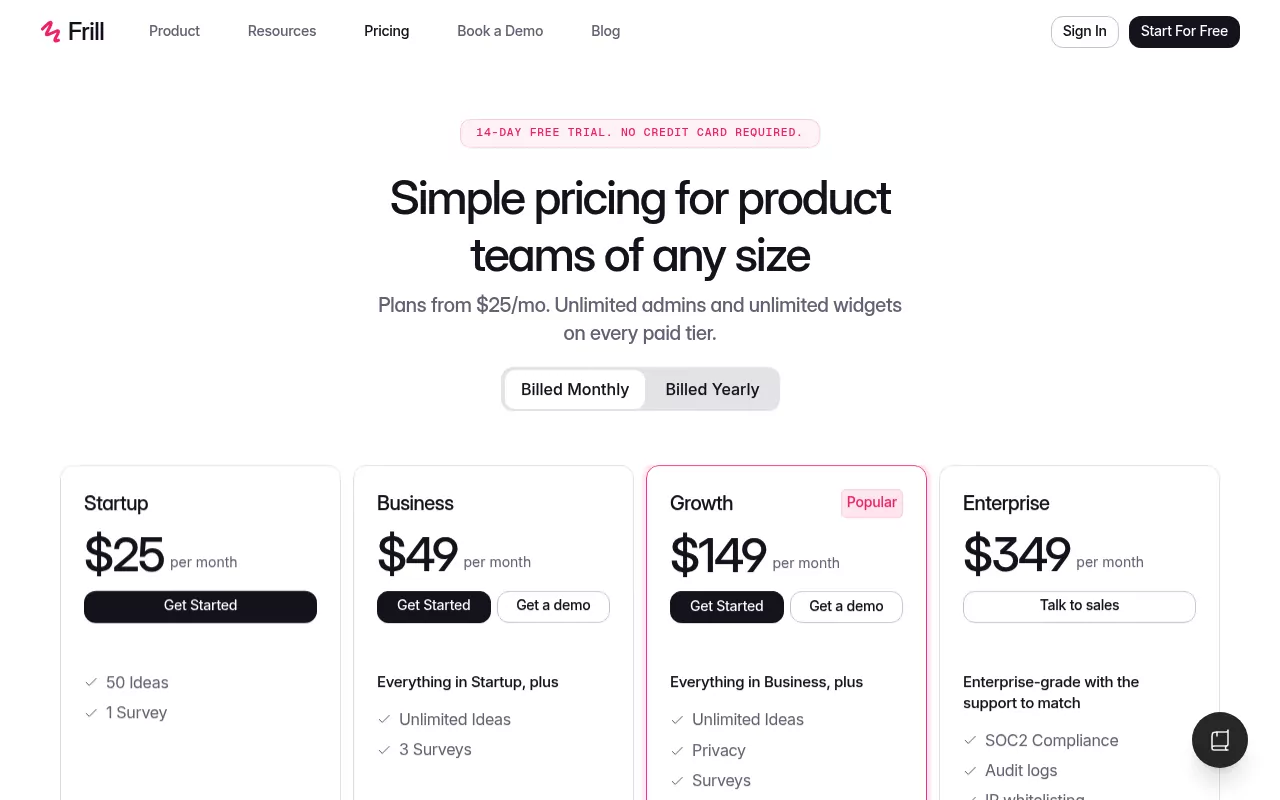
Pricing: Startup is $25 a month billed monthly, or $22 billed yearly. Business is $49 ($44), Growth $149 ($136) and Enterprise $349 ($319), per Frill's pricing page (October 2026).
Every paid plan has unlimited admins and tracked users. Startup caps you at 50 active ideas. The 14-day trial needs no card.
Moving from UserVoice: Frill lists bulk CSV import and export on every paid plan, plus a named Canny import.
Where it beats UserVoice: a flat, published price. SSO and vote on behalf come on every paid plan.
Where it falls short: Frill uses a single board by design, so several UserVoice forums become Topics. On Startup and Business, a private board and idea pre-approval need the Privacy add-on.
Best for: teams with many admins who want one flat bill.
5. Sleekplan: Best Budget Pick With NPS, CSAT and a Free UserVoice Import
Sleekplan pairs a feedback board, changelog and roadmap with NPS and CSAT surveys and AI tools it calls Sleek Intelligence.
Pricing: Indie is free for a single admin, with a board and changelog but no roadmap. Starter costs $13 a month billed yearly ($15 monthly) with 3 seats. Business costs $38 billed yearly ($45 monthly) with 10 seats, per Sleekplan's pricing page (October 2026).
Tracked users are unlimited, and the 30-day trial needs no card. The Sleekplan pricing guide has the full plan breakdown.
Moving from UserVoice: its UserVoice page says it imports a UserVoice export for free. It keeps posts, comments, votes, voters, statuses, categories and original timestamps.
Where it beats UserVoice: Starter adds SSO, an API, webhooks, and post and vote on behalf. Business adds user segments and B2B user groups.
Where it falls short: seats are capped, with no add-on on Starter. AI use is metered in credits.
Best for: small budgets that also want NPS and CSAT.
6. UserJot: Best Free Plan for a Public Board
UserJot sells boards, a roadmap and a changelog with the line "Pay for features, not seats." Every plan has unlimited users and posts.
Pricing: Free includes 3 team members, 2 boards, a public roadmap and a changelog. Starter costs $29 a month and adds a custom domain, private boards, moderation and one integration.
Professional costs $59 a month, with unlimited boards and JWT single sign-on, per UserJot's pricing page (October 2026). Your first paid plan gets a 14-day trial.
Moving from UserVoice: its UserVoice page says it imports the UserVoice Ideas and Voters CSV, with AI mapping the columns. Comments do not come across.
Where it beats UserVoice: a real free plan with a public roadmap and changelog, and no per-user fees.
Where it falls short: no revenue or account weighting is listed, and Starter has one integration. Its live chat and Juno AI agent are still in beta.
Best for: a free public board with a roadmap and changelog.
7. Fider: Best Open-Source, Self-Hosted Board
Fider is an open-source voting and discussion board, licensed AGPL-3.0 on GitHub. It comes up often in open-source threads about replacing UserVoice.
Pricing: the hosted version is free up to a fair-use limit of 250 feedback items. Pro costs $25 a month, month to month, and adds moderation, unlimited items and SEO indexing, per Fider's pricing page (October 2026). Self-hosting has no license fee.
Moving from UserVoice: fider.io lists no importer, so expect to move open requests by hand.
Where it beats UserVoice: you can run it on your own servers. Docker is the usual route in Fider's self-hosting docs. UserVoice's pricing page lists no self-hosted option.
Where it falls short: fider.io lists no roadmap view, changelog or widget. Self-hosting means you run the server, updates and backups.
Best for: teams that want an open-source UserVoice alternative on their own servers.
8. Tiny Team Feedback: Best for Organization-wide Module Pricing
Tiny Team's Feedback module covers voting boards, a roadmap, a changelog and customer surveys on one branded portal. It is sold as a module plan for the whole organization.
Key features:
- As many boards as you need, each private to your team or public, with 1 to 20 statuses per board.
- Verified customers post, vote and comment. Managers add internal notes that customers never see.
- Duplicates are merged by hand, and votes, comments and subscribers move over.
- A roadmap per board, built from the statuses you choose.
- A changelog that can mark linked requests completed and email subscribers.
- NPS, CSAT, customer effort and product-market fit surveys, by portal link or website popup.
- A portal on your own subdomain, with sign-in by email link (or a 6-digit code inside the embed).
- Status-change emails to everyone who posted or voted.
Pricing model: choose a plan for your whole organization, with no per-seat, per-tracked-user or per-voter fees. Review current prices, payment timing and renewal terms before paying.
Moving from UserVoice: there is no import, so open requests are re-created by hand. That works for a few dozen requests, not for years of history.
Where it falls short of UserVoice: no revenue, MRR or segment weighting. No Salesforce, HubSpot, Zendesk, Jira, Slack or other integrations, and no webhooks or public API.
No posting or voting on behalf of customers, no SSO or JWT sign-in, and no customers-only boards. No moderation queue, no AI of any kind, and no CSV import or export.
Best for: small teams that used UserVoice mainly for a public portal, voting, statuses, a roadmap and status emails. Review its current payment schedule and renewal terms before choosing a plan.
Teams that rank requests by CRM revenue or rely on capture on behalf should pick Canny, Savio or Featurebase. See current prices.
Other UserVoice Competitors Worth a Look
A few heavier suites show up in UserVoice comparisons too. A small team that only needs a voting board usually needs none of them.
- Productboard: a product management suite priced per maker. Its pricing page shows Business by demo, with a 5-maker minimum, and no dollar figure.
- Aha! Ideas: ideas portals, idea scoring and revenue-based ranking, from $39 per user a month (Aha! pricing).
- Pendo: product analytics and in-app guides with feedback attached. Pendo Free covers up to 500 monthly active users; paid plans are quoted (Pendo pricing).
Closer in shape to a feedback board:
- UseResponse: a feedback portal, help desk and knowledge base. Cloud costs $49 per agent a month billed annually. On-premise costs $120 per agent a month, paid annually, from 5 agents (UseResponse pricing).
- Upvoty: boards and a roadmap from $15 a month billed monthly, with the changelog on the $25 plan (Upvoty pricing).
- Nolt: flat-rate boards with unlimited users and admins, from $29 a month billed annually (Nolt pricing).
- Quackback: open source under AGPL-3.0 and self-hostable, with a hosted Free plan and Pro at $29 a month billed yearly for 5 seats (Quackback pricing). It also bundles a support inbox, help center and AI.
What UserVoice Costs in 2026 (Checked 25 October 2026)
UserVoice pricing is quote only. The live pricing page shows no figure and bills by feedback volume, tools and integrations, never by seat. The last published line was "Starting at $16,000 per year," in the June 2026 archive snapshot linked above.
Rival vendors publish their own estimates, and they disagree. Canny's comparison page cites Vendr data: a median contract of $16,719 a year, roughly $10,000 to $56,000. It adds $2,000 to $10,000 or more for enterprise onboarding.
Formbricks cites G2's vendor-submitted table at $10,788 to $16,188 a year. Treat these as third-party estimates, not UserVoice's own price. The only way to get a real number is a demo and a quote.

What a Small Team Would Pay: A Worked Example
Say 3 people manage feedback and about 300 customers post or vote. You need a board, a public roadmap and a changelog, with no AI agent.
Here is what each tool lists for that setup on 25 October 2026. Prices change, so treat this as a snapshot.
| Tool | Plan that fits | Price | Billed |
|---|---|---|---|
| UserVoice | Quote | Quote only (last listed from $16,000 a year) | Yearly contract |
| Canny | Pro, 300 tracked users | $179 a month ($224 billed monthly) | Yearly |
| Savio | Essential, 3 paid users | $85 a month ($107 billed monthly) | Annually |
| Featurebase | Growth, 3 seats | $87 a month ($111 billed monthly) | Yearly |
| Frill | Startup, under 50 ideas | $22 a month ($25 billed monthly) | Yearly |
| Sleekplan | Starter, 3 seats | $13 a month ($15 billed monthly) | Yearly |
| UserJot | Free, 3 team members | $0 ($29 a month for a custom domain) | n/a |
| Fider | Does not fit | No roadmap or changelog listed | n/a |
| Tiny Team Feedback | Feedback module | See current module plans and prices | See current renewal terms |
The Canny figures come from its billing help article (June 2026). Savio's figure is $39 plus two extra paid users at $23. Frill's Business plan ($44 billed yearly) applies past 50 active ideas.
Tiny Team Feedback has no per-seat or per-voter fees, so the 3 managers and 300 voters do not change its price.
How to Move Your Data Off UserVoice
UserVoice's help article on exporting ideas, voters and activity (updated August 2026) shows what you can take with you. Plan the move in five steps.
- Export before the contract ends. The Ideas and Voters export (CSV or XLSX) keeps who backed each idea, plus account traits such as MRR, plan and segment. The full export runs one year at a time, skips deleted ideas and shows vote totals, not who voted. Comments export separately.
- Pick the import path. Canny says its team moves UserVoice data for free. Sleekplan says it imports a UserVoice export for free, comments and timestamps included. UserJot imports the Ideas and Voters CSV but not comments. Featurebase and Frill take a CSV. Tiny Team Feedback has no import, so you re-create open requests by hand.
- Re-create statuses and roadmap columns before you invite customers.
- Swap the widget and portal links, then email supporters where the board moved.
- Keep the export files as your archive of old votes and comments.

Who Should Stay With UserVoice
UserVoice still fits some teams well. Stay if you rank requests by Salesforce revenue and trust that sync. Stay if sales and support log feedback through the Contributor Console or the Zendesk and Salesforce integrations.
It also fits teams that need SSO-gated private forums and Jira or Azure DevOps sync. The same goes for teams that want SOC 2 Type II and a dedicated success manager.
Teams with a large internal user base may like a price that is never set by seat. UserVoice's product feed also describes an AI agent and MCP access, both in beta.
The Bottom Line: Which UserVoice Alternative to Pick
- The same portal without the sales cycle: Canny.
- Rank requests by revenue on a small budget: Savio, or Featurebase if you also need a help desk.
- One flat bill for many admins: Frill. The cheapest monthly plan plus NPS: Sleekplan.
- Free: UserJot for a public board, Fider to self-host.
If a voting board, a public roadmap and a changelog cover what your team needs, Tiny Team's Feedback module is worth a look. It offers a module plan for your whole organization, with no per-seat or per-voter fees. See current prices. New workspace access starts after the first module payment is confirmed.
Frequently Asked Questions
Which UserVoice alternative is closest to UserVoice?
Canny is closest. It offers a public portal, voting, a roadmap, a changelog, private boards, portal SSO and vote on behalf on every plan. Unlike UserVoice, it bills by tracked users, and HubSpot and Salesforce sit on its custom-priced Business plan.
Is there a free UserVoice alternative?
Yes: UserJot Free includes a public roadmap and changelog, and Fider is free hosted up to 250 items or free to self-host. Canny Free covers 25 tracked users, Featurebase Free has one seat, and Sleekplan Indie gives one admin a board and changelog. UserVoice has no free plan, while Tiny Team Feedback offers module plans for the whole organization; check its current pricing and payment terms.
Is there an open-source UserVoice alternative?
Fider and Quackback are both open source under AGPL-3.0 and can be self-hosted. UseResponse also sells an on-premise license for your own server. Either way, you run the hosting, updates and backups yourself.
What did Microsoft replace UserVoice with?
Microsoft's support page says it moved away from UserVoice product by product during 2021, in favor of its own channels. Those include the Feedback web portal, in-product feedback, Windows Feedback Hub, Microsoft Tech Community and Microsoft Store. These are Microsoft's own tools, not products you can buy.