Employee turnover rate is one of the most vital HR metrics you should track. It shows how many people leave your company over a set time. Knowing your turnover rate helps you spot problems early, see the true cost of lost talent, and take steps to keep your best people.
High turnover hurts more than morale. It drives up hiring costs, slows down teams, and drains know-how from your org. Teams with low turnover build stronger bonds, keep what they know, and hit better results.
This guide covers everything: how to figure out your rate, what good looks like in your field, and real ways to bring that number down.
What Is Employee Turnover Rate?
Employee turnover rate is the share of workers who leave your company in a given time span — most often a year. It covers all exits: quits, firings, layoffs, and retirements. It does not count moves within the company like transfers or promotions.
Think of it as a health check for your team. Some turnover is fine — it brings new ideas and lets you swap out poor fits. But too much signals real trouble: bad bosses, low pay, no growth, or a toxic culture.
Types of Employee Turnover
Voluntary turnover happens when people choose to leave. They find a new job, want better pay, or just feel stuck. This makes up about 70% of all turnover and is the type you can do the most about.
Involuntary turnover is when the company makes the call — firing for poor work, cutting staff, or letting someone go for breaking rules. Some of this is needed, but high rates here may point to bad hiring.
Functional vs. dysfunctional turnover is about who leaves. When a low performer walks out, that can help the team (functional). When a star player leaves, that's a big loss (dysfunctional) — and it's the kind you most want to stop.
How to Calculate Employee Turnover Rate

The Basic Formula
The standard employee turnover rate formula is simple:
Turnover Rate = (People Who Left ÷ Average Headcount) × 100
Here's how to use it:
- Count exits: Add up everyone who left during your time window (quits and firings both count)
- Find average headcount: (Staff at start + Staff at end) ÷ 2
- Do the math: Divide exits by average headcount, then times 100 for a percent
A Quick Example
Say your company had:
- 50 people at the start of the year
- 60 people at the end of the year
- 8 people left during the year
Math:
- Average headcount: (50 + 60) ÷ 2 = 55
- Turnover rate: (8 ÷ 55) × 100 = 14.5%
| Metric | Value |
|---|---|
| Start headcount | 50 |
| End headcount | 60 |
| Exits | 8 |
| Average headcount | 55 |
| Turnover rate | 14.5% |
Other Ways to Calculate
Start-of-period method: Use only the headcount at the start: Turnover = (Exits ÷ Start Headcount) × 100
Monthly tracking: For quicker reads, run the same formula each month: Monthly Turnover = (Monthly Exits ÷ Month-End Headcount) × 100
The key is to pick one method and stick with it. That way your trends stay clean. You can track this easily in a spreadsheet — or use an HR platform built for small teams that does the math for you.
Which Time Frame to Use
Yearly is best for big-picture trends and comparing against industry data. Quarterly helps you spot shifts mid-year. Monthly gives you the fastest signal but can bounce around a lot in smaller teams. For most growing companies, tracking monthly and rolling up to quarterly is a good balance.

Employee Turnover Rate Benchmarks by Industry (2026)
How does your rate stack up? Data from the Bureau of Labor Statistics (BLS) and recent surveys show big gaps by field:
High-Turnover Fields
| Industry | Yearly Turnover Rate |
|---|---|
| Hotels & Food Service | 85–95% |
| Retail | 60–70% |
| Arts & Fun | 55–65% |
| Shipping & Warehouses | 45–55% |
| Construction | 40–50% |
Mid-Range Fields
| Industry | Yearly Turnover Rate |
|---|---|
| Healthcare | 25–35% |
| Manufacturing | 20–30% |
| Pro Services | 18–25% |
| Tech | 15–25% |
| Real Estate | 15–20% |
Low-Turnover Fields
| Industry | Yearly Turnover Rate |
|---|---|
| Government | 8–12% |
| Schools | 10–15% |
| Utilities | 5–10% |
| Finance & Insurance | 8–15% |
| Mining | 5–8% |
Fields with tough physical work, seasonal jobs, or lower wages tend to see more exits. Those that need rare skills, offer strong perks, or have clear career paths keep people longer.
Keep in mind: these are averages. Great companies in high-turnover fields often beat the norm by a wide margin through better management and stronger culture.
The True Cost of Employee Turnover
Turnover costs real money — more than most leaders think. The Work Institute's Retention Report puts the price of replacing one person at about 33% of their yearly pay. For senior or hard-to-fill roles, it can reach 50–200%.
Direct Costs
Hiring: Job ads, recruiter fees, job fairs, and brand work. For skilled roles, outside recruiter fees alone can hit 15–25% of the new hire's pay.
Interviews: HR and manager time, background checks, skills tests, and travel. This can eat up dozens of hours.
Training: Onboarding, course work, mentor time, and the ramp-up phase where output stays low.
Hidden Costs
Lost output: People often check out during their notice time. The rest of the team picks up extra work and may burn out.
Brain drain: When someone leaves, they take know-how, client bonds, and key skills with them. This is especially painful in small teams — losing 1 person out of 10 means you just lost 10% of your team's knowledge.
Morale hit: Watching coworkers leave shakes confidence. It can trigger a wave of more exits. Tracking employee engagement helps you spot dips before they snowball.
Client impact: When client-facing staff leave, it can hurt trust and drop service quality.
A Simple Cost Estimate
Yearly Turnover Cost = Exits × Average Pay × Cost Factor
If 10 people left and average pay is $60,000:
- Low estimate (33%): 10 × $60,000 × 0.33 = $198,000
- Mid estimate (50%): 10 × $60,000 × 0.50 = $300,000
That number alone makes a strong case for investing in employee retention.
Common Causes of High Employee Turnover
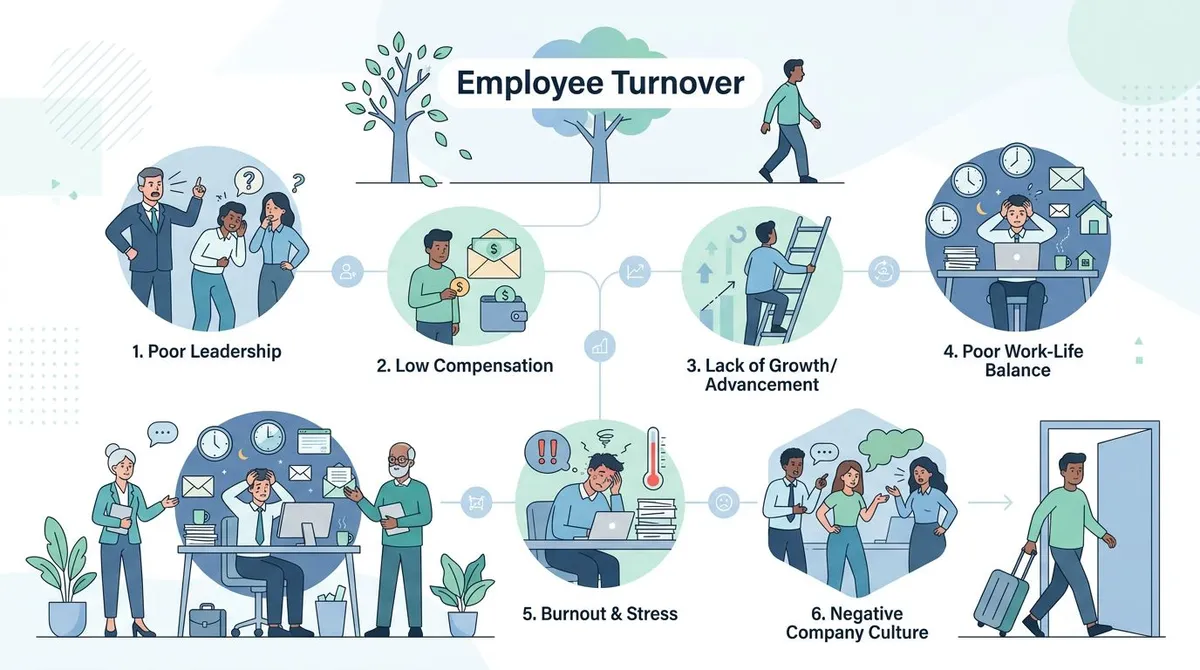
To fix turnover, you need to know why people leave. Research points to a handful of big drivers:
Bad Management
This is the top reason people quit. Workers don't leave companies — they leave managers. Common problems:
- No clear goals or direction
- Too much control (or too little support)
- Little to no feedback or praise
- Poor communication
- No help with growth
One mid-size tech firm cut turnover by 40% just by starting regular one-on-ones and training managers better. If you're not sure where to start, try stay interviews — they reveal what keeps people around and what might push them out.
Pay That Doesn't Match the Market
Money isn't everything, but being underpaid drives people away fast. This includes:
- Below-market base pay
- No raises tied to results
- Weak perks and benefits
- No path to earn more over time
A strong compensation plan aligned with market data goes a long way toward keeping people.
No Room to Grow
Top performers need to see a future with you. Without it, they'll find one somewhere else:
- No clear career ladder
- Few chances to learn new skills
- Same tasks, month after month
- No mentors or coaches
Build growth into your culture with tools like employee development plans and performance reviews that focus on the future, not just the past.
Work-Life Balance Problems
More and more, people prize flex time and boundaries:
- Long hours with no letup
- Rigid schedules
- Stingy time-off rules
- High-stress, "always on" culture
A fair PTO policy and clear norms around after-hours work signal that you care about your people as whole humans — not just workers.
Toxic Culture
Culture can make or break retention. Even well-paid workers leave a bad vibe:
- Low trust and safety
- Poor openness from leaders
- Office politics and conflict
- Values that are talked about but not lived

7 Proven Ways to Reduce Employee Turnover
Cutting turnover takes a real plan — not just pizza parties. Here are seven steps that work:
1. Fix Your Hiring and Onboarding
A bad hire who leaves in year one is a double loss. Tighten your hiring with structured interviews, skill checks, and culture-fit talks.
Then invest in onboarding. A solid 90-day plan should include clear goals, a buddy system, weekly check-ins, and early wins. According to Gallup, workers who go through great onboarding are 69% more likely to stay three years. Check out our full onboarding process guide for a step-by-step approach.
2. Train Your Managers
Your managers are your front line of retention. Invest in teaching them to:
- Run good one-on-ones (use our one-on-one meeting template)
- Give honest, kind feedback
- Set clear goals and check in often
- Back their people's growth
- Build trust and safety
3. Build Clear Career Paths
Work with each person to map out where they want to go and how to get there. Offer learning budgets, stretch projects, and chances to move across teams.
4. Pay Fairly
Run market checks every year. Small, proactive raises cost far less than losing good people and hiring replacements. When in doubt, use a solid compensation planning framework.
5. Recognize Good Work
Mix formal and casual praise. This can be as simple as a shout-out in a team meeting or as big as a bonus tied to results. People who feel seen and valued stick around.
6. Listen — Then Act
Use engagement surveys, pulse polls, and exit interviews to learn what people think. The surveys only matter if you act on what you hear. Share results, make changes, and close the loop.
7. Track It With the Right Tools
You can't fix what you don't measure. Use people analytics to spot turnover patterns by team, tenure, or manager. Modern HR tools like Tiny Team make it easy to track headcount, run performance reviews, and keep all your people data in one place — at a flat rate that won't break the bank.
Tracking Turnover Over Time
Once you have your formula down, build a simple system to watch trends and catch problems early.
Key Metrics to Watch
- Overall turnover rate — your north star, tracked monthly and yearly
- Voluntary vs. involuntary — split these to know if people choose to leave or are let go
- Team-level rates — find hot spots that may point to bad managers or too much work
- Tenure-based rates — lots of exits in the first 90 days? Your onboarding needs work. Exits at the 2–3 year mark? Career growth may be lacking
- Star player exits — losing your best people is far worse than losing poor fits
Build a Simple Dashboard
Track these numbers in a spreadsheet or HR tool each month:
- Monthly turnover with a trend line
- Team-by-team breakdown
- Cost impact (exits × average pay × cost factor)
- Action items and their status
Review Cadence
Monthly: Quick look at the numbers — any red flags?
Quarterly: Deeper dive into patterns, what's working, what's not.
Yearly: Set goals, plan budgets, and map out big retention moves for the year ahead.
Frequently Asked Questions
What is a good employee turnover rate?
It depends on your field. In general, under 15% per year is great, 15–25% is normal for most industries, and above 30% means you have a serious problem. Some turnover is healthy — it brings in fresh talent and lets you move on from poor fits.
How often should I calculate turnover rate?
Most teams do well tracking it monthly for a quick read, with a deeper look each quarter. Monthly numbers help you catch issues fast. Quarterly data shows real trends instead of noise.
Should I count temps in my turnover rate?
No. Stick to full-time and part-time regular staff for your main turnover number. If temps or contractors are a big part of your team, track them in a separate metric.
What's the gap between turnover rate and retention rate?
They're two sides of the same coin. If turnover is 20%, retention is 80%. Turnover shows the size of the problem. Retention puts the focus on what's going right.
How can small teams reduce turnover on a tight budget?
You don't need big budgets to keep people. Regular one-on-ones, flexible hours, growth chances, clear career paths, and a strong culture matter more than flashy perks. For small teams, every exit hits harder — one person out of ten is 10% of your whole team — so even low-cost efforts pay off fast.
How do I find out why people are really leaving?
Exit interviews are a start, but people often hold back on the way out. Stay interviews — talks with current staff about what they love and what bugs them — give you more honest, useful data while you still have time to act.