An employee handbook template is a structured document that outlines your company's policies, procedures, and expectations for all employees. Rather than starting from scratch, a well-designed template provides the framework you need to create comprehensive workplace guidelines that protect your business while supporting your team's success.
Whether you're a startup founder drafting your first handbook or an HR manager updating existing policies, this guide provides everything you need. For related templates, check out our new hire onboarding checklist and employee offboarding checklist.
Why Your Company Needs an Employee Handbook
A 45-person marketing agency in Denver discovered this the hard way. Without clear written policies, they faced three separate disputes in six months—one harassment complaint, one wrongful termination claim, and ongoing confusion about their flexible work policy. After implementing a comprehensive handbook, these issues virtually disappeared.
According to the Society for Human Resource Management (SHRM), companies with employee handbooks reduce workplace disputes by up to 67% and see improved employee satisfaction scores. The U.S. Department of Labor's Employment Law Guide also emphasizes that written policies help ensure compliance with federal employment regulations.
The Business Case for Employee Handbooks
Beyond legal protection, handbooks serve multiple strategic purposes. They establish your company culture from day one, reduce manager workload by answering common questions, and create consistency across teams and locations. Most importantly, they demonstrate professionalism that helps attract top talent in competitive markets.
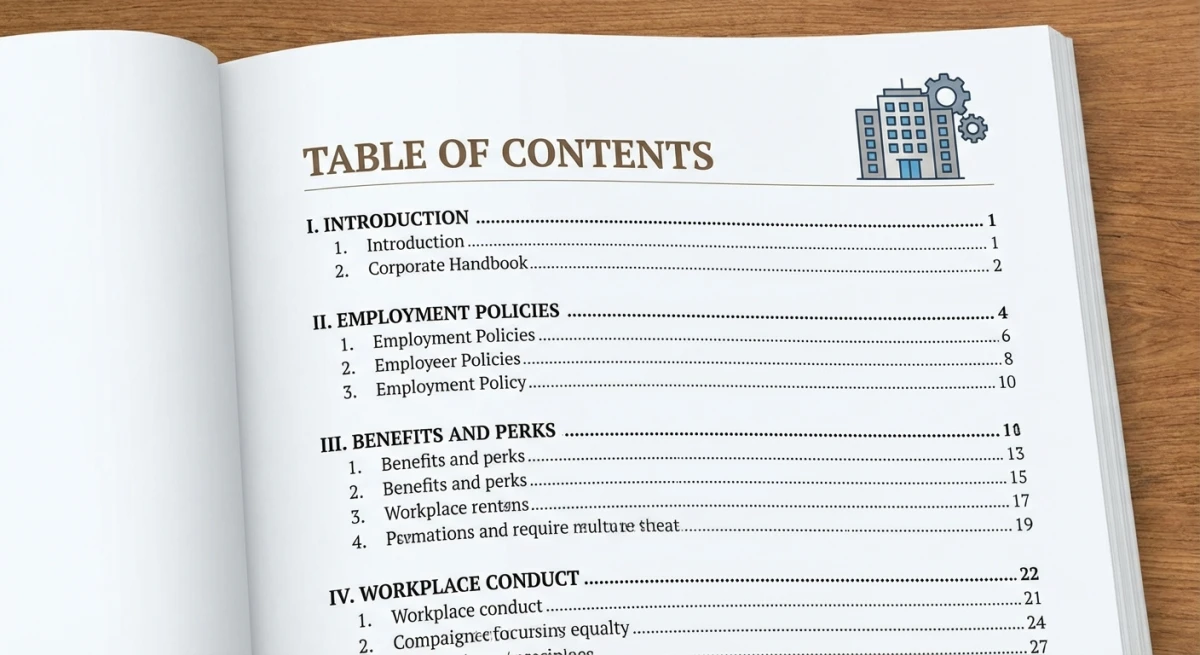
Essential Handbook Sections: A Complete Framework
Rather than overwhelm you with endless policy options, let's focus on the sections that every handbook needs—regardless of company size or industry.
1. Company Introduction and Culture
Your opening section sets the tone for everything that follows. Start with a personal welcome message from leadership, then paint a clear picture of your company's identity.
Key elements to include:
- Welcome message from the CEO or founder
- Company mission, vision, and core values
- Brief company history or origin story
- Organizational chart showing key roles
- Equal opportunity employment statement
Consider this example from a 25-person software company: "Welcome to our team! We're not just building software—we're solving real problems for small businesses like the corner bakery or the family law firm. Every feature we ship has a story behind it, and as you'll discover, we're pretty obsessed with getting the details right."
2. Employment Fundamentals
This section establishes the basic employment relationship. Rather than drowning in legal terminology, focus on practical information employees need to understand their status and responsibilities.
Employment classifications explained:
- Full-time: 40+ hours per week, benefits-eligible
- Part-time: Less than 30 hours per week, limited benefits
- Contractor: Project-based work, separate tax treatment
- Intern: Educational experience with structured learning goals
Include your probationary period policy here. Most companies use 90 days, during which performance is closely monitored and benefits may be limited. Be specific about evaluation milestones and what success looks like.
3. Workplace Standards and Professional Conduct
Rather than generic "be professional" guidelines, provide specific scenarios employees encounter. This section should read like practical advice from a mentor, not legalese from a compliance manual.
A successful approach is storytelling through examples. Instead of saying "maintain professional communication," try: "When Sarah in accounting emails about the budget deadline, respond within 24 hours even if it's just 'Got it, will have this to you by Thursday.' Clear communication prevents minor issues from becoming major problems."
Attendance expectations should be crystal clear:
- Arrive ready to work at your scheduled start time
- Call your direct manager within 30 minutes if you'll be late or absent
- Use our team calendar system to request time off at least 48 hours in advance
- Provide medical documentation for absences exceeding three consecutive days
4. Anti-Harassment and Discrimination Policies
This section requires precise language and comprehensive coverage. According to Forbes HR Council research, companies with detailed harassment policies see 40% fewer workplace complaints.
Protected characteristics include:
- Race, color, religion, sex, national origin
- Age (40 and older), disability status
- Pregnancy, genetic information
- Sexual orientation, gender identity
- Military service status
Reporting procedures must offer multiple options:
- Direct supervisor (if they're not involved)
- Human Resources department
- Anonymous hotline or online form
- Skip-level reporting to senior management
Include specific examples of prohibited behavior, from obvious harassment to subtle microaggressions. Remember that creating a respectful workplace isn't just about avoiding lawsuits—it's about building an environment where everyone can do their best work.
5. Compensation and Benefits Deep Dive
Rather than vague benefit descriptions, provide specific details employees need to make informed decisions. Include enrollment deadlines, contribution limits, and real-world examples of how benefits work.
Salary administration framework:
- Annual review cycle timing (typically December)
- Merit increase criteria and typical ranges
- Promotion guidelines and salary adjustment policies
- Overtime eligibility and approval procedures
For startups and growing companies, consider using an HR platform like Tiny Team to track compensation data and ensure pay equity across your organization. With features designed for teams of 5-100 people, it's more cost-effective than traditional HR software while providing the documentation you need.
Benefits breakdown example:
- Health insurance: Company pays 80% of premiums, employee pays 20%
- Dental and vision: Fully company-paid for employees, 50% for dependents
- 401(k): 4% company match, immediate vesting
- Professional development: $1,500 annual allowance per employee

6. Time Off and Leave Policies
This section generates more employee questions than almost any other. Be specific about accrual rates, approval processes, and blackout periods.
PTO accrual structure (example):
- Years 1-2: 15 days annually (1.25 days per month)
- Years 3-5: 20 days annually (1.67 days per month)
- Years 6+: 25 days annually (2.08 days per month)
Use tools like Tiny Team's PTO calculator to help employees understand their accrued time off and plan accordingly. Clear visibility prevents surprises and reduces administrative overhead for managers.
Holiday policy considerations: Include your standard holiday list, floating holiday options, and policies for employees who observe different religious holidays. A tech company in Austin solved this elegantly by offering 10 fixed holidays plus 2 floating days that employees can use for personal observances or mental health days.
Digital vs. Traditional Employee Handbooks
| Feature | Digital Handbook | Print Handbook |
|---|---|---|
| Updates | Instant distribution to all employees | Requires reprinting and redistribution |
| Search | Full-text search, quick answers | Manual page flipping |
| Cost | Low ongoing costs | High printing and distribution costs |
| Accessibility | 24/7 access from any device | Must have physical copy available |
| Tracking | Analytics on which sections are read most | No usage insights |
| Legal compliance | Automatic version control | Risk of outdated versions in circulation |
| Employee preference | 78% prefer digital (2025 survey) | 22% prefer physical copy |
Most successful companies now use a hybrid approach: digital as the primary handbook with key policies available in print form at each location.
7. Performance Management and Career Development
Transform this section from corporate jargon into a roadmap for employee success. Instead of "employees will be evaluated annually," explain what great performance looks like and how employees can achieve it.
Performance review process (quarterly approach):
Quarter 1: Goal setting and expectation alignment
- Manager and employee collaborate on SMART goals
- Clear success metrics established
- Development opportunities identified
Quarter 2: Mid-cycle check-in and course correction
- Progress assessment on Q1 goals
- Obstacle identification and problem-solving
- Skill development plan updates
Quarter 3: Pre-review preparation
- Employee self-assessment completion
- 360-degree feedback collection
- Achievement documentation gathering
Quarter 4: Annual review and planning
- Comprehensive performance evaluation
- Salary and promotion decisions
- Following year goal setting
8. Technology and Data Security
A 35-person consulting firm learned this lesson expensively when an employee's unsecured laptop was stolen, containing client data for 200+ customers. The resulting breach cost $45,000 in notifications, credit monitoring, and legal fees—money that could have been avoided with clear security policies.
Essential technology policies:
- Password requirements (12+ characters, unique for work accounts)
- Two-factor authentication mandatory for all business systems
- Personal device usage guidelines for email and file access
- Software installation approval process
- Data backup and retention procedures
Social media guidelines should be practical, not restrictive. Instead of banning social media, provide guidance: "Feel free to mention that you work at [Company] on LinkedIn, but don't share confidential client information or internal processes. When in doubt, ask your manager."
Creating Your Employee Handbook: The 30-Day Implementation Plan
Week 1: Foundation and Research
Days 1-3: Audit your current policies and identify gaps
- Review existing documents, offer letters, and informal policies
- Research federal and state employment law requirements
- Survey employees about policy questions they have
Days 4-7: Gather stakeholder input
- Interview department heads about day-to-day policy needs
- Consult with legal counsel on compliance requirements
- Review competitor handbooks for structure and tone ideas
Week 2: Content Creation
Days 8-10: Draft core sections
- Company introduction and culture
- Employment fundamentals
- Code of conduct and workplace standards
Days 11-14: Develop detailed policies
- Anti-harassment and discrimination
- Compensation and benefits
- Time off and leave policies
Week 3: Policy Development and Review
Days 15-17: Complete remaining sections
- Performance management
- Technology and security policies
- Safety and emergency procedures
Days 18-21: Internal review and revision
- Legal counsel review for compliance
- Management team feedback and approval
- HR department fact-checking and formatting
Week 4: Implementation and Launch
Days 22-25: Prepare for rollout
- Design digital handbook platform or document management system
- Create acknowledgment forms and tracking system
- Schedule all-hands meeting for handbook introduction
Days 26-30: Launch and follow-up
- Distribute handbook to all employees
- Conduct Q&A sessions for questions
- Collect feedback for future improvements
Employee Handbook Tools and Resources
For most small to medium businesses, an integrated HR platform provides the best balance of functionality and cost. Tiny Team's pricing is free for teams up to 10 people and a flat $79/month for teams up to 50 (all features, not per-seat), which makes it attractive for growing companies that want professional handbook management without per-employee fees. You can also explore our employee review templates to pair with your handbook's performance management section.
Common Employee Handbook Mistakes That Cost Companies Money
The "Copy and Paste" Trap
A Denver-based startup copied their handbook template from a Fortune 500 company website. The problem? Their "template" included policies for stock options they didn't offer, international travel they never conducted, and manufacturing safety procedures for their software company. Employees were confused, managers couldn't answer questions, and the handbook became a joke rather than a resource.
Solution: Start with a solid template, but customize everything to match your actual business operations.
The "Set It and Forget It" Problem
Employment laws change frequently. A handbook that's accurate today may create legal vulnerabilities tomorrow. California alone passed 15 new employment-related laws in 2025, affecting everything from sick leave to pay transparency.
Solution: Schedule quarterly handbook reviews and subscribe to employment law updates from SHRM or your state's department of labor.
The "Too Legal" Syndrome
When every policy reads like a court document, employees stop reading. One company discovered their harassment policy was so dense with legal terminology that 60% of employees couldn't identify what constituted reportable behavior.
Solution: Write for your audience. Use clear, conversational language while maintaining legal accuracy. If you need help structuring performance reviews or choosing HR software, those guides complement your handbook efforts.

The Future of Employee Handbooks
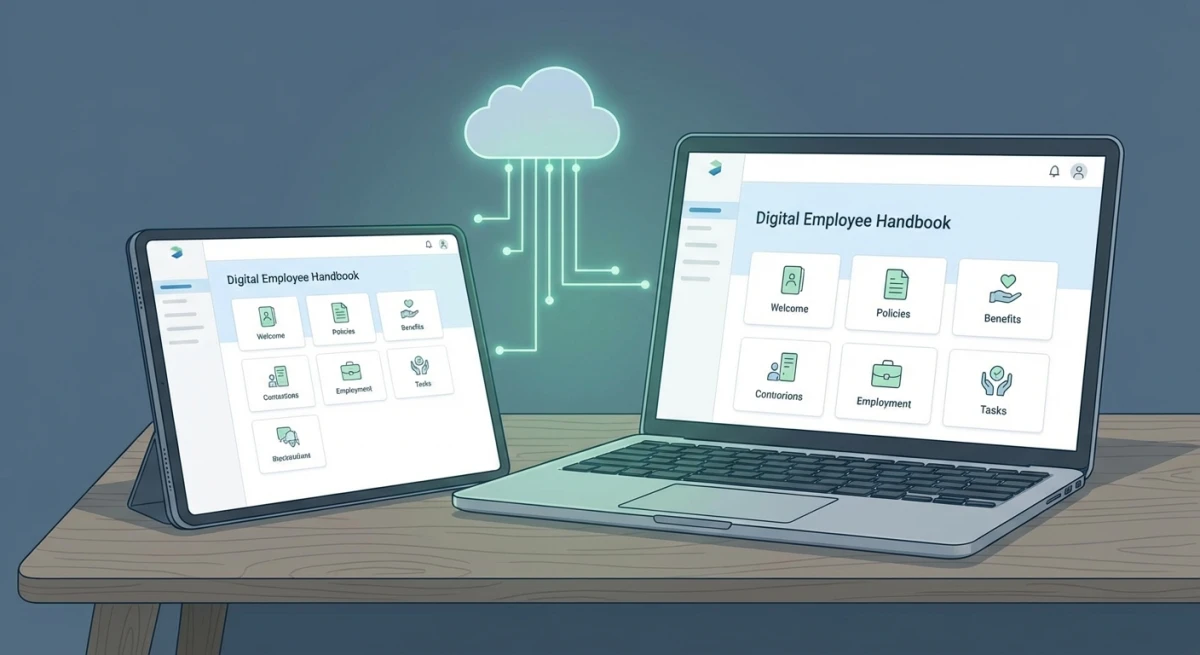
Smart companies are moving beyond static documents to interactive, living resources. Integration with HR systems allows for automatic policy acknowledgments and real-time updates. When a company updates their PTO policy, the system can automatically notify affected employees and require acknowledgment.
Consider platforms that offer both handbook management and broader HR functionality. Tiny Team's document management features integrate with their people management and team calendar systems, creating a seamless employee experience. For teams managing remote employees, digital handbooks are especially critical.
Frequently Asked Questions
How long should an employee handbook be?
Most effective employee handbooks range from 30-80 pages. The key is comprehensive coverage without overwhelming detail. Include essential policies with full explanations, but reference separate documents for complex procedures like benefits enrollment or safety protocols.
Do we need different handbooks for remote and office employees?
No, but you may need supplementary remote work policies. Create one comprehensive handbook that covers both scenarios, with specific sections addressing remote work expectations, home office requirements, and digital communication guidelines.
What's the biggest legal risk of not having an employee handbook?
At-will employment protection is the most critical. Without documented policies and procedures, companies lose significant legal protection in wrongful termination, discrimination, and harassment claims. Courts often interpret the absence of written policies as evidence of arbitrary or discriminatory treatment.
How do we handle handbook acknowledgments and tracking?
Digital systems are most effective for tracking acknowledgments. Use an HR platform or document management system that requires electronic signatures and maintains audit trails. For companies without digital systems, maintain a physical file with signed acknowledgment forms and dates.
Should we include salary ranges or compensation information?
Include your compensation philosophy and general structure, but avoid specific salary ranges unless required by law. Some states now require pay transparency in job postings, but internal handbook requirements vary. Focus on how compensation decisions are made rather than specific amounts.
What happens when an employee claims they never received the handbook?
Proper documentation prevents this issue. Maintain records of distribution dates, acknowledgment signatures, and any training provided. Digital distribution systems automatically track when employees access and acknowledge handbook receipt, providing stronger legal protection than manual processes.
Ready to Create Your Employee Handbook?
A comprehensive employee handbook isn't just a legal necessity—it's a strategic tool for building company culture, reducing administrative overhead, and protecting your business. Whether you're starting from scratch or updating an existing handbook, the investment in clear, comprehensive policies pays dividends in improved employee satisfaction and reduced legal risk.
Start with the essential sections outlined in this guide, customize policies to match your company's unique needs, and remember that your handbook should evolve as your business grows. Consider integrated HR solutions that can help manage policies, track acknowledgments, and keep your handbook current as employment laws change.
For growing companies looking to streamline their HR processes, Tiny Team offers comprehensive people management features including document management, team calendars, and performance tracking—free for teams up to 10 people and a flat $79/month for teams up to 50 (every feature, not per-seat). It's designed specifically for companies with 5-100 employees who want professional HR capabilities without the complexity and per-employee costs of enterprise solutions.
Need help with compensation planning as you develop your handbook? Try our paycheck calculator to ensure your salary and wage policies align with your budget and compliance requirements.
Remember, the best employee handbook is one that employees actually read, understand, and follow. Focus on clarity, relevance, and practical value—your team and your legal advisors will thank you for it.